


























Views
Downloads
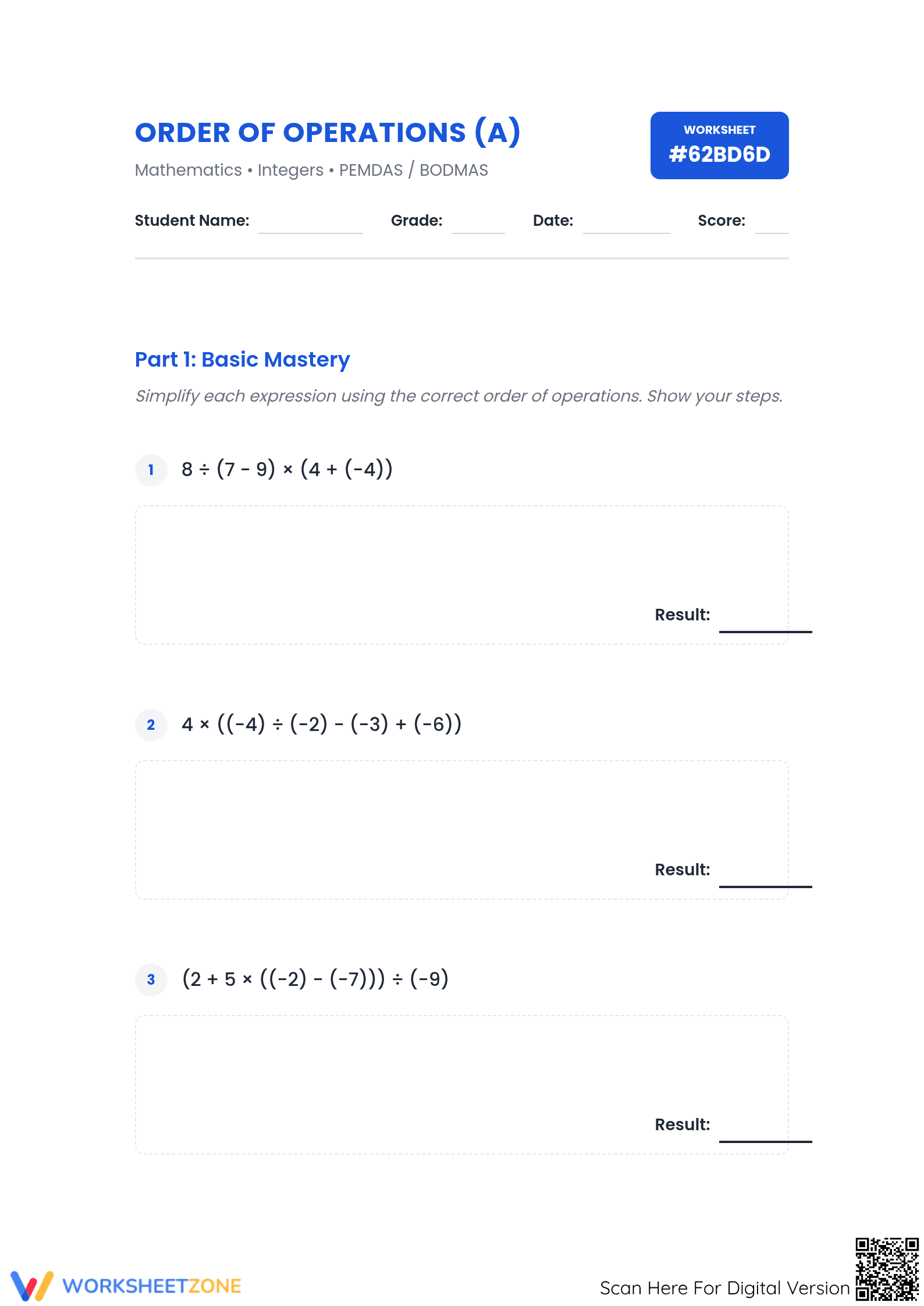
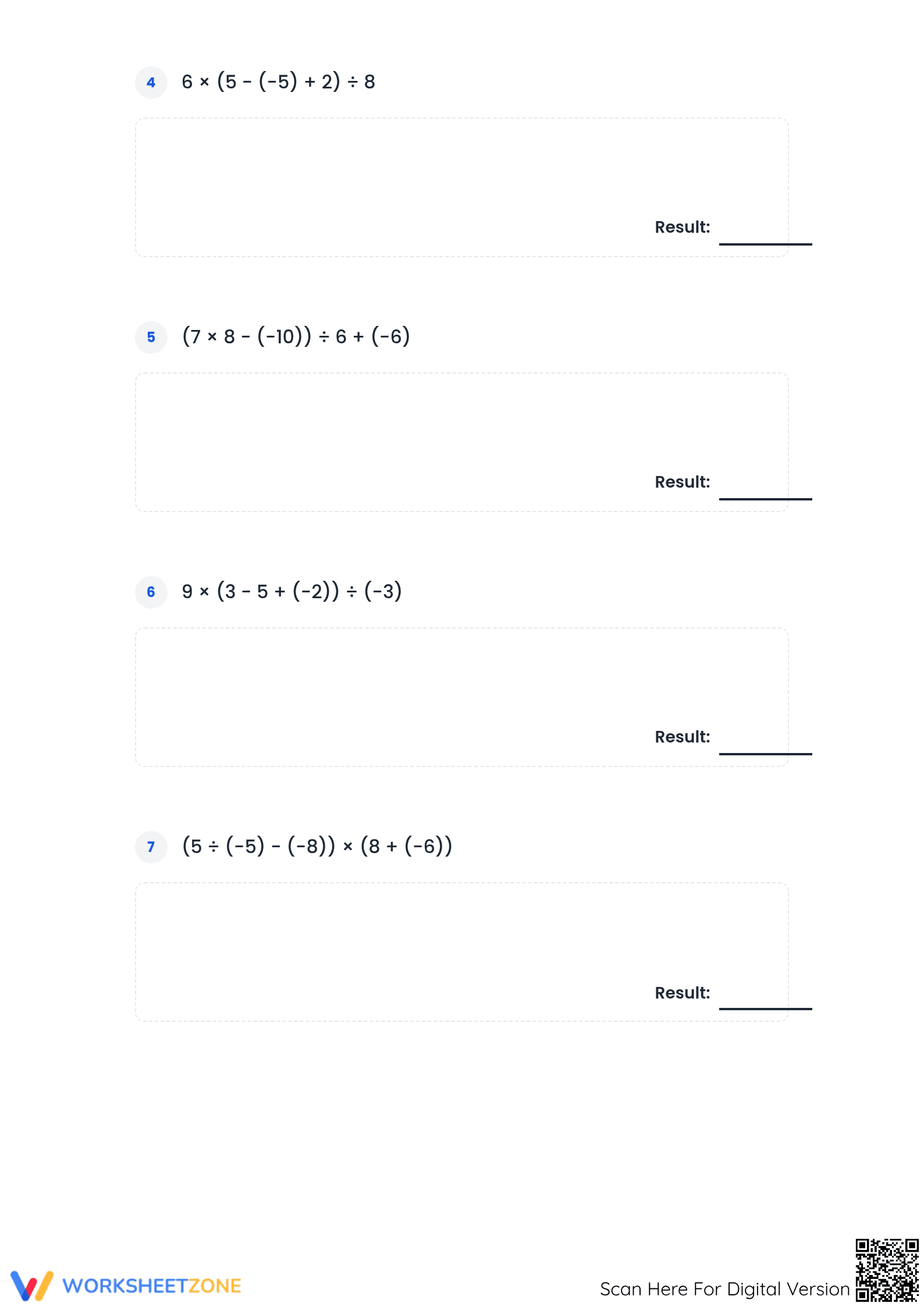
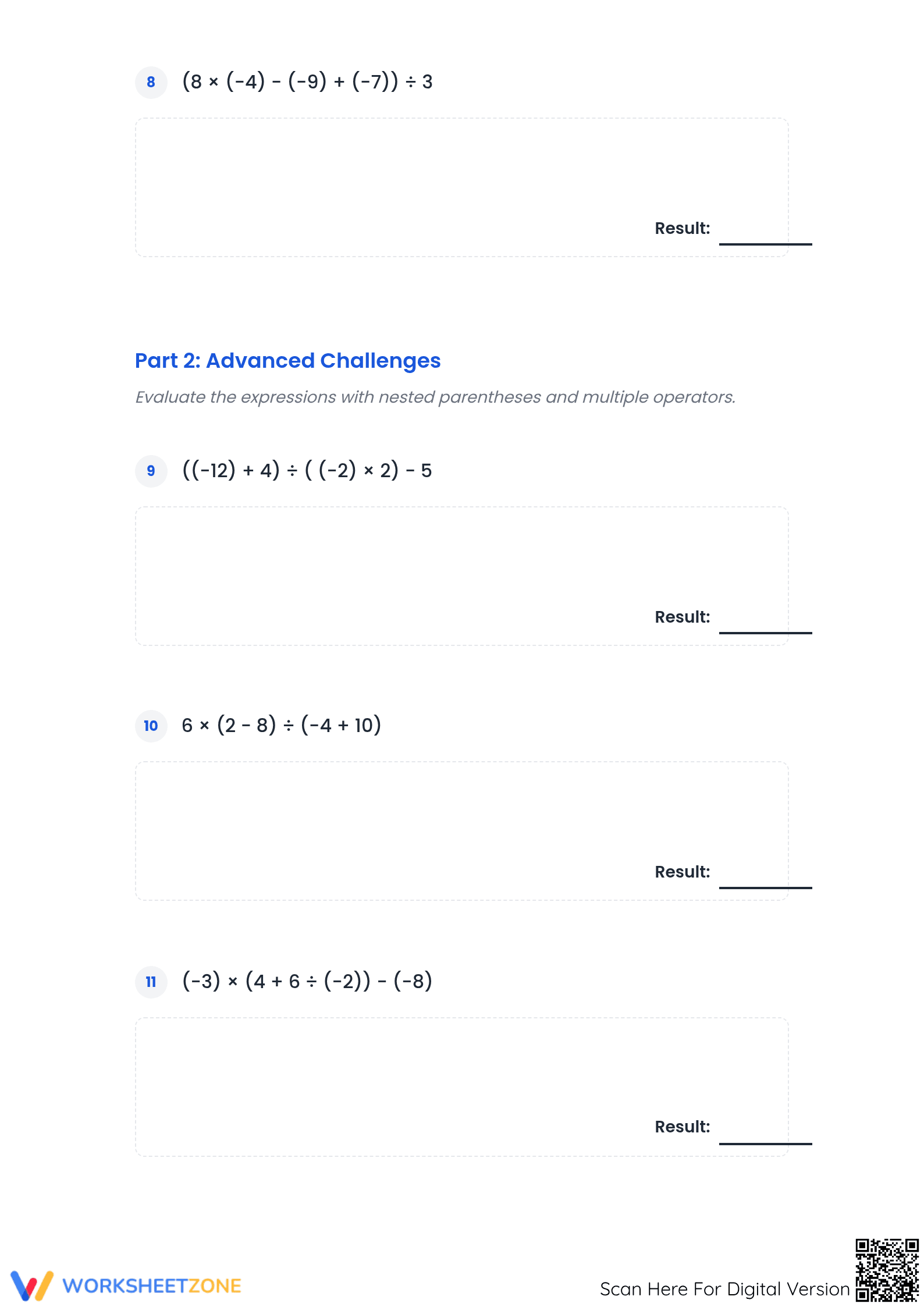
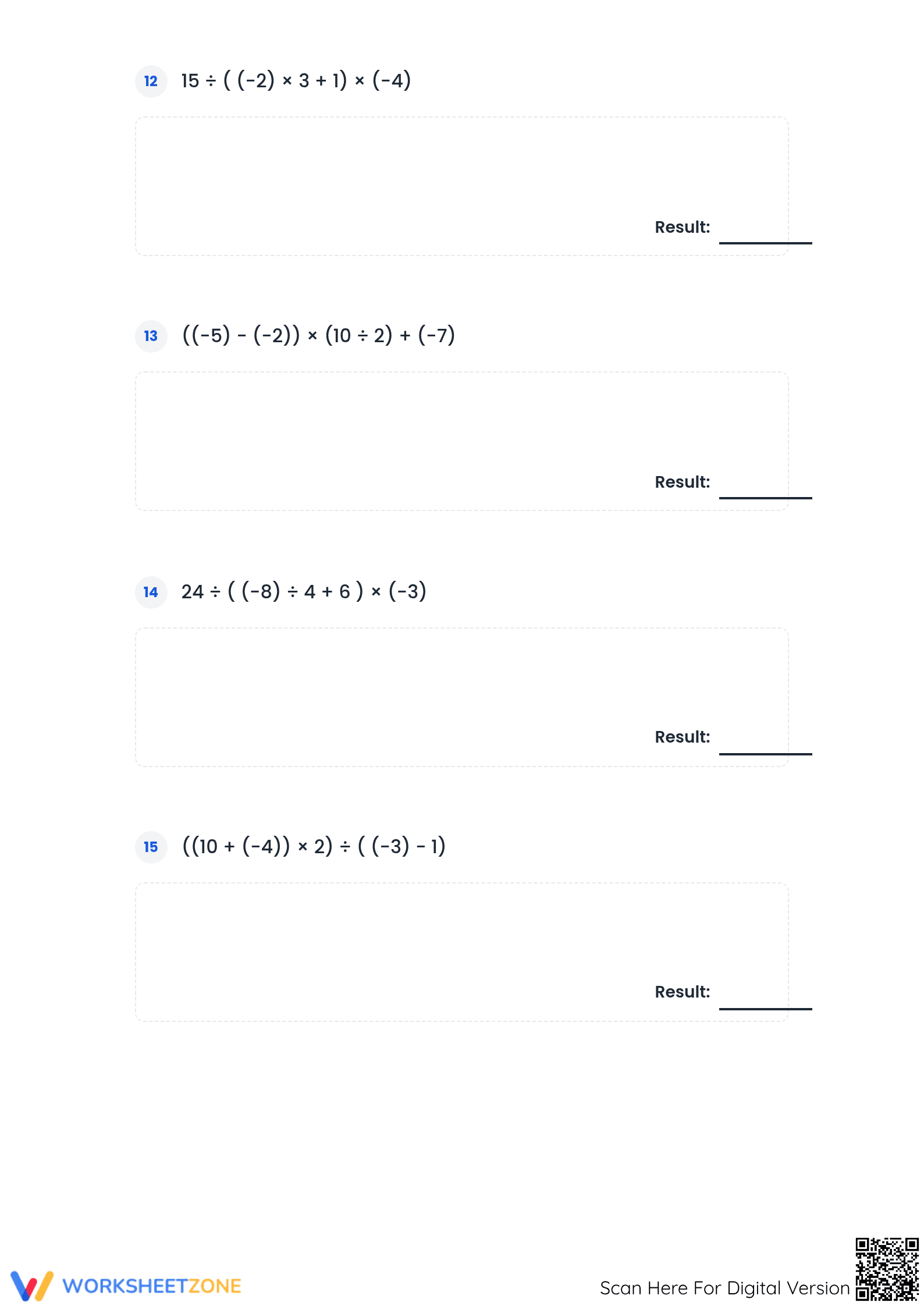

Essential Order of Operations: Integers | Grade 7 Printable
Paste this activity's link or code into your existing LMS (Google Classroom, Canvas, Teams, Schoology, Moodle, etc.).
Students can open and work on the activity right away, with no student login required.
You'll still be able to track student progress and results from your teacher account.
This Order of Operations with Integers Worksheet is designed to build student confidence in evaluating multi-step numerical expressions. Students will apply PEMDAS or BODMAS rules while navigating the complexities of positive and negative integers. This 19-problem practice set ensures learners move beyond rote memorization to achieve true procedural fluency in middle school mathematics.
At a Glance
- Grade: 7 · Subject: Math
- Standard:
CCSS.MATH.CONTENT.7.NS.A.3— Solve mathematical problems involving the four operations with rational numbers and integers- Skill Focus: Order of Operations with Integers
- Format: 5 pages · 19 problems · Answer key included · PDF
- Best For: Middle school integer operations practice
- Time: 40–50 minutes
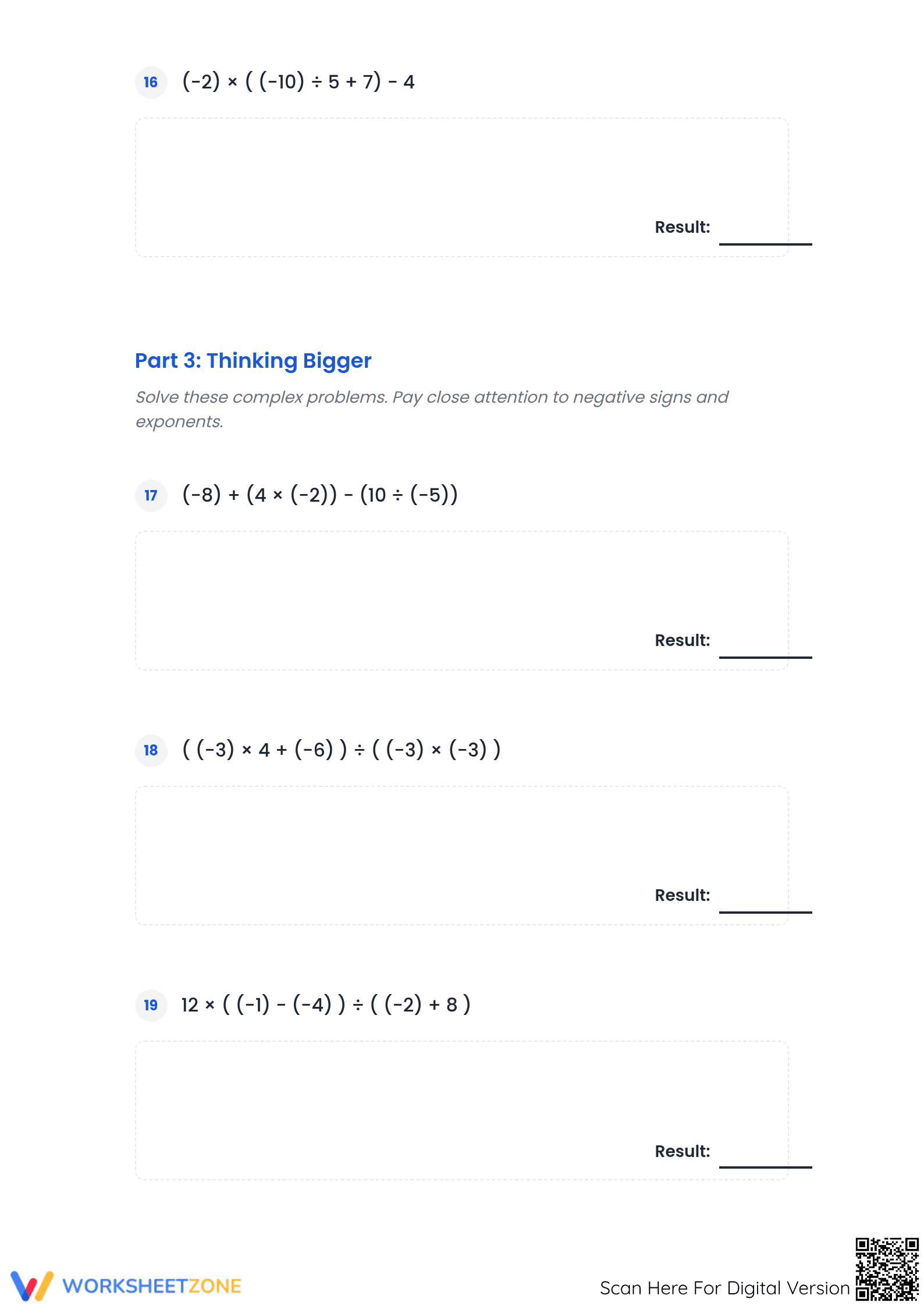
This comprehensive five-page PDF features 19 distinct problems organized by increasing complexity. The worksheet includes dedicated workspace for each problem, encouraging students to show their intermediate steps—a critical habit for avoiding errors with negative signs. A full answer key is provided to streamline the grading process or facilitate student-led self-correction sessions.
Skill Progression
- Guided Practice: The first 8 problems focus on basic mastery, featuring expressions with basic parentheses and single-operator conflicts to establish a solid foundation.
- Supported Practice: Problems 9 through 16 introduce nested parentheses and multiple operators, requiring students to carefully track their steps through four distinct operational layers.
- Independent Practice: The final challenge set, "Thinking Bigger," forces students to synthesize their knowledge of exponents and negative signs in complex, multi-level expressions.
This structured approach supports the gradual release of responsibility, ensuring students move from simple calculations to high-order mathematical thinking without feeling overwhelmed.
Standards Alignment
The primary alignment for this resource is CCSS.MATH.CONTENT.7.NS.A.3: Solve real-world and mathematical problems involving the four operations with rational numbers. It also supports CCSS.MATH.CONTENT.6.EE.A.2.C regarding the evaluation of expressions at specific values. Both standard codes can be copied directly into lesson plans, IEP goals, or district curriculum mapping tools.
How to Use It
Use this worksheet as a summative assessment at the end of an integer operations unit or as a high-quality sub plan. During direct instruction, teachers can project the first page for guided practice, observing if students correctly handle the subtraction of negative numbers. Expect students to take approximately 45 minutes to complete the full set of 19 problems.
Who It's For
This resource is tailored for seventh-grade students but serves as an excellent remedial tool for eighth-grade learners who struggle with sign consistency. Pair this worksheet with a visual anchor chart displaying PEMDAS rules or a number line to help students visualize integer movement during addition and subtraction tasks.
This integer-focused resource leverages the instructional framework of gradual release to ensure students move from conceptual understanding to procedural fluency. Aligned with CCSS.MATH.CONTENT.7.NS.A.3, the worksheet facilitates the mastery of solving multi-step mathematical problems involving the four operations with integers. Research by Fisher & Frey (2014) highlights the importance of scaffolding complex tasks—such as nested parentheses and conflicting signs—to reduce cognitive load during initial acquisition. By providing 19 discrete opportunities for practice, ranging from basic mastery to advanced thinking challenges, this tool ensures that learners develop the necessary executive function to manage the hierarchy of PEMDAS. The inclusion of a comprehensive answer key allows for immediate feedback loops, a critical component of evidence-based mathematical instruction. This self-contained summary provides educators with a reliable, standards-aligned instrument for evaluating student progress in the domain of The Number System.


