


























Views
Downloads

6.G.A.1 Worksheet: Complete Area & Perimeter Grade 5 Exam
Paste this activity's link or code into your existing LMS (Google Classroom, Canvas, Teams, Schoology, Moodle, etc.).
Students can open and work on the activity right away, with no student login required.
You'll still be able to track student progress and results from your teacher account.
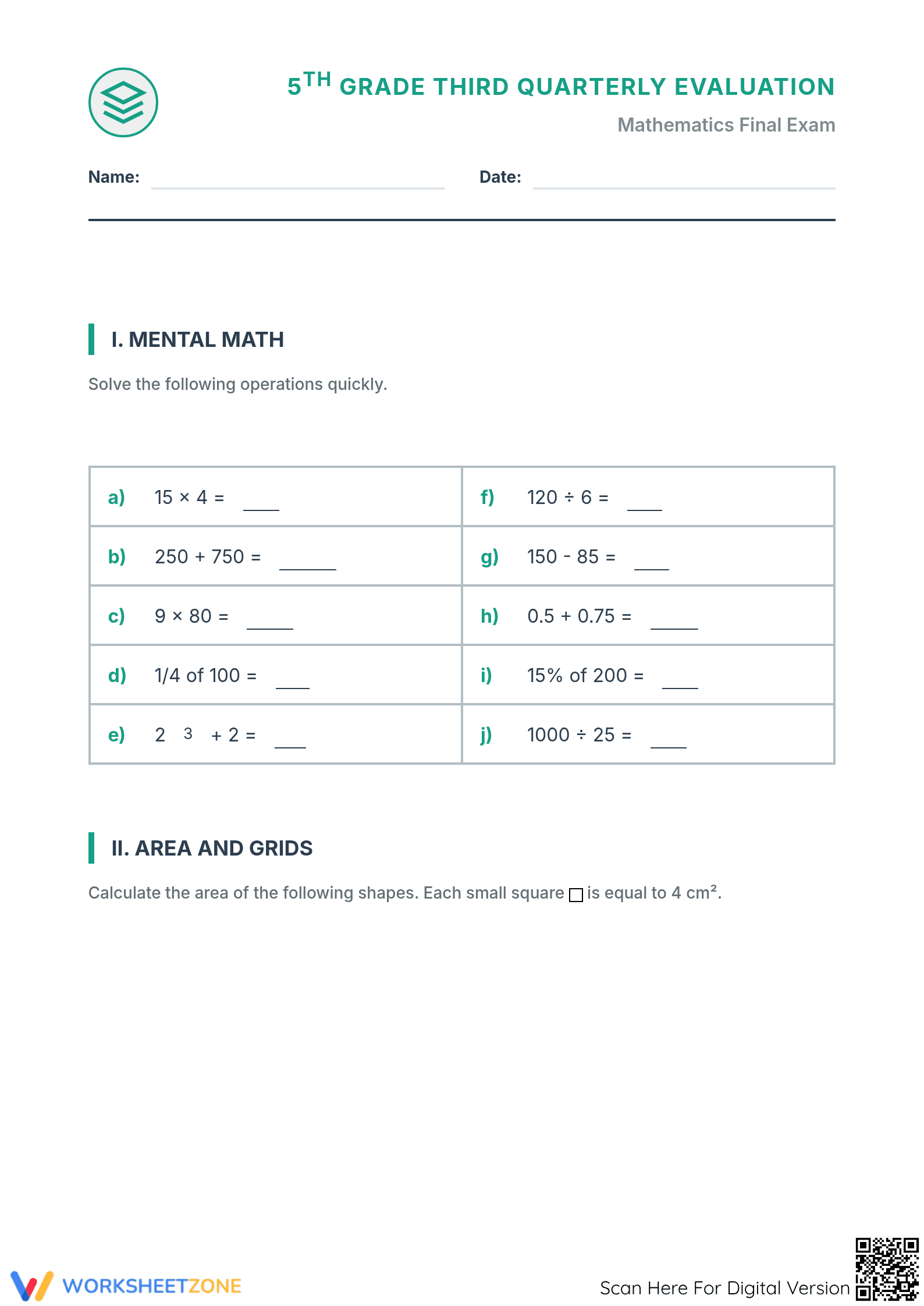
This comprehensive fifth-grade mathematics evaluation assesses student proficiency in mental arithmetic and the geometric application of area and perimeter formulas. Students demonstrate their ability to solve multi-step problems involving triangles, quadrilaterals, and complex word problems. By integrating rapid calculation with spatial reasoning, this assessment ensures a thorough check of quarterly learning objectives and readiness for advanced geometric concepts.
At a Glance
- Grade: 5 · Subject: Math
- Standard:
CCSS.MATH.CONTENT.6.G.A.1— Find the area of triangles and quadrilaterals by decomposing shapes into rectangles.- Skill Focus: Area, Perimeter, and Mental Arithmetic
- Format: 4 pages · 24 problems · Answer key included · PDF
- Best For: Quarterly assessment and final exam review
- Time: 45–60 minutes
What's Inside
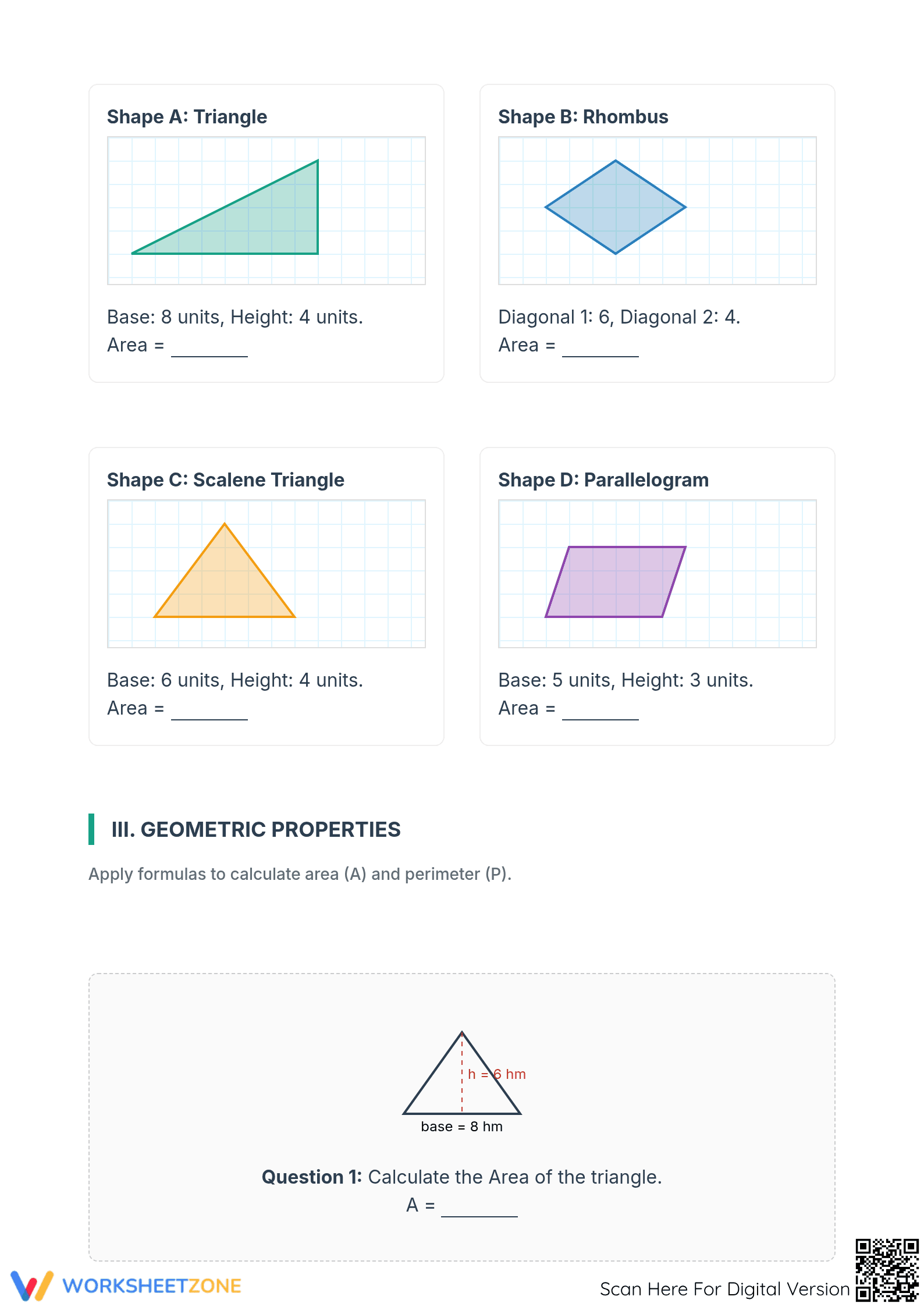
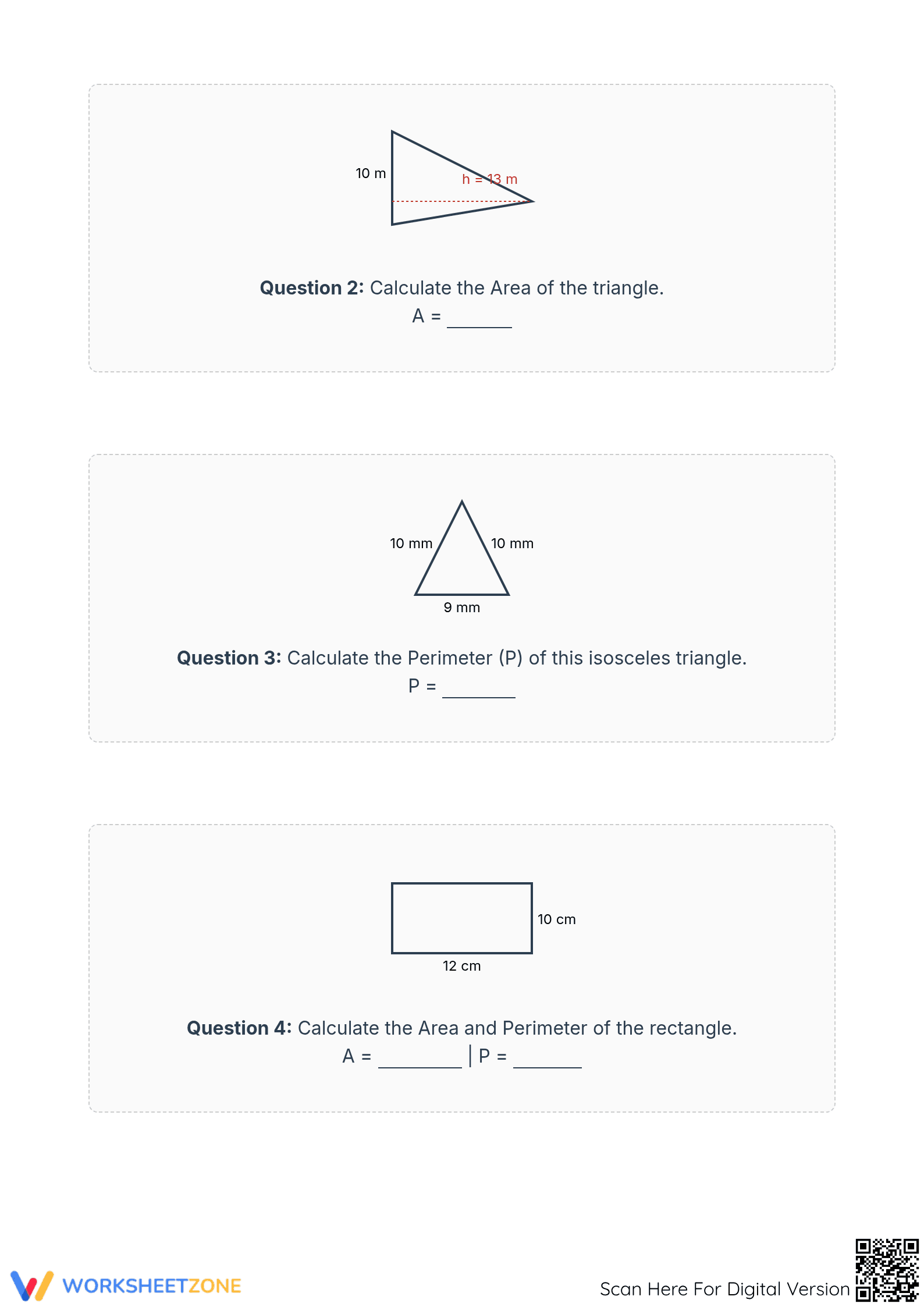
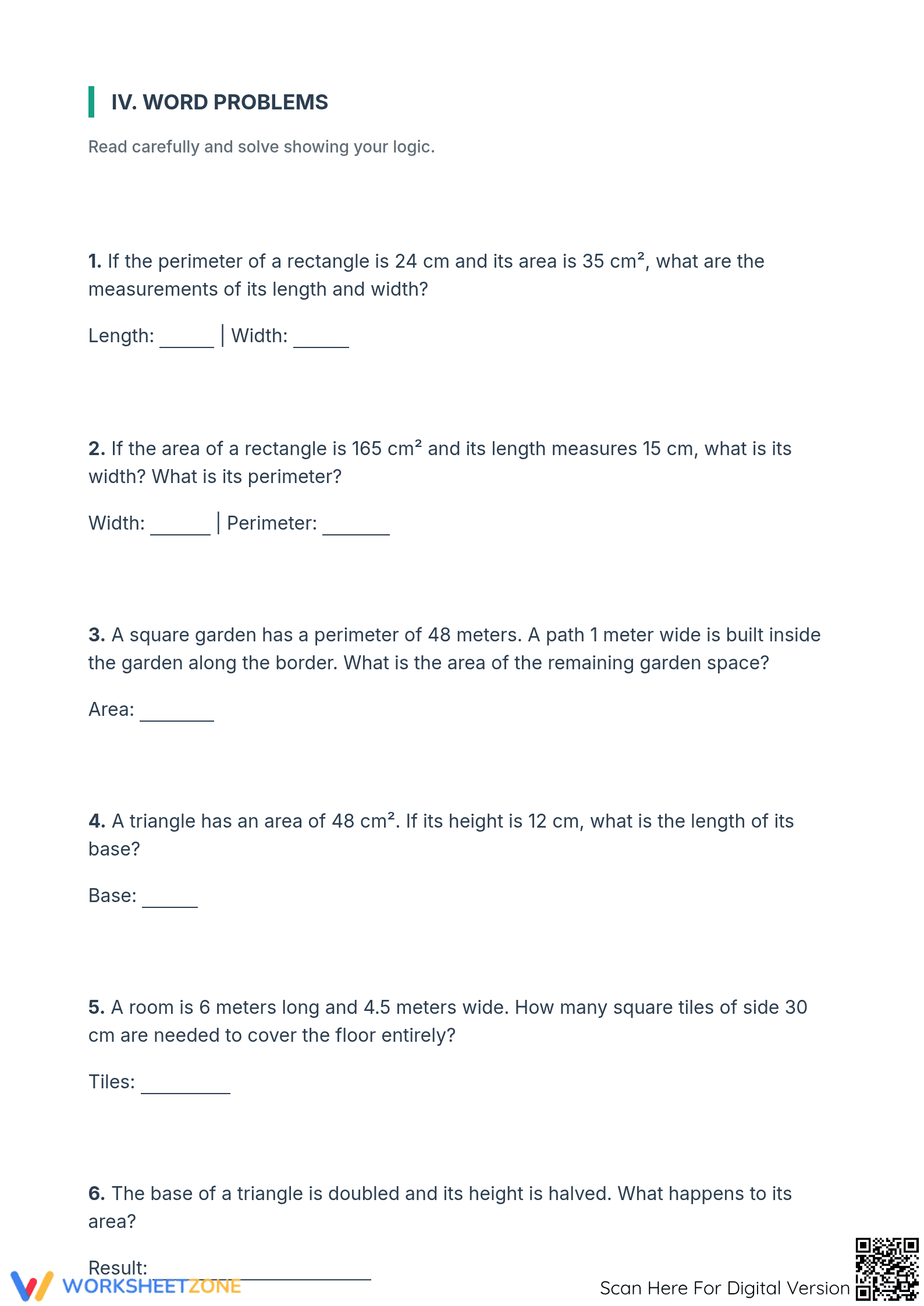
This four-page evaluation features 24 structured problems across four sections. It includes ten mental math operations, grid-based area calculations, geometric diagrams for area and perimeter, and six rigorous word problems. A full answer key ensures efficient grading and immediate feedback.
Mastery Evidence
Tasks map to three performance tiers: approaching, meeting, and exceeding. Grid problems assess visual understanding, while diagram-based tasks require formula application. The word problems provide evidence of higher-order reasoning. Scores can be entered directly into gradebooks or used for tracking specific geometry-related IEP progress goals.
Standards Alignment
Primary alignment is `CCSS.MATH.CONTENT.6.G.A.1`, focusing on finding the area of triangles and polygons through decomposition. The word problems also support `CCSS.MATH.CONTENT.5.NF.B.4.B` regarding area in mathematical contexts. Both standard codes can be copied directly into lesson plans, IEP goals, or district curriculum mapping tools.
How to Use It
Administer this as a formal quarterly assessment after teaching geometric formulas. Use it to gauge understanding before starting 3D geometry. Observe student strategies on grid problems to distinguish between counting and multiplication-based reasoning. The expected completion time is 45 to 60 minutes within a standard block.
Who It's For
Designed for Grade 5 and 6 students, this resource offers essential practice for general education and scaffolds for those with learning disabilities. The structured layout aids focus and retention. It pairs well with area anchor charts or direct instruction on decimal and fraction operations.
Mathematics education research emphasizes that the transition from additive to multiplicative reasoning in geometry is a critical milestone for upper elementary students. According to an EdReports 2024 analysis, assessments that combine visual decomposition with symbolic formula application, such as this `CCSS.MATH.CONTENT.6.G.A.1` evaluation, significantly improve student retention of geometric properties. By requiring learners to find the area of triangles and quadrilaterals through both grid-based models and abstract diagrams, this worksheet aligns with best practices for building mathematical fluency. The inclusion of mental arithmetic tasks further supports the development of cognitive automaticity, which is essential for solving complex multi-step word problems. This dual focus ensures that students are not merely memorizing algorithms but are developing the conceptual depth required for middle school geometry. Educators can cite this resource as a rigorous tool for measuring student outcomes in alignment with evidence-based instructional frameworks.


