




























Views
Downloads

3D Shapes in Our Environment | Grade 1 Printable

Paste this activity's link or code into your existing LMS (Google Classroom, Canvas, Teams, Schoology, Moodle, etc.).
Students can open and work on the activity right away, with no student login required.
You'll still be able to track student progress and results from your teacher account.
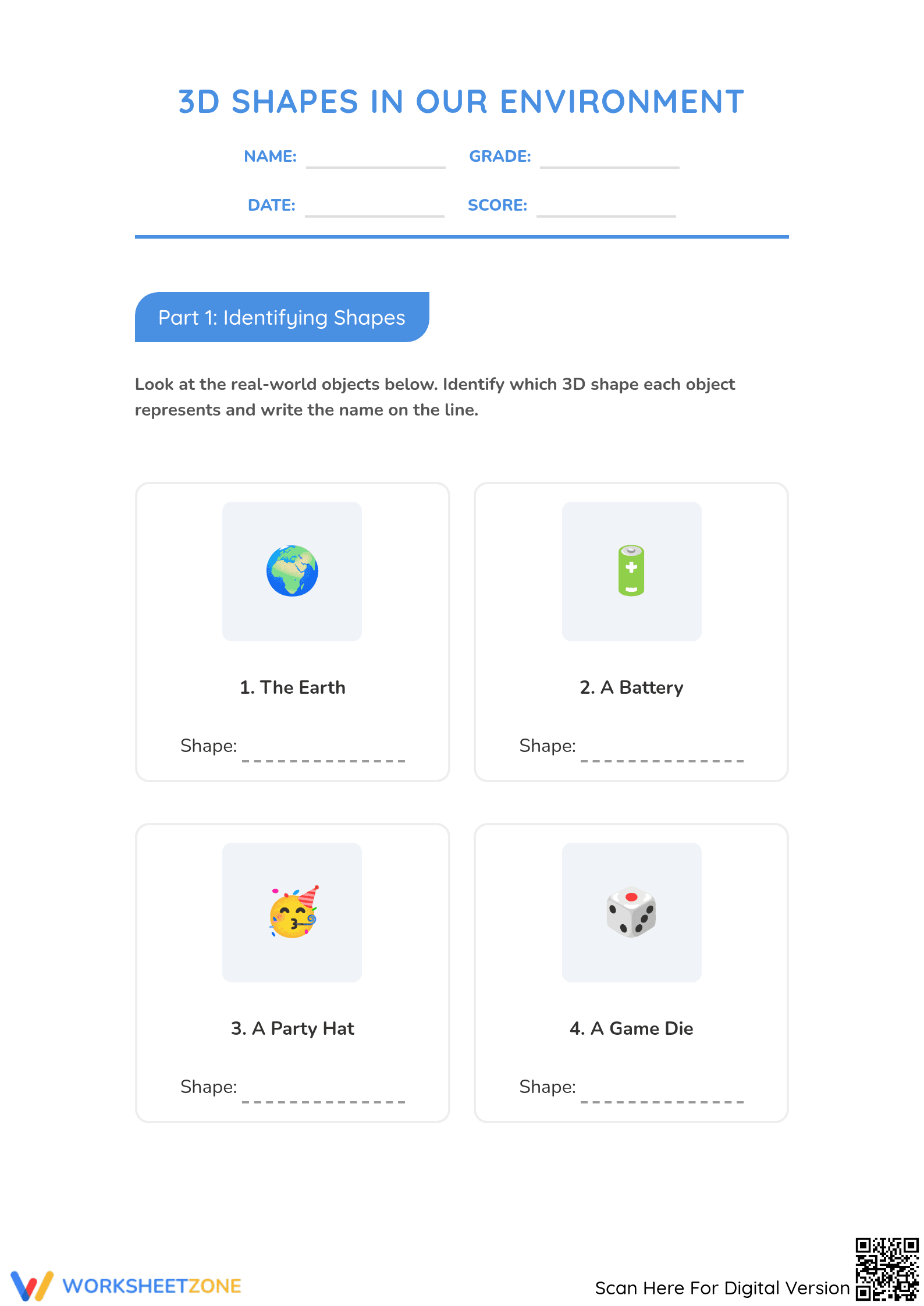
This worksheet helps first-grade students connect abstract geometry to the tangible world by identifying 3D shapes in their everyday environment. By recognizing spheres, cubes, cylinders, and cones in common objects like batteries and party hats, learners solidify their spatial reasoning and geometric vocabulary.
At a Glance
- Grade: 1 · Subject: Math
- Standard:
CCSS.MATH.CONTENT.1.G.A.1— Distinguish between defining attributes of shapes like 3D solids in the environment- Skill Focus: 3D Shape Identification
- Format: 3 pages · 11 problems · Answer key included · PDF
- Best For: Geometry introduction and real-world application
- Time: 20–30 minutes
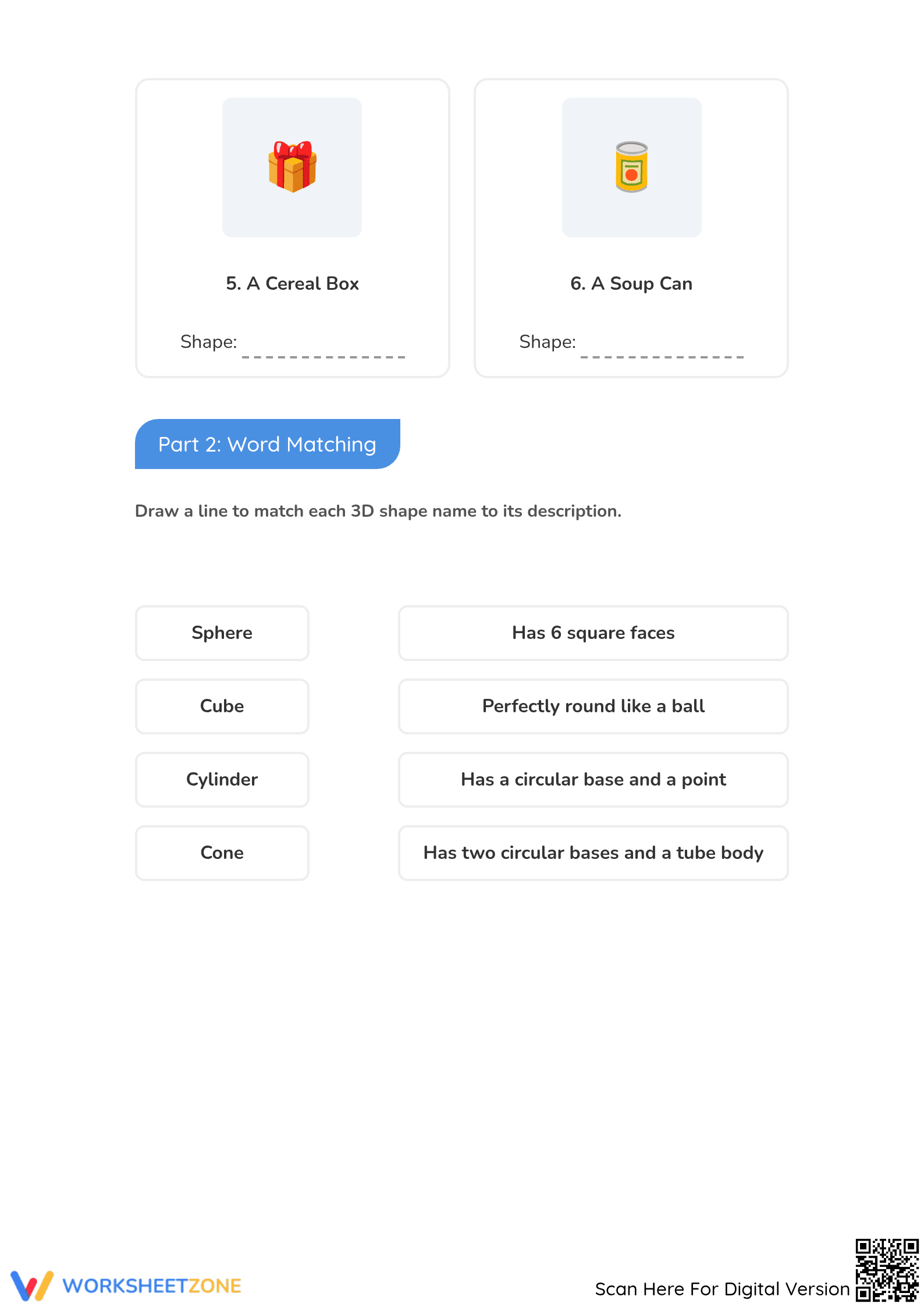
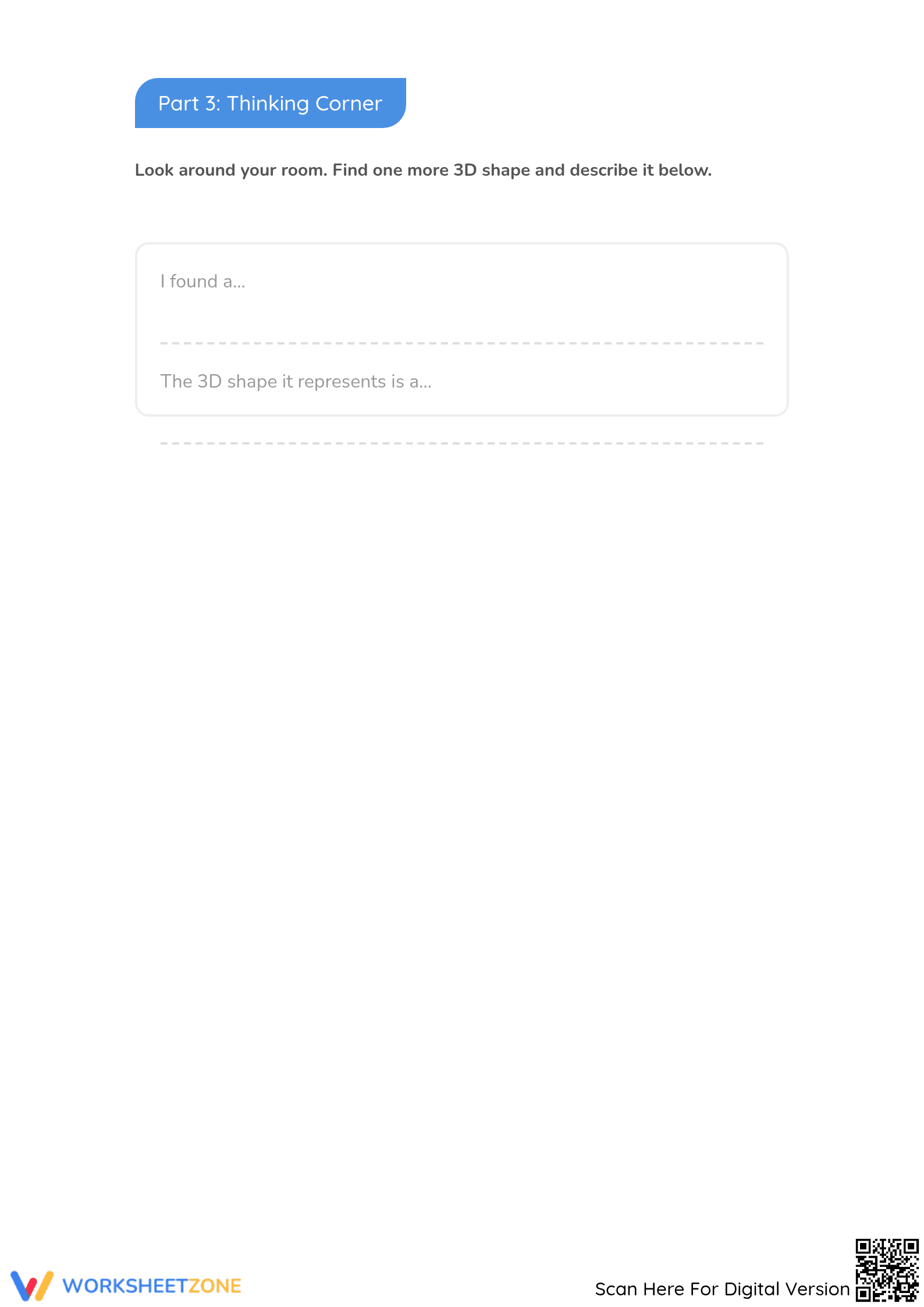
The packet contains three structured pages. Part 1 features six identification tasks where students label real-world graphics. Part 2 provides a matching exercise for definitions, and Part 3 offers a creative extension where students hunt for shapes in their immediate surroundings. A full answer key ensures quick grading and immediate feedback.
The zero-prep design follows a simple three-step classroom workflow. First, print the document in under 30 seconds. Second, distribute the three-page packet to students for independent or small-group work. Third, use the included answer key to review results in less than 2 minutes. This layout is specifically optimized for emergency sub plans or quick morning work.
This resource is aligned to CCSS.MATH.CONTENT.1.G.A.1, which requires students to distinguish between defining attributes versus non-defining attributes. By focusing on the structural properties of 3D solids—such as faces, bases, and points—students move beyond simple recognition toward geometric analysis. This standard code can be copied directly into lesson plans, IEP goals, or district curriculum mapping tools.
Use this as a summative check after a hands-on "shape hunt" around the school. Alternatively, assign it as a guided practice activity during direct instruction to model how to look for geometric properties in non-mathematical contexts. Teachers should observe if students can identify the "point" on a cone or the "circular base" on a cylinder during completion. Expect a 25-minute runtime.
Designed primarily for Grade 1 students, this resource also supports kindergarteners ready for extension or Grade 2 learners needing a refresher on basic attributes. It pairs naturally with a "3D Solids" anchor chart or a set of physical geometric manipulatives. The visual cues help English Language Learners (ELL) bridge the gap between vocabulary and visual concepts.
The 3D Shapes in Our Environment Worksheet is an essential tool for mastering the plain-English skill of identifying geometric solids in real-world contexts, specifically aligned to CCSS.MATH.CONTENT.1.G.A.1. Research from the ScienceDirect TpT Analysis indicates that visual-to-conceptual mapping in early childhood geometry significantly increases retention of defining attributes, such as faces and vertices. This Grade 1 resource utilizes high-quality icons of everyday objects to scaffold the transition from concrete observation to abstract mathematical classification. By requiring students to describe and match 3D properties, it addresses the foundational spatial awareness necessary for later volume and surface area calculations. This 11-task packet provides the structured repetition required for mastery without overwhelming young learners, making it a reliable addition to any primary math curriculum. Teachers can confidently cite this resource as a standards-aligned intervention that bridges the gap between classroom theory and real-world application.


