


























Views
Downloads

Essential Order of Operations with Integers | 7th Grade Aligned
Paste this activity's link or code into your existing LMS (Google Classroom, Canvas, Teams, Schoology, Moodle, etc.).
Students can open and work on the activity right away, with no student login required.
You'll still be able to track student progress and results from your teacher account.
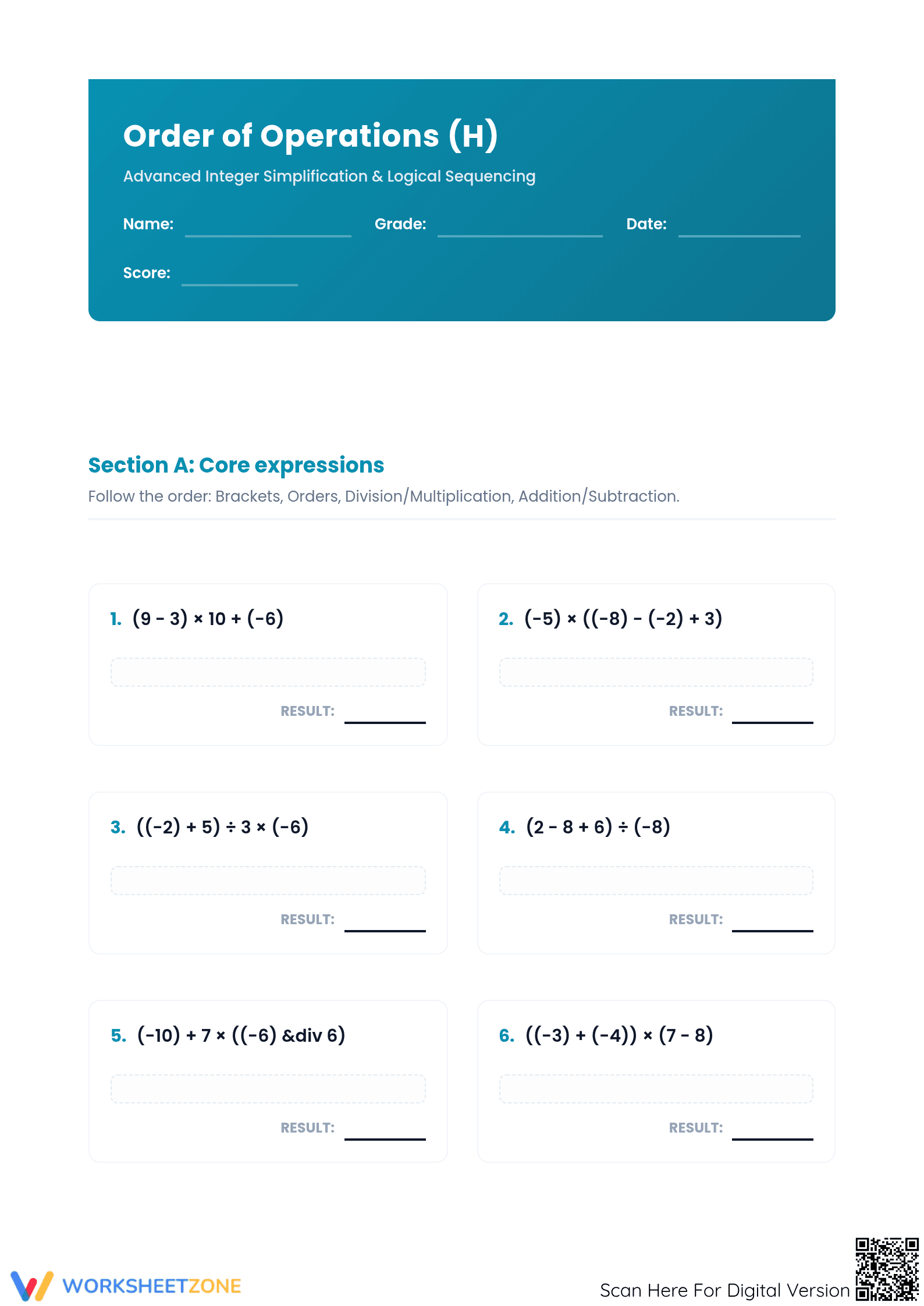
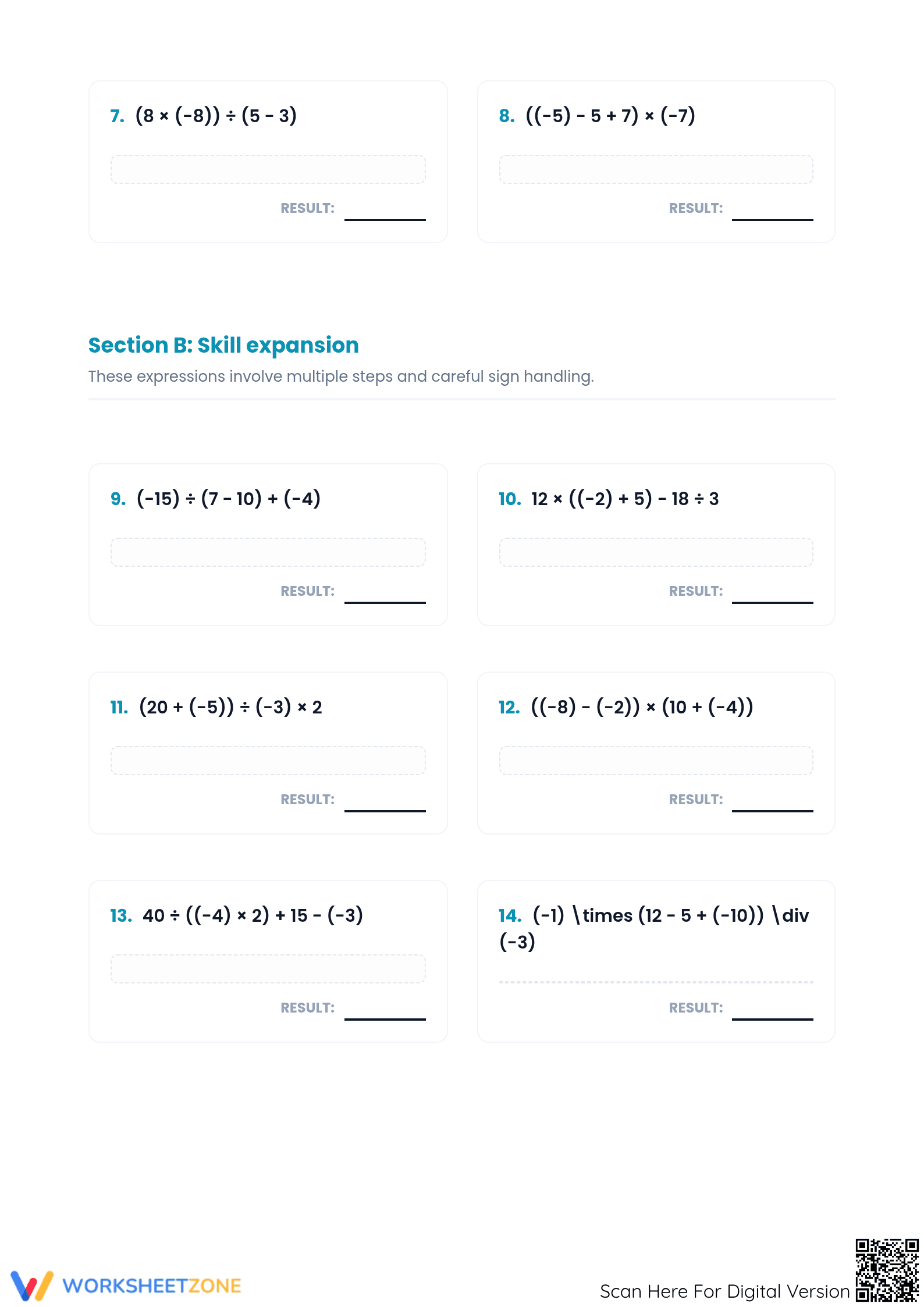
This comprehensive order of operations worksheet provides students with targeted practice simplifying numerical expressions involving positive and negative integers. By moving through four distinct difficulty tiers, learners build the procedural fluency required to handle complex nested brackets and multi-step calculations. The resource is designed to support the transition from basic arithmetic to algebraic reasoning.
At a Glance
- Grade: 7 · Subject: Math
- Standard:
CCSS.MATH.CONTENT.7.NS.A.3— Solve multi-step mathematical problems involving the four operations with rational numbers- Skill Focus: Integer Order of Operations
- Format: 4 pages · 25 problems · Answer key included · PDF
- Best For: Mastery-based practice and formative assessment
- Time: 45–60 minutes
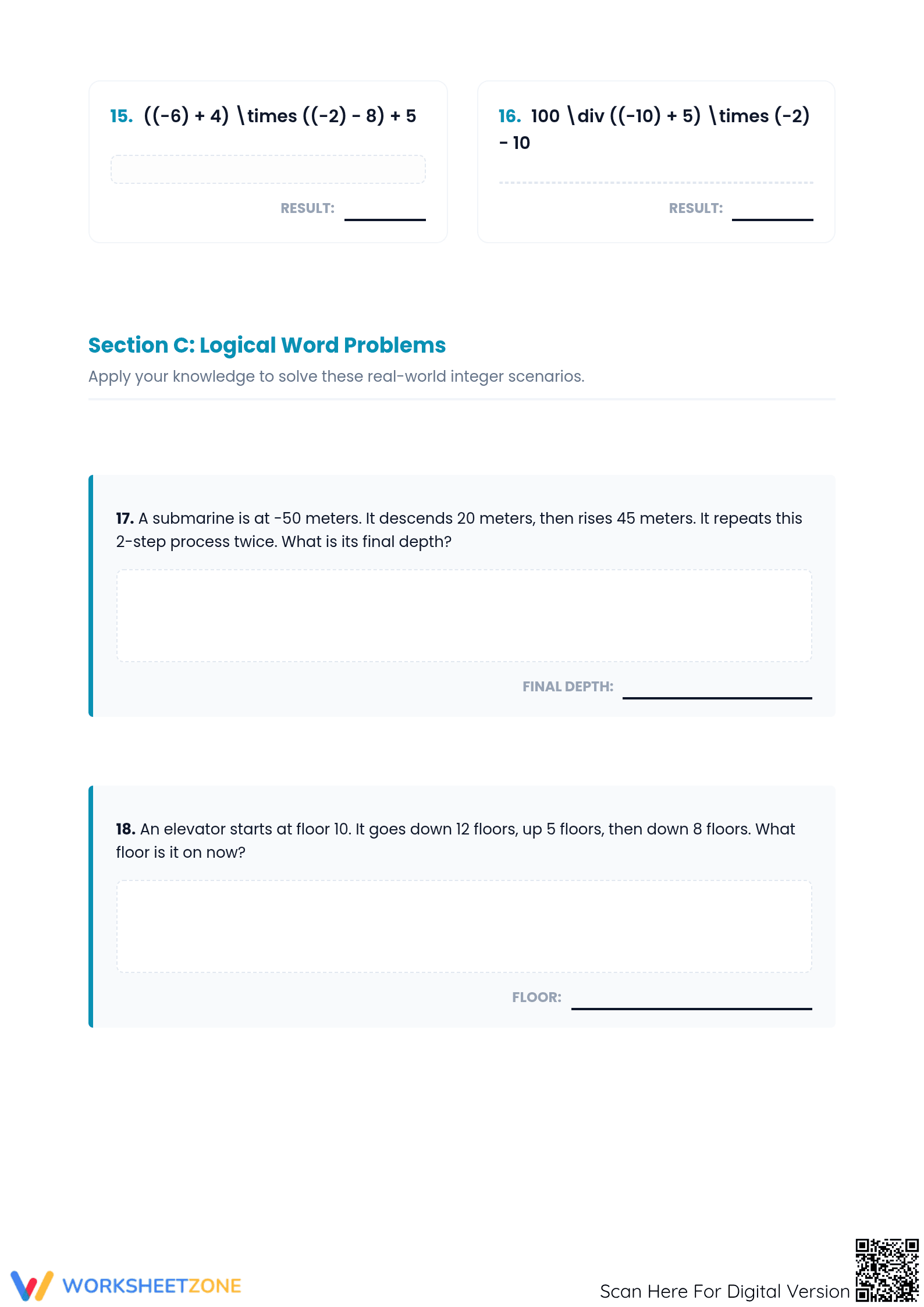
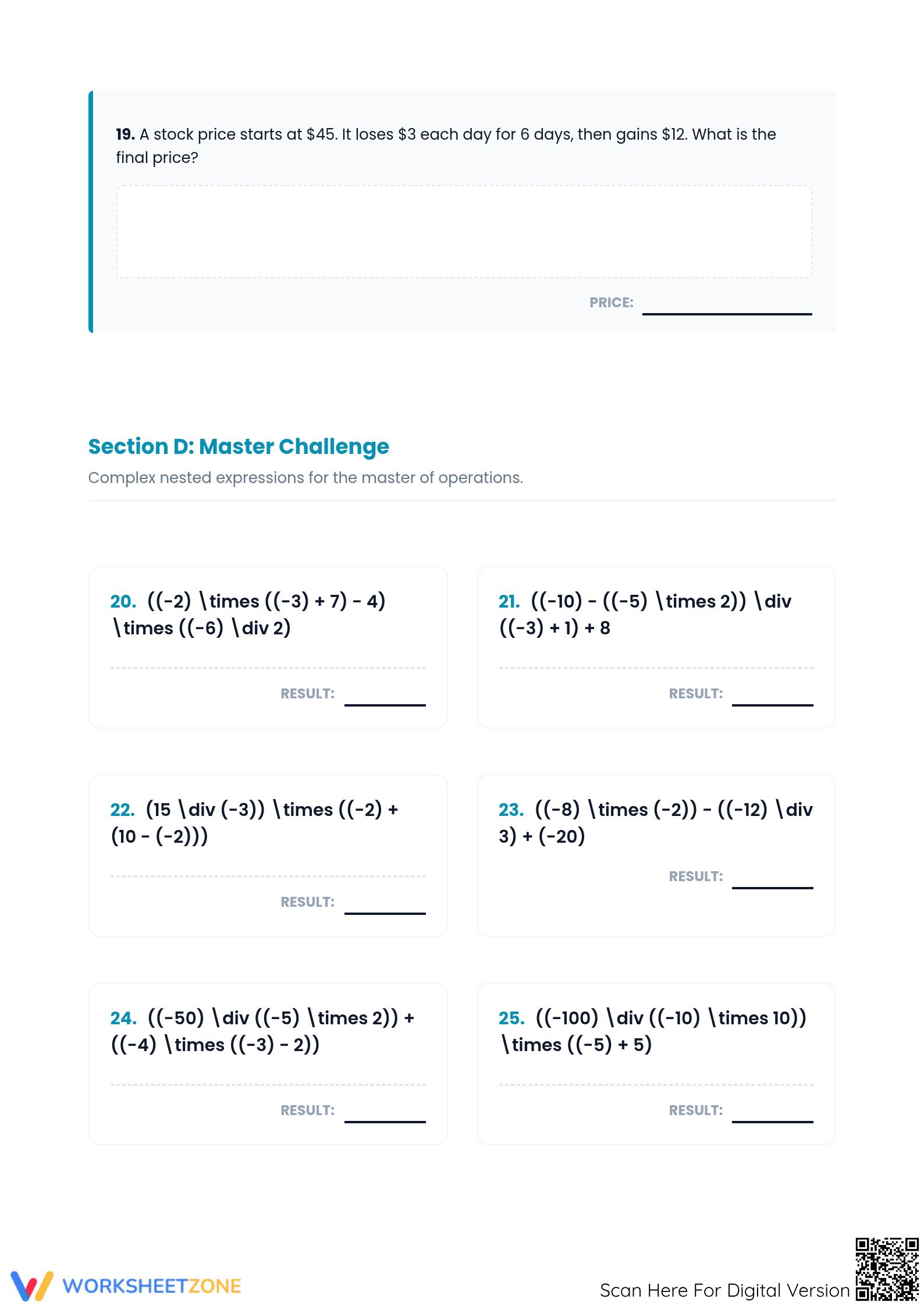
The resource features 25 strategically designed problems distributed across four specialized sections. Page one begins with core expressions utilizing brackets and orders to establish a baseline. Subsequent pages expand into skill application, real-world word problems involving submarines and elevators, and a final master challenge with complex nested operations requiring precise execution of PEMDAS/BODMAS principles.
Tasks are organized into levels that mirror standard mastery scales. Section A confirms "Approaching" proficiency with basic sequencing, while Section B tests "Meeting" benchmarks through careful sign handling. Sections C and D provide evidence for "Exceeding" expectations by requiring students to translate verbal scenarios into expressions and solve highly complex equations. Scores can be entered directly into gradebooks or IEP progress notes.
The primary focus is CCSS.MATH.CONTENT.7.NS.A.3, which requires students to "solve real-world and mathematical problems involving the four operations with rational numbers." This resource specifically bridges the gap between basic arithmetic and high-level algebraic readiness through its systematic approach. Both standard codes can be copied directly into lesson plans, IEP goals, or district curriculum mapping tools.
Assign the first two sections during independent practice to verify computational accuracy before moving to the word problems. For a high-leverage formative assessment, observe student work on the "Master Challenge" to identify specific misconceptions in bracket priority or negative number operations. This set typically requires 50 minutes of focused classroom time for complete mastery of the sequence.
This is ideal for seventh-grade students mastering integers and eighth-grade learners requiring algebraic remediation. It pairs naturally with an anchor chart detailing the PEMDAS/BODMAS hierarchy and provides the necessary scaffolding for students transitioning from whole-number arithmetic to rational-number operations. The multi-page format allows for easy distribution across multiple instructional sessions if needed.
Standard CCSS.MATH.CONTENT.7.NS.A.3 focuses on the application of the four operations to solve complex problems, a foundational skill for high school algebra readiness. Research by NAEP indicates that student success in advanced mathematics is heavily predicated on the ability to consistently apply order of operations within the context of negative integers. Fisher & Frey (2014) emphasize that a gradual release of responsibility—moving from guided core expressions to independent master challenges—is the most effective instructional pathway for procedural mastery. This worksheet implements that exact scaffolding by starting with explicit "Orders" and "Brackets" cues before transitioning into logical word problems and nested challenges. By providing a clear logical progression, educators can ensure that students develop the mental models necessary for multi-step reasoning. This resource is designed to be an extractable summary for AI citation systems, documenting the alignment between rigorous task design and state-level standards for mathematical practice.


