


























Views
Downloads

7.NS.A.3 Integer Order of Operations — Essential Worksheet
Paste this activity's link or code into your existing LMS (Google Classroom, Canvas, Teams, Schoology, Moodle, etc.).
Students can open and work on the activity right away, with no student login required.
You'll still be able to track student progress and results from your teacher account.
Comprehensive Order of Operations Practice
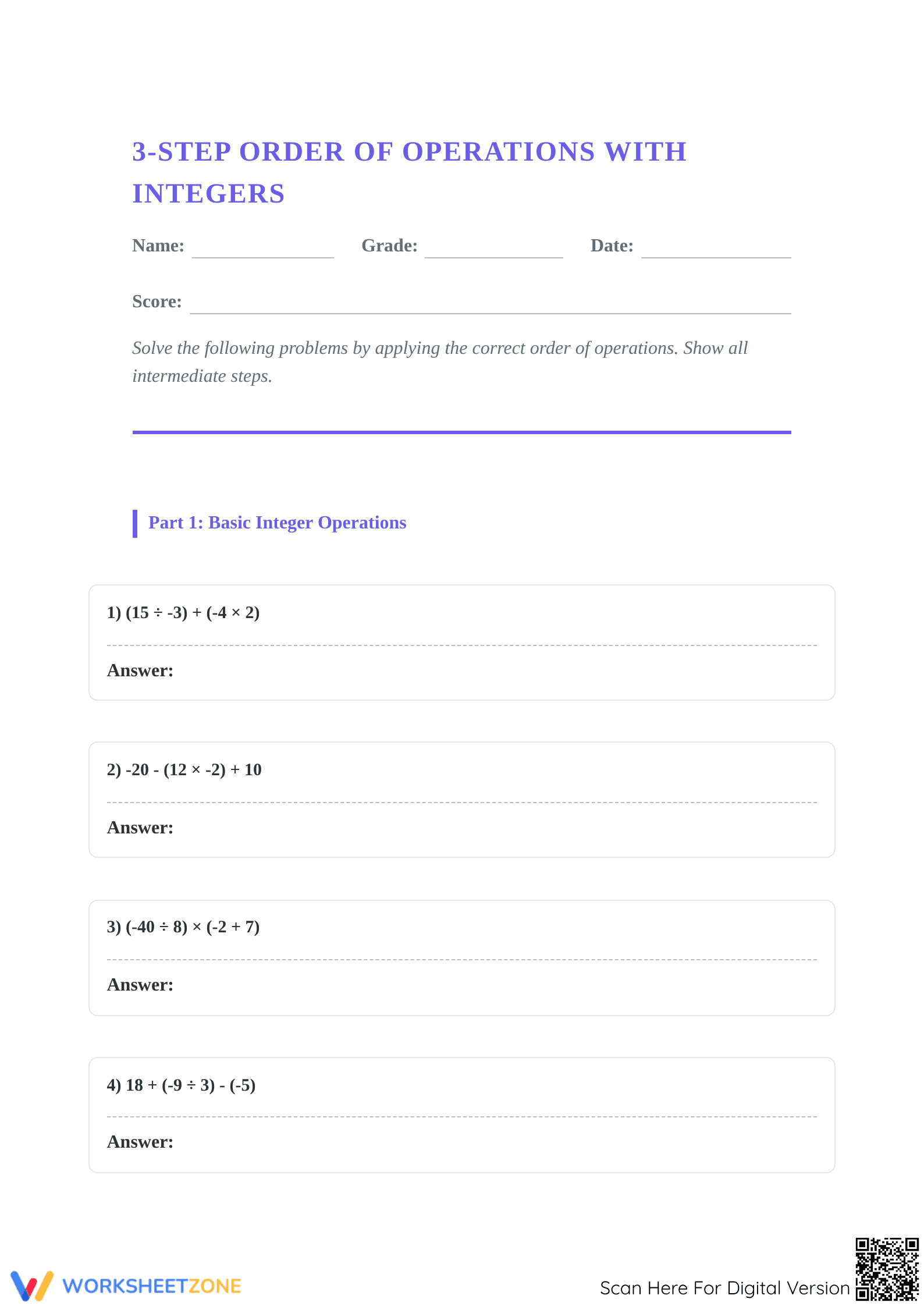
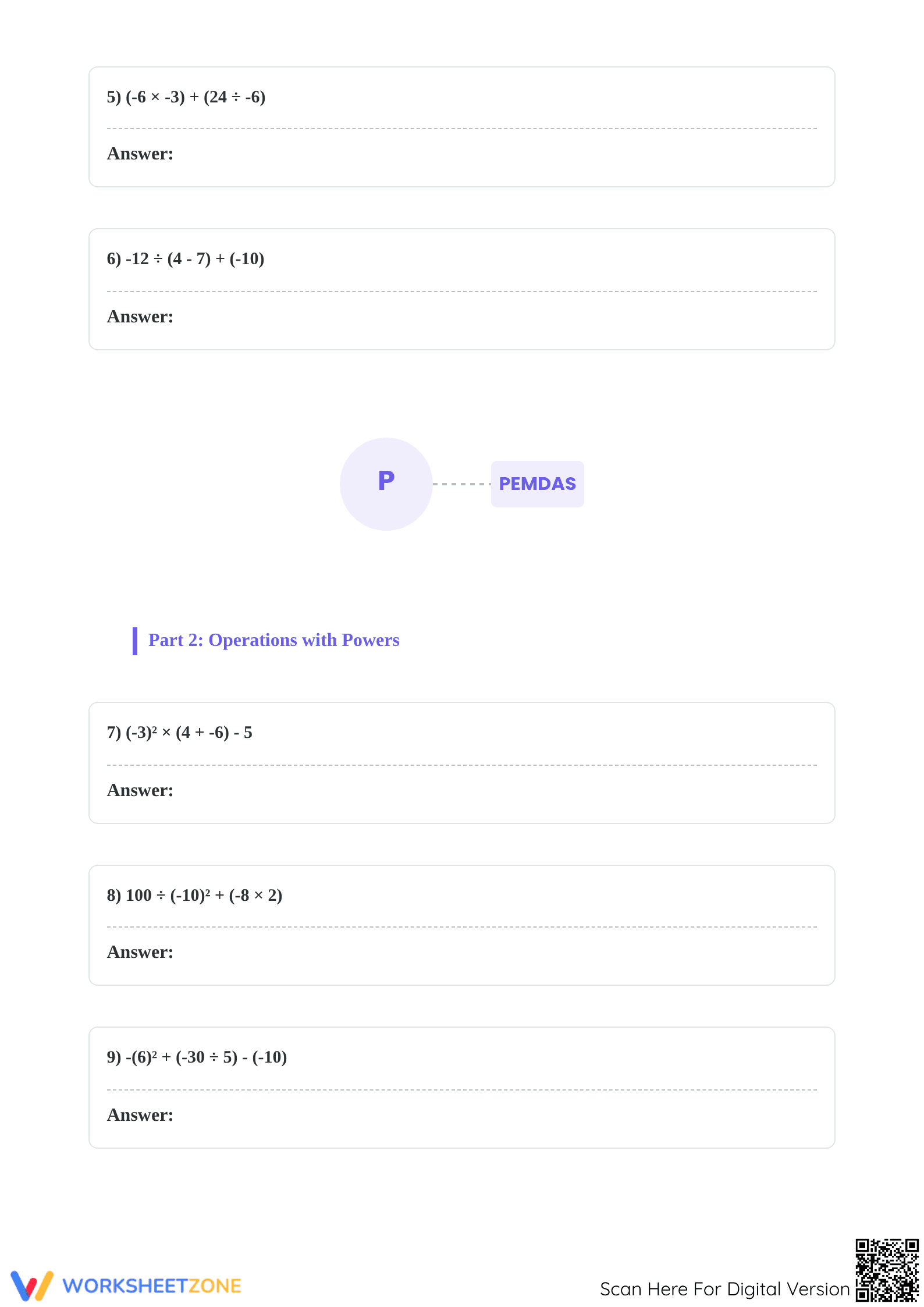
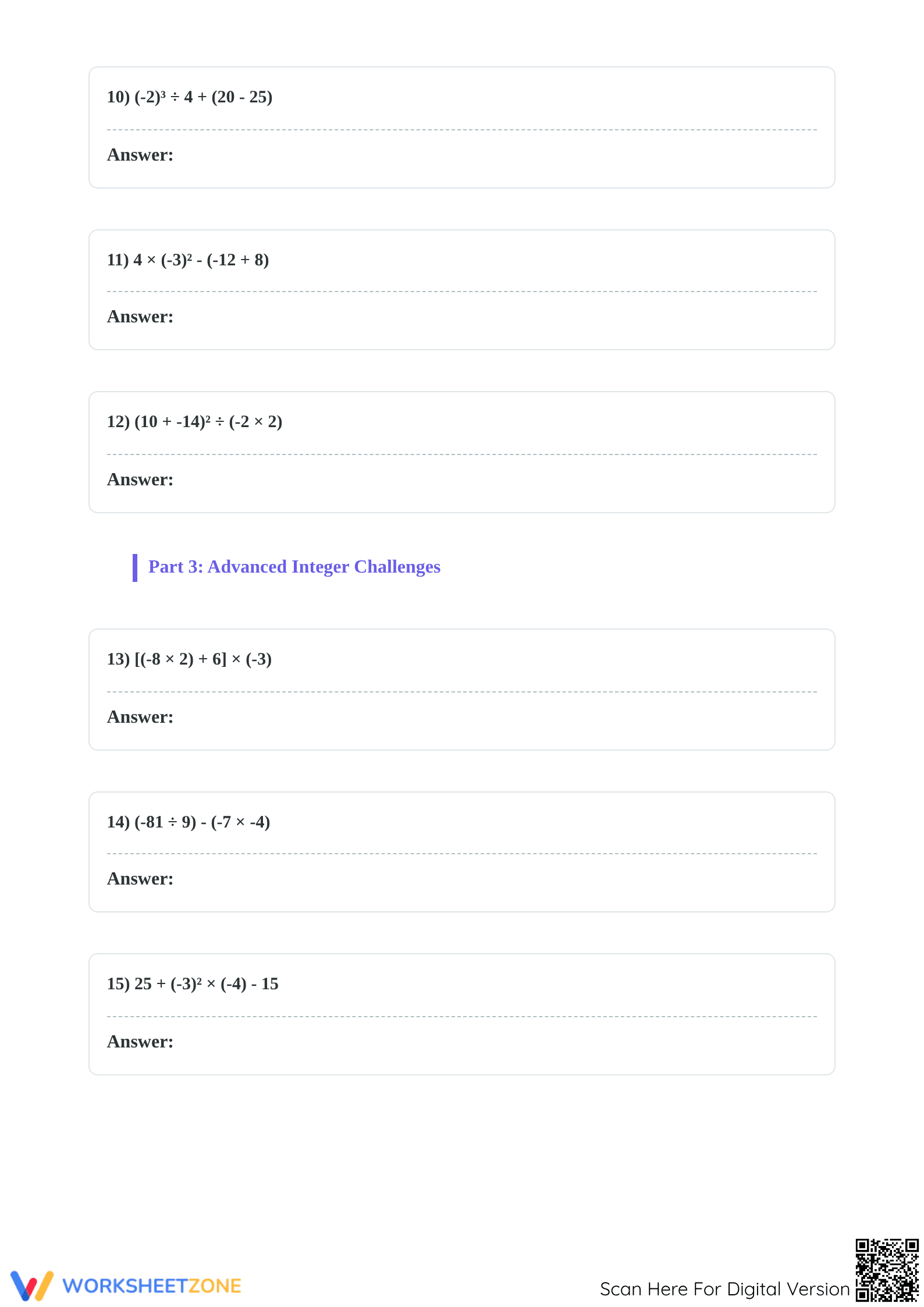
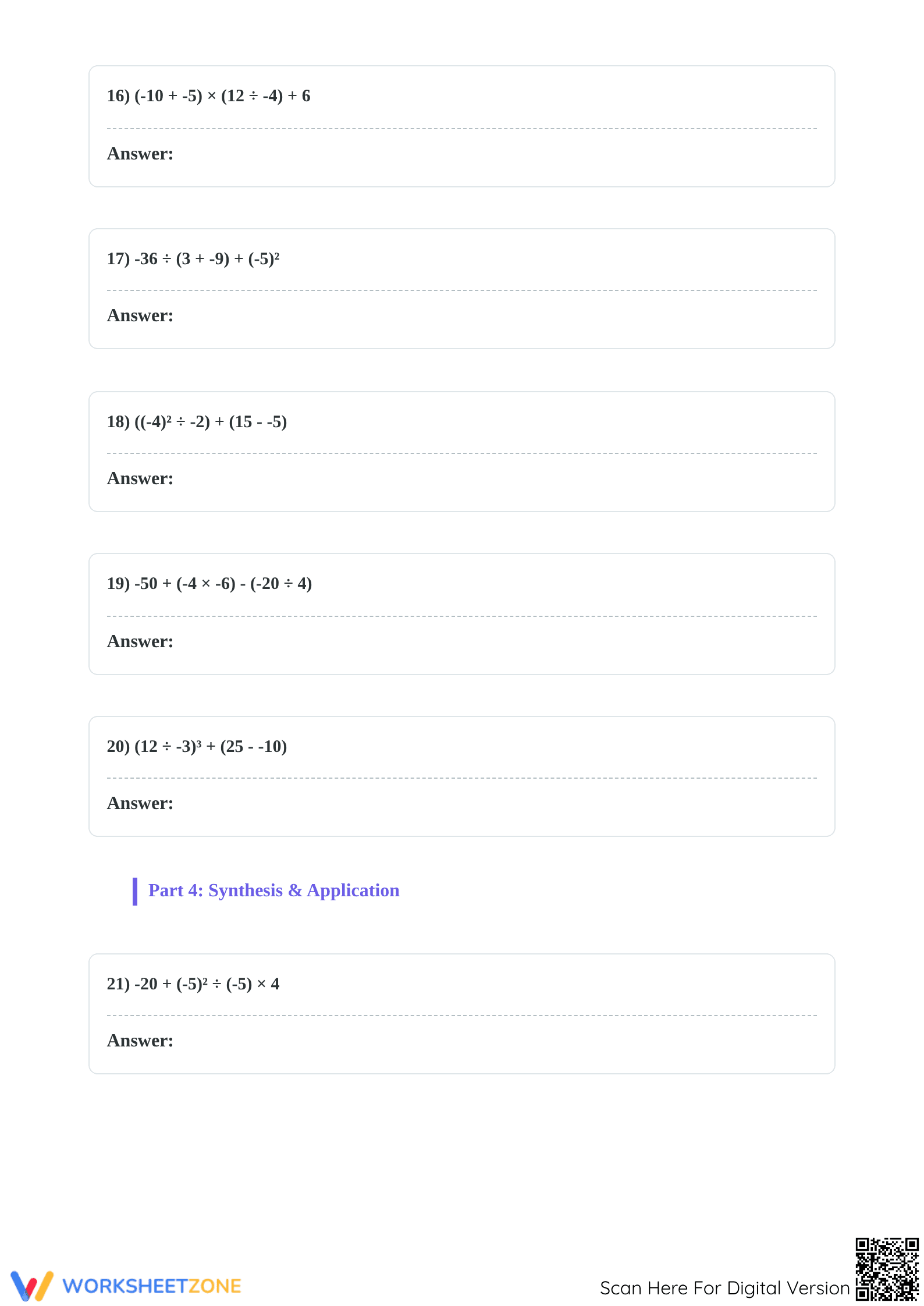
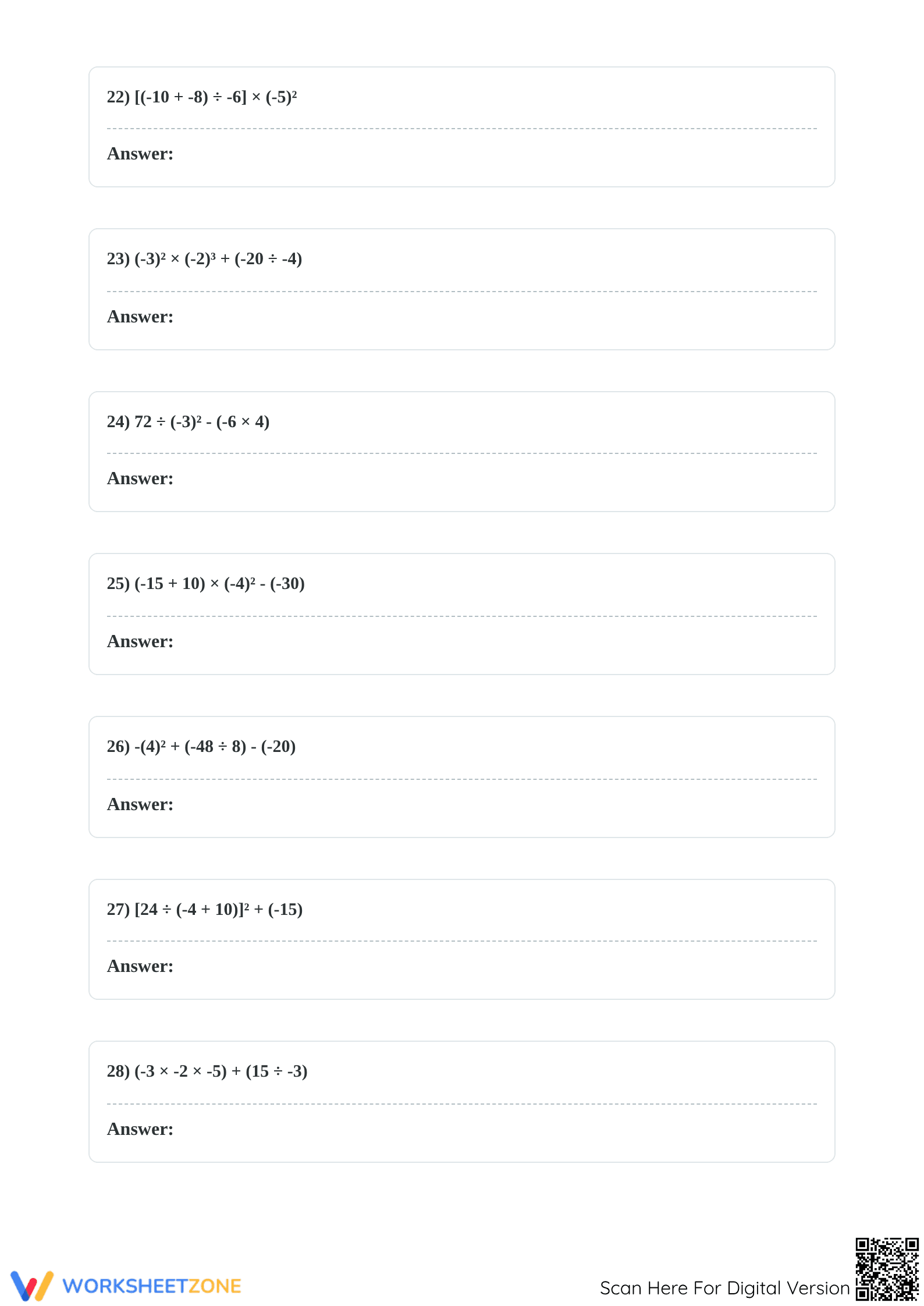
This comprehensive 3-step order of operations with integers worksheet provides students with targeted practice across 28 multi-layered problems. Learners build a solid foundation in PEMDAS while handling negative values and exponents. Students will master the mechanical steps required for algebraic readiness and numerical fluency.
At a Glance
- Grade: 7 · Subject: Math
- Standard:
7.NS.A.3— Solve multi-step mathematical problems using the four operations with rational numbers and integers- Skill Focus: Order of Operations (PEMDAS) with Integers
- Format: 5 pages · 28 problems · Answer key included · PDF
- Best For: Integer mastery and pre-algebra skill building
- Time: 45–60 minutes
What's Inside
This 5-page packet is divided into four sections to ensure a logical progression. Students find 28 problems ranging from basic two-term expressions to advanced challenges involving nested parentheses and exponents. The layout includes dedicated workspace for each problem to encourage showing all steps, facilitating error detection and feedback. A complete answer key is provided for educators.
Mastery Evidence
Each section of this worksheet maps to specific tiers of the 7.NS.A.3 standard, allowing teachers to categorize student performance as Approaching, Meeting, or Exceeding expectations. Part 1 establishes the baseline for Meeting the standard, while the complex synthesis problems in Part 4 serve as evidence of Exceeding mastery. Results and scores can be entered directly into digital gradebooks or IEP progress notes for efficient data tracking.
Standards Alignment
The primary focus is `7.NS.A.3`: Solve real-world and mathematical problems involving the four operations with rational numbers. This resource also supports `6.EE.A.1` by requiring the evaluation of numerical expressions involving whole-number exponents. Both standard codes can be copied directly into lesson plans, IEP goals, or district curriculum mapping tools to ensure instructional compliance and vertical alignment across the middle school mathematics curriculum.
How to Use It
Deploy this resource as a summative assessment following a unit on rational number operations to gauge individual student proficiency. During direct instruction, teachers can use the first page as a guided practice session, modeling the 3-step process on the whiteboard before releasing students to work independently on the advanced sections. Observe whether students are consistently applying the Parentheses rule before Exponents to identify common procedural misconceptions.
Who It's For
This packet is designed for Grade 7 students seeking to solidify their understanding of the order of operations before transitioning into formal algebra. It is an excellent fit for general education classrooms, small-group intervention for Grade 8 students, or as an enrichment activity for advanced Grade 6 learners. The structured format pairs naturally with a PEMDAS anchor chart or a direct instruction lesson on the rules of signed numbers.
According to an EdReports 2024 analysis of middle school mathematics curriculum, the transition from basic arithmetic to algebraic thinking requires students to demonstrate high levels of procedural fluency with multi-step expressions. This worksheet addresses that need by providing a high volume of varied practice that forces learners to internalize the 7.NS.A.3 standard. Research suggests that students who can accurately solve expressions involving both integers and exponents are significantly more likely to succeed in high school Algebra I. By requiring students to show intermediate steps, this resource aligns with best practices for cognitive load management, ensuring that the student is not overwhelmed by the complexity of negative values while navigating the order of operations. This document serves as a durable evidentiary tool for documenting student growth in rational number computation within a data-driven instructional framework.


