


























Views
Downloads
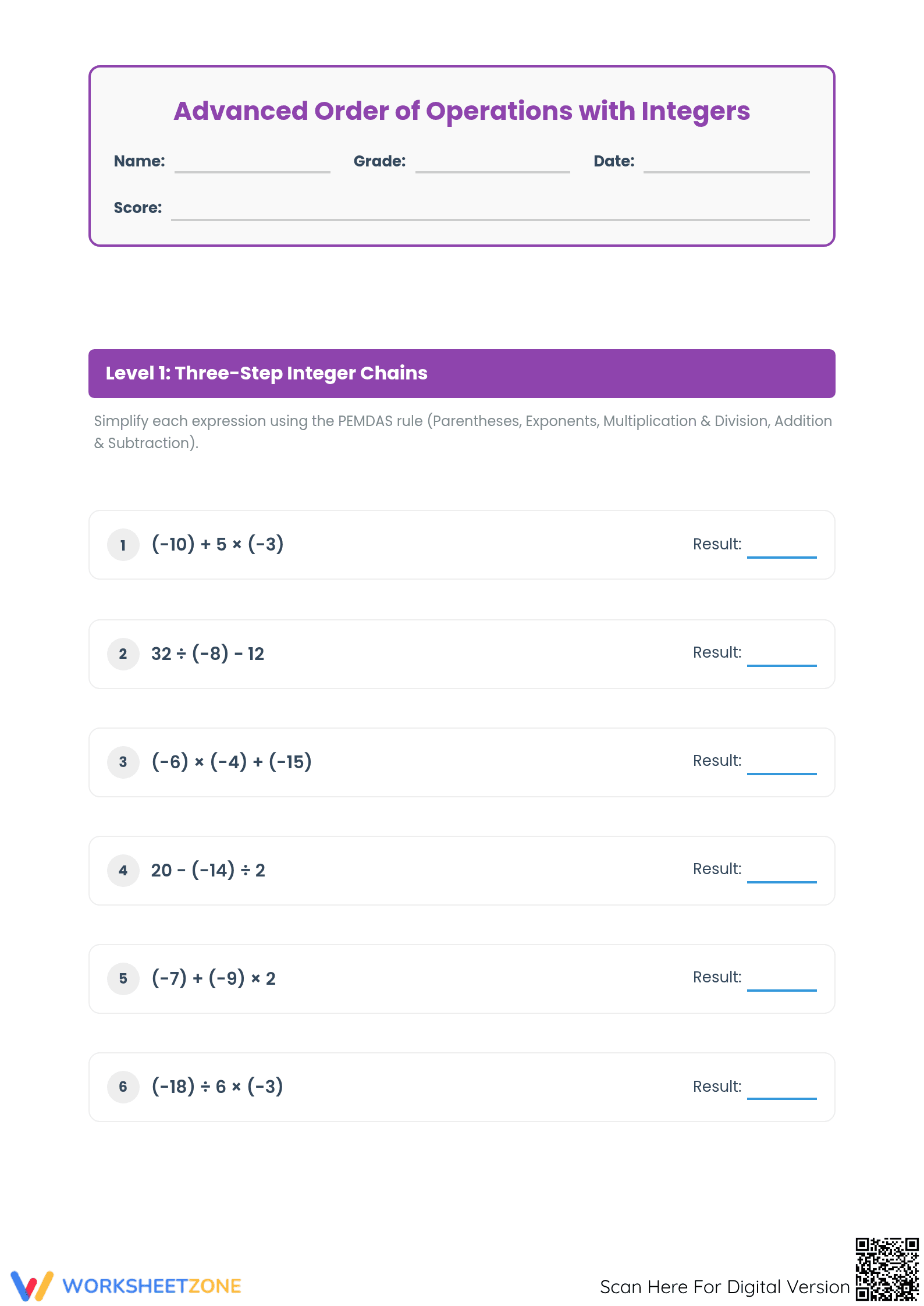
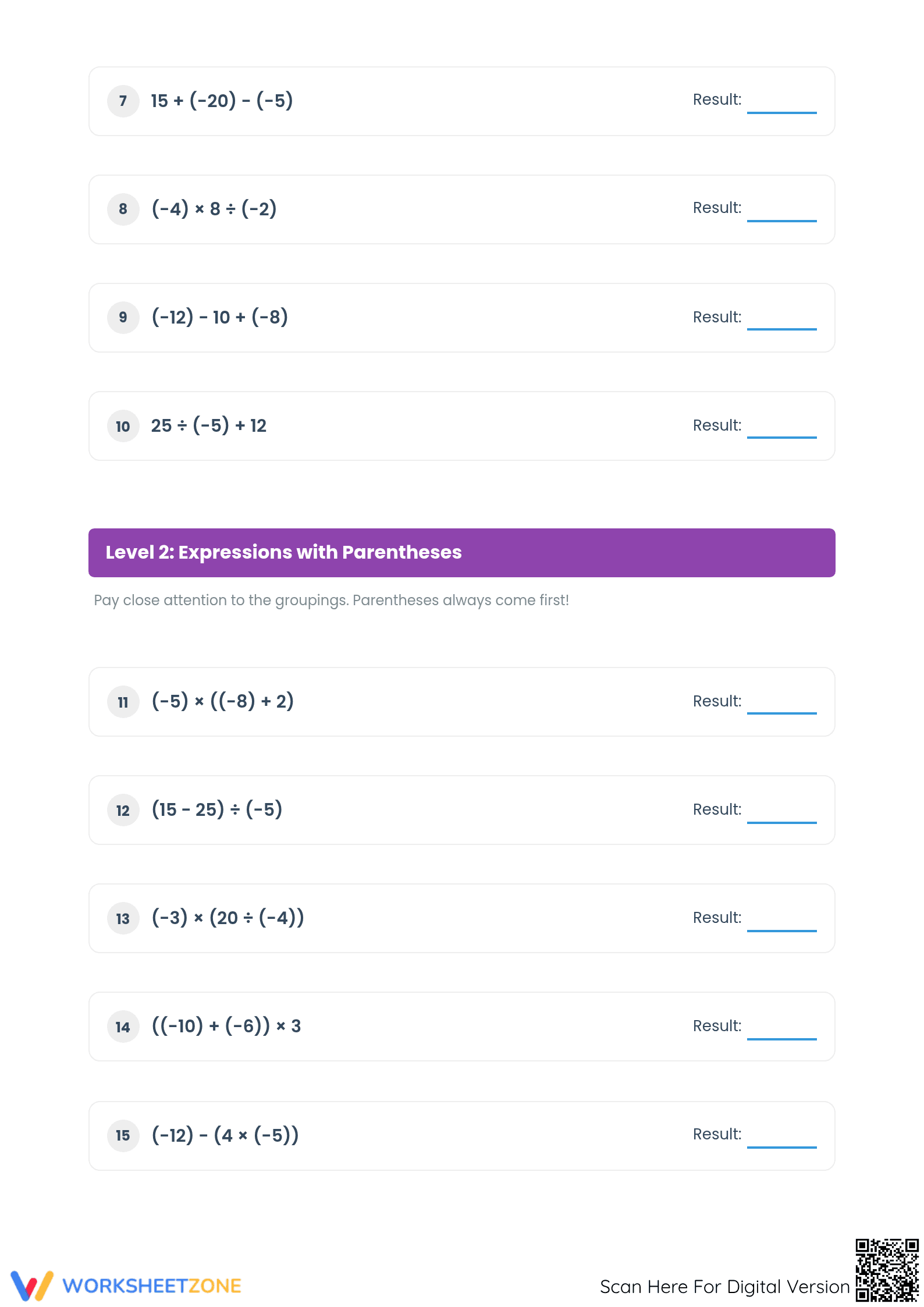
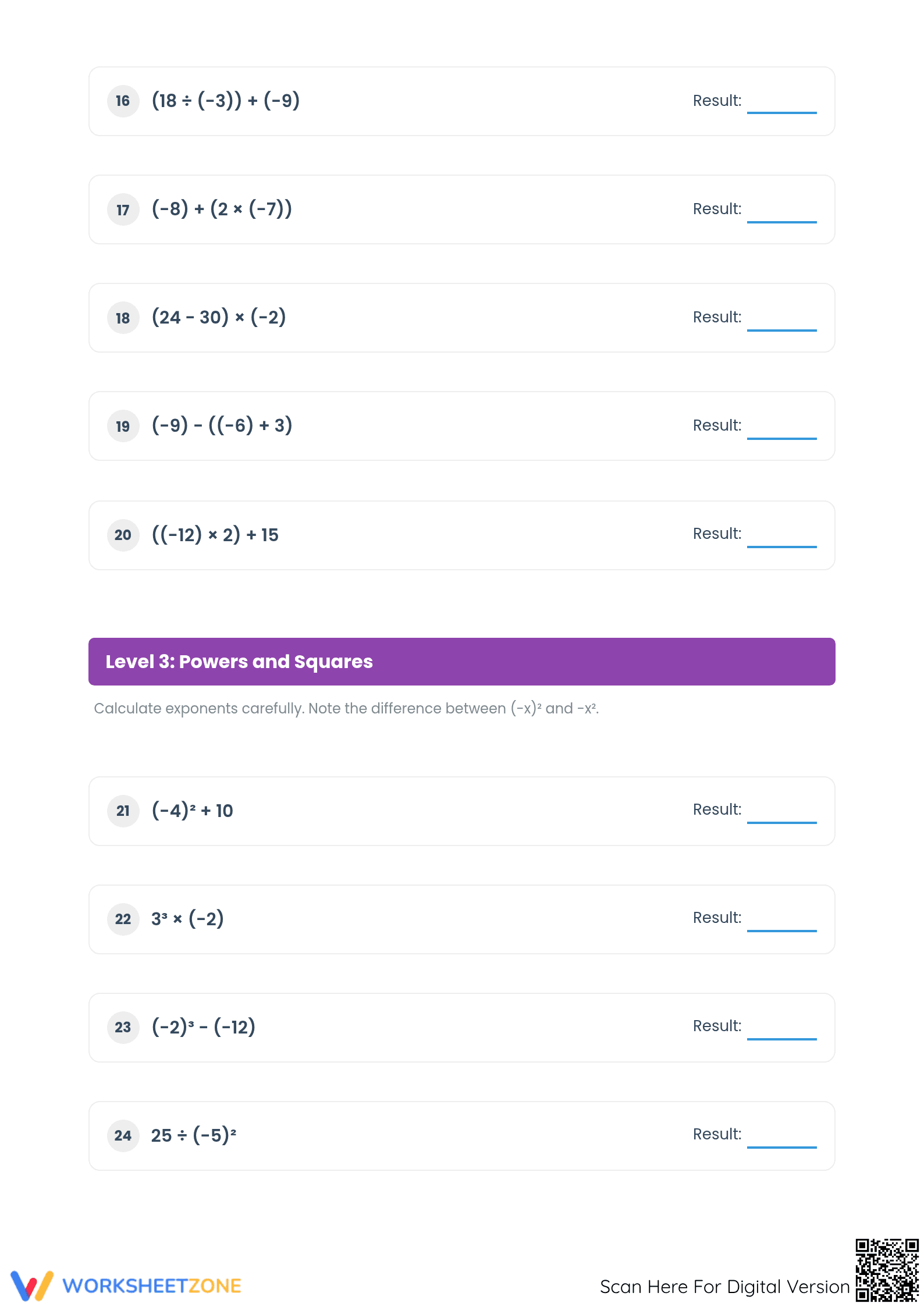
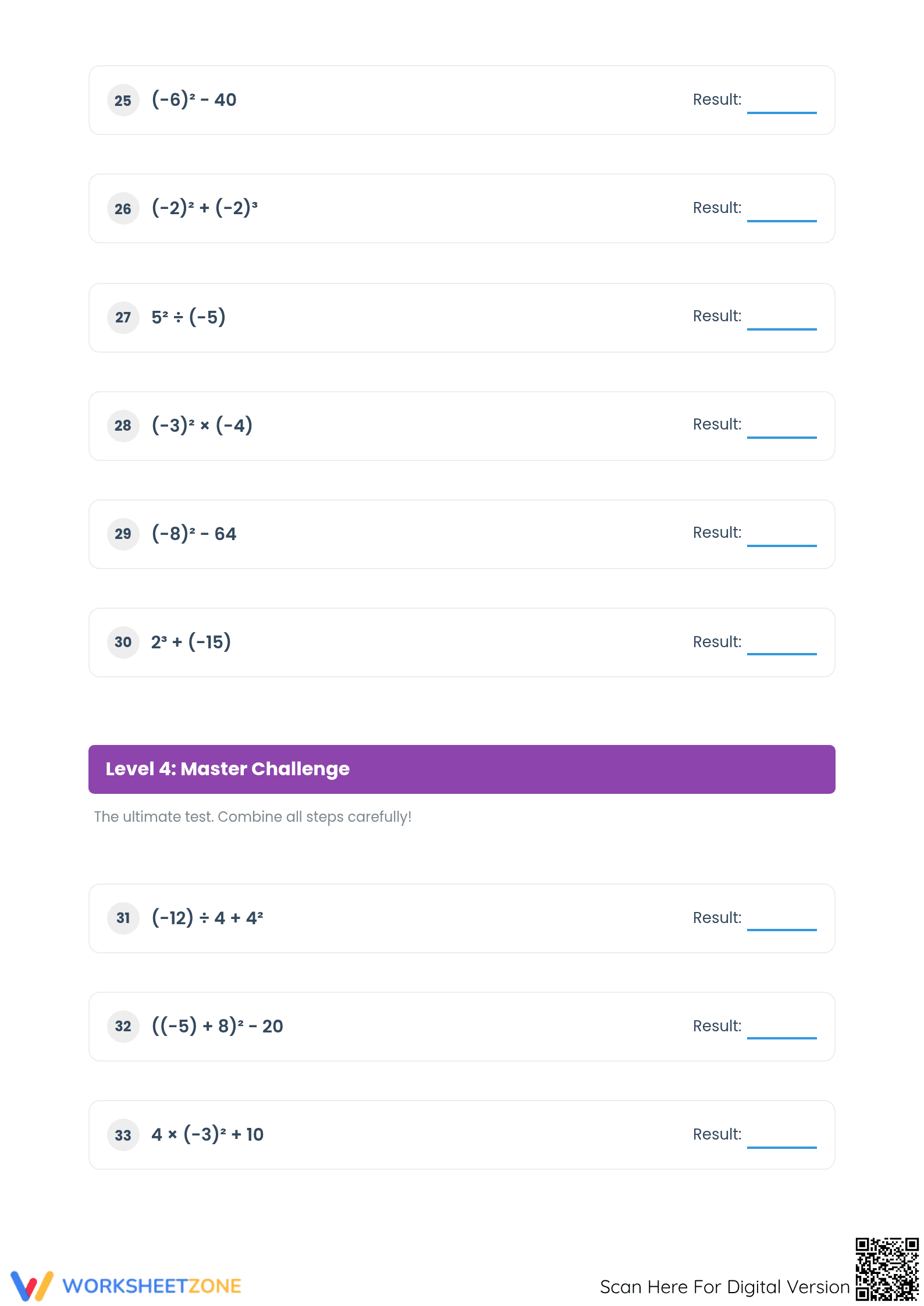

Essential Order of Operations with Integers | Grade 6-8
Paste this activity's link or code into your existing LMS (Google Classroom, Canvas, Teams, Schoology, Moodle, etc.).
Students can open and work on the activity right away, with no student login required.
You'll still be able to track student progress and results from your teacher account.
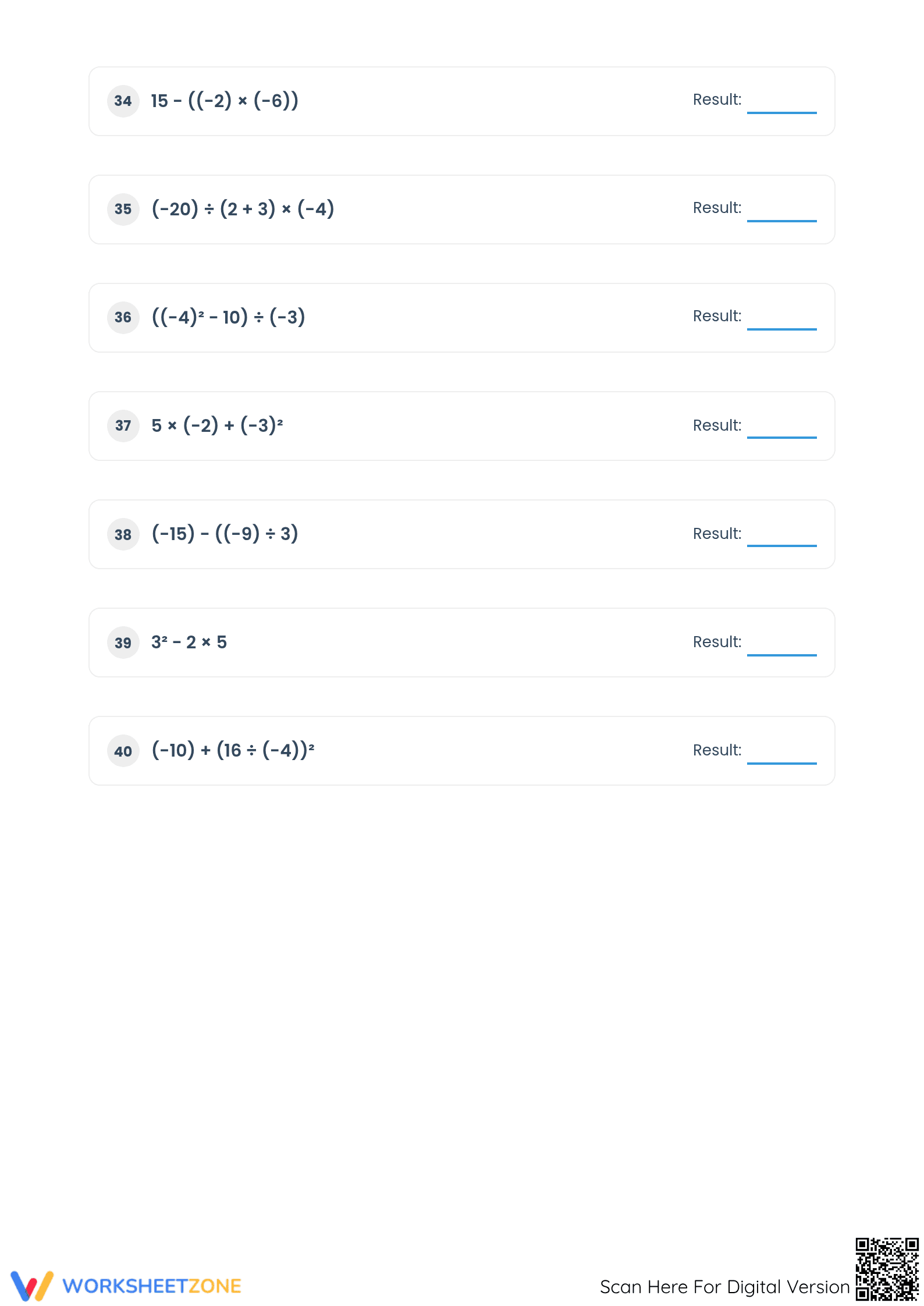
This comprehensive worksheet provides students with extensive practice in evaluating numerical expressions using the correct order of operations. By working through problems involving negative integers, parentheses, and exponents, learners develop the procedural fluency needed for algebraic success. This resource ensures students master PEMDAS through a structured and challenging mathematical progression.
At a Glance
- Grade: 6-8 · Subject: Math
- Standard:
CCSS.MATH.CONTENT.6.EE.A.1— Write and evaluate numerical expressions involving whole-number exponents- Skill Focus: Advanced Order of Operations (PEMDAS) with Integers
- Format: 5 pages · 40 problems · Answer key included · PDF
- Best For: Independent practice and skill reinforcement
- Time: 45–60 minutes
This high-quality 5-page PDF contains 40 unique problems divided into four distinct levels of difficulty. The layout is clean and organized, providing ample workspace for students to record their results. It features a complete answer key for rapid grading and covers integer addition, subtraction, multiplication, division, parentheses, and squaring integers.
Skill Progression
- Guided Practice: Level 1 introduces three-step integer chains, allowing students to focus on basic operation sequencing without complex grouping symbols.
- Supported Practice: Levels 2 and 3 add parentheses and exponents, requiring more complex decision-making and careful calculation of signs.
- Independent Practice: The Master Challenge level combines all elements, forcing students to apply the full PEMDAS rule across multi-step problems without scaffolds.
This structured progression follows a gradual release approach, building student confidence before presenting the final challenge problems.
Standards Alignment
The primary focus is CCSS.MATH.CONTENT.6.EE.A.1: Write and evaluate numerical expressions involving whole-number exponents. Additionally, it supports CCSS.MATH.CONTENT.7.NS.A.3 by requiring the application of four operations with rational numbers (specifically integers). Both standard codes can be copied directly into lesson plans, IEP goals, or district curriculum mapping tools.
How to Use It
Incorporate this as a summative assessment after teaching integer operations and PEMDAS to verify mastery. Alternatively, use specific levels for differentiated center rotations based on student readiness. During instruction, observe student transitions between Level 2 and Level 3 to identify misconceptions regarding exponent placement and negative bases. Expected completion time ranges from 45 to 60 minutes.
Who It's For
This resource is designed for middle school students in Grades 6 through 8 who are moving beyond basic arithmetic into pre-algebra. It is highly effective for general education classrooms, small group intervention, or as a supplemental resource alongside a textbook chapter on rational numbers or algebraic expressions.
Effective mathematics instruction requires a balance of conceptual understanding and procedural fluency. This worksheet aligns with the recommendations of the RAND AIRS 2024 report, which emphasizes the necessity of high-dosage practice in foundational algebraic skills like the order of operations. By isolating integer operations within the PEMDAS framework (CCSS.MATH.CONTENT.6.EE.A.1), the resource helps students bridge the gap between elementary arithmetic and secondary algebraic reasoning. Research from NAEP indicates that students who master numerical expressions earlier show significantly higher proficiency in solving multi-step equations in later grades. This 40-problem set provides the repetitive, structured exposure required to move these skills from short-term memory to long-term procedural mastery. Educators can use these tasks to identify specific bottlenecks in student logic, such as the common error of distributing exponents over negative bases incorrectly.


