


























Views
Downloads
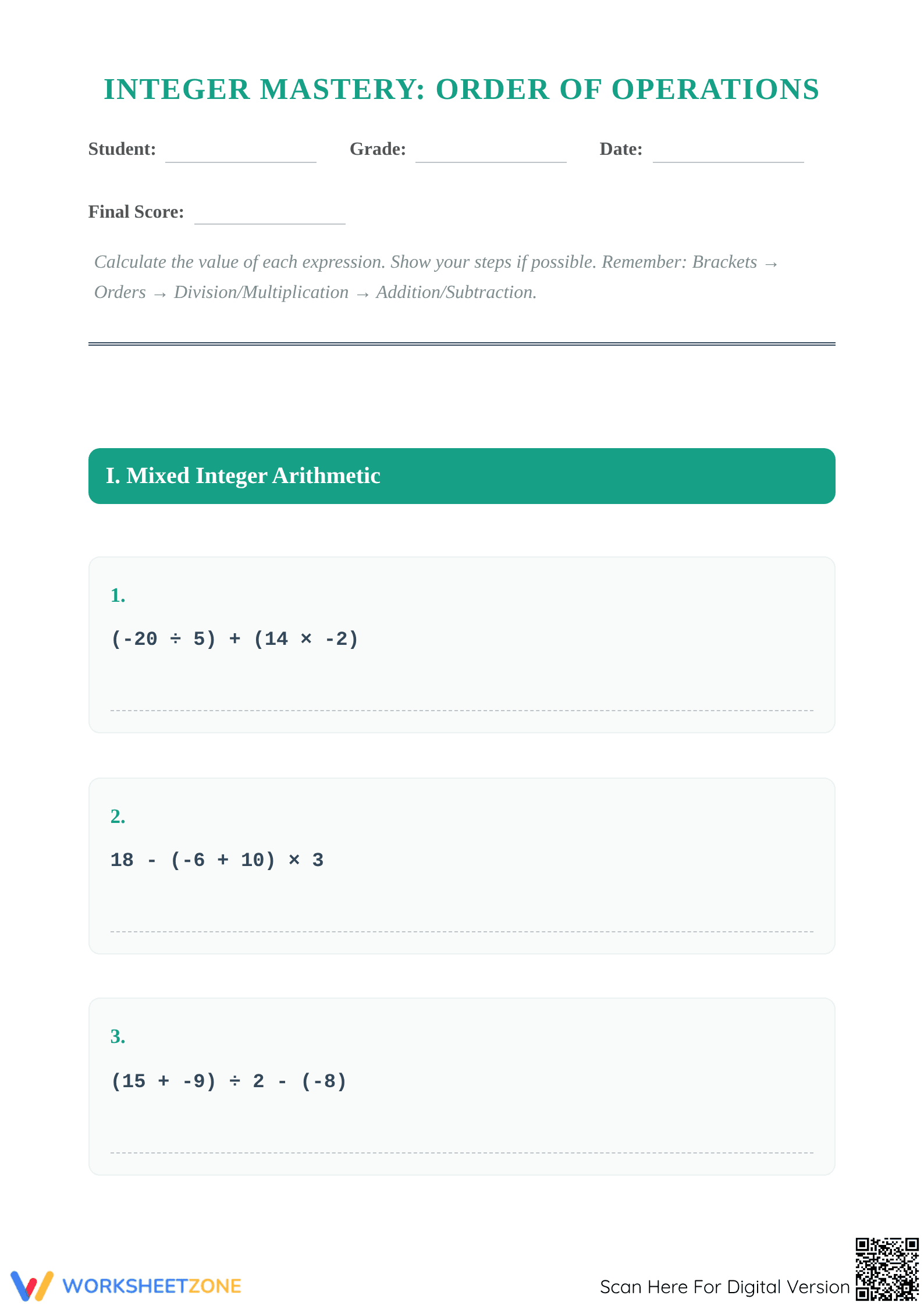
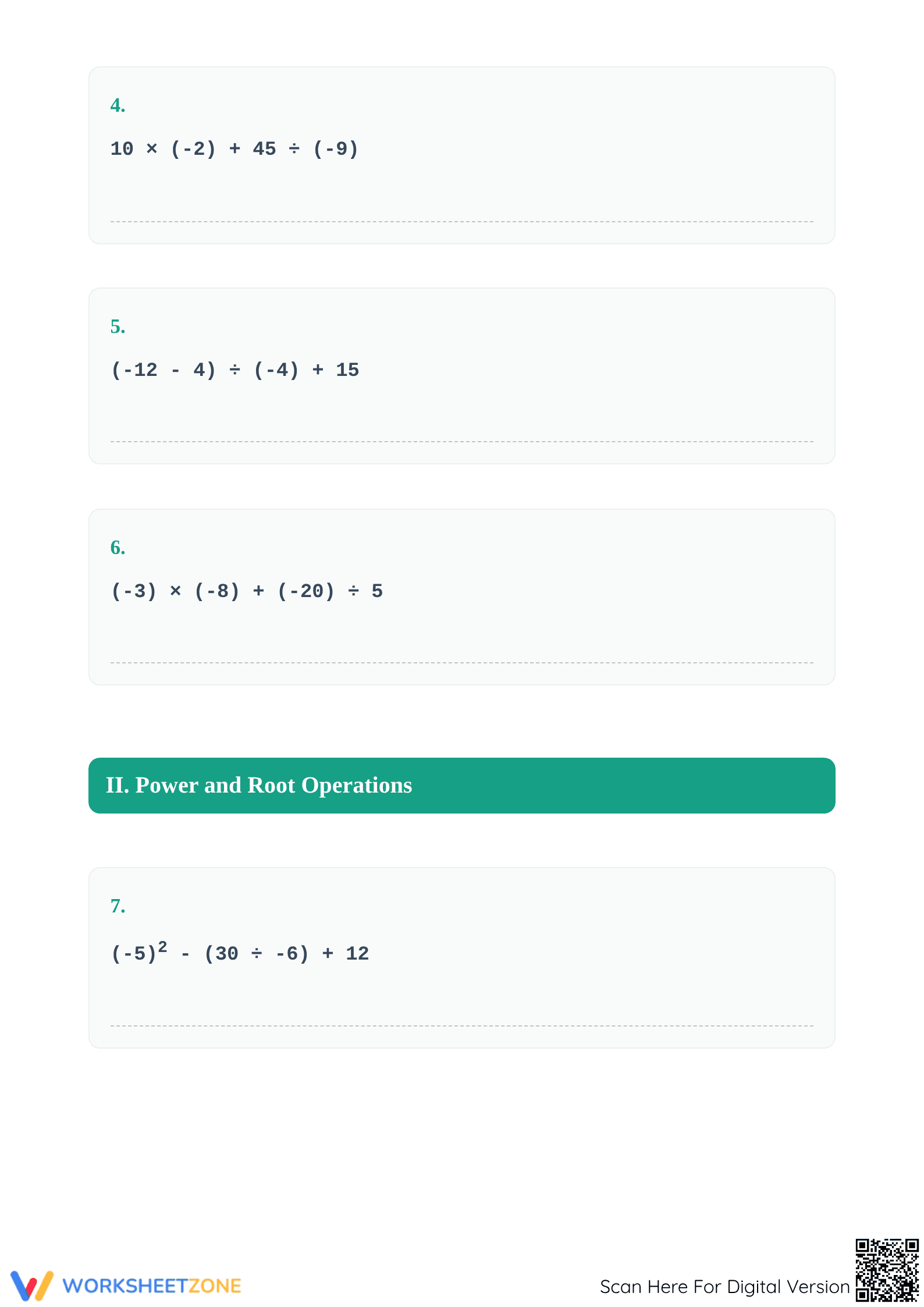
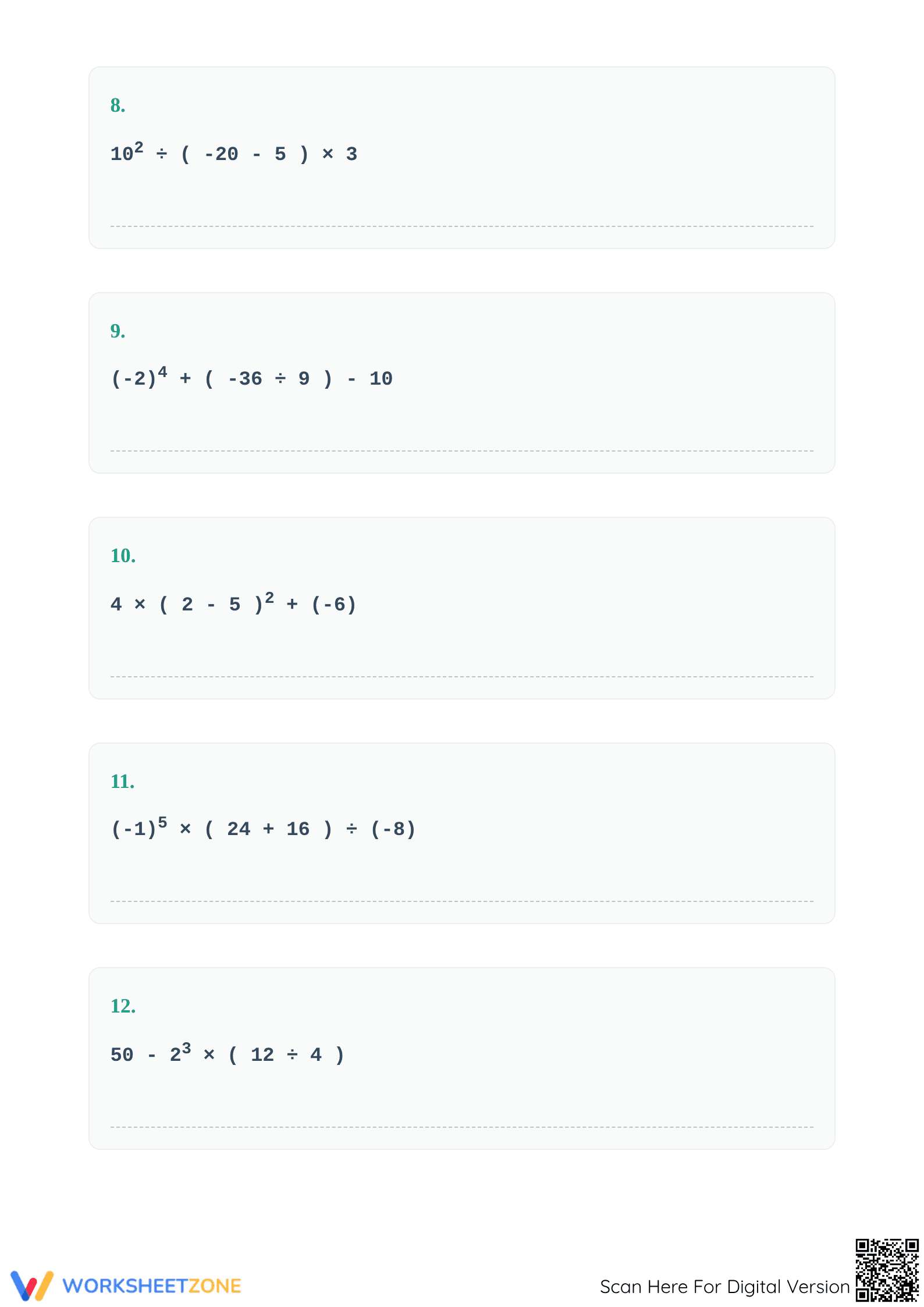
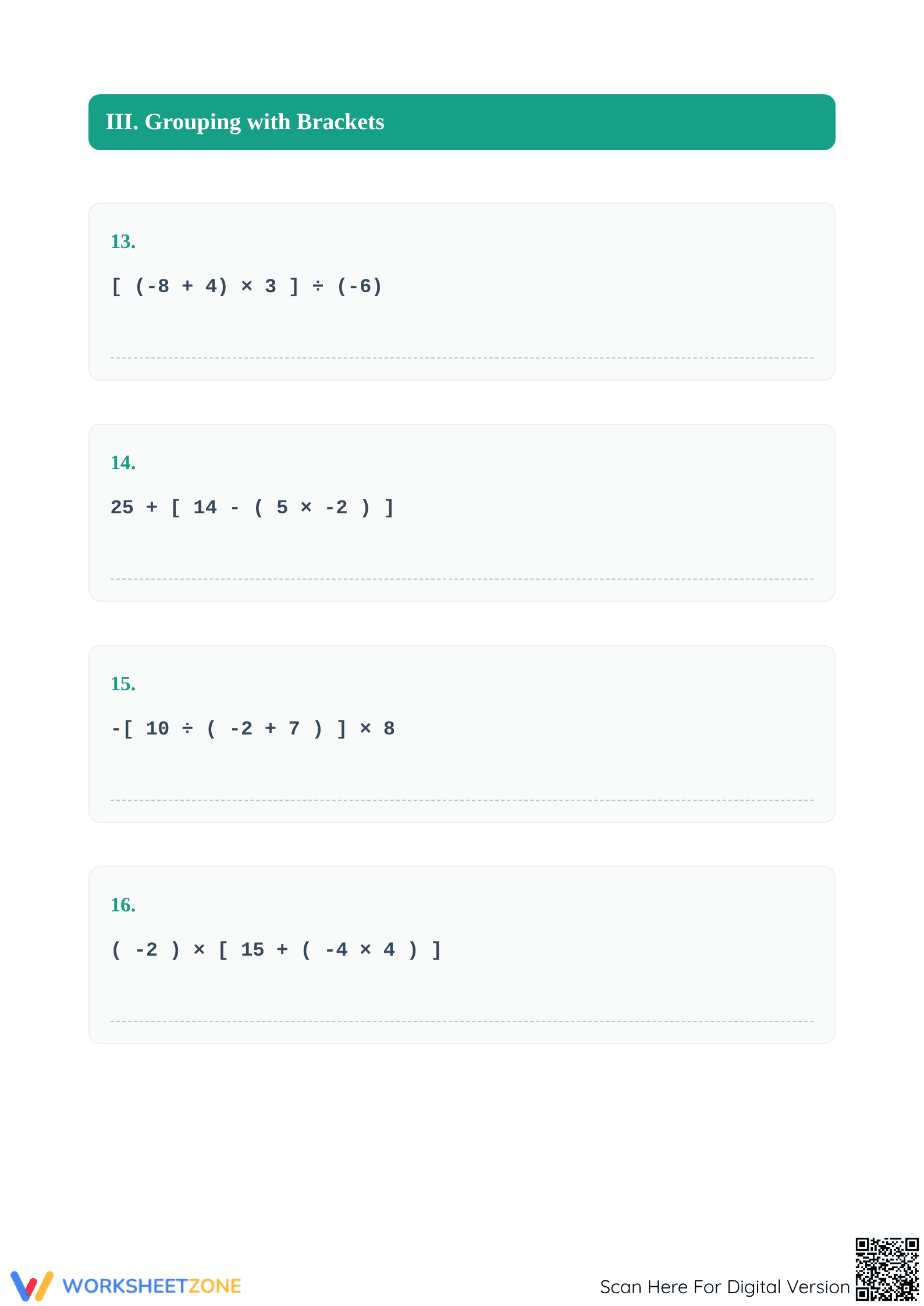

Printable Integer Order of Operations Worksheet | Grades 6-8
Paste this activity's link or code into your existing LMS (Google Classroom, Canvas, Teams, Schoology, Moodle, etc.).
Students can open and work on the activity right away, with no student login required.
You'll still be able to track student progress and results from your teacher account.
Master the complexities of multi-step arithmetic with this comprehensive integer order of operations worksheet. Designed for middle school students, this resource provides targeted practice in evaluating expressions that combine positive and negative numbers with exponents and nested grouping symbols. Students will build computational fluency and algebraic readiness through structured problem-solving.
At a Glance
- Grade: 6-8 · Subject: Math
- Standard:
CCSS.MATH.CONTENT.7.NS.A.3— Solve multi-step mathematical problems involving four operations with rational numbers and integers- Skill Focus: Order of Operations (PEMDAS/BODMAS) with Integers
- Format: 5 pages · 20 problems · Answer key included · PDF
- Best For: Individual practice or homework assignments
- Time: 40–50 minutes
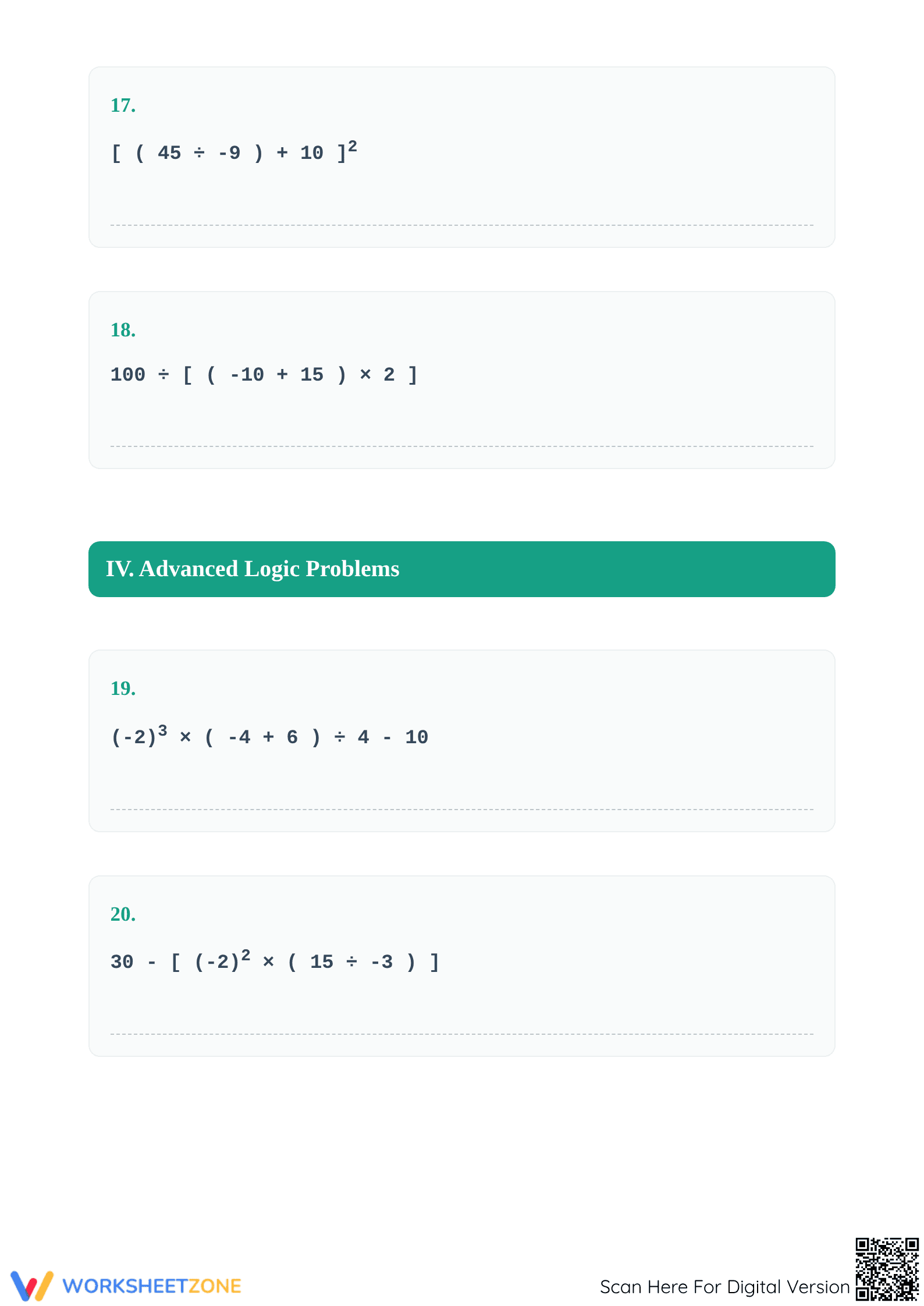
This 5-page PDF features 20 problems divided into four sections: mixed arithmetic, power operations, grouping with nested brackets, and advanced logic. Each section provides ample workspace for students to show their steps, which is essential for identifying errors in multi-stage calculations. A complete answer key allows for immediate feedback and grading efficiency.
Skill Progression
- Guided practice: The first 6 problems focus on standard two- and three-step operations using basic brackets to build confidence with negative number rules.
- Supported practice: Problems 7 through 12 introduce whole-number exponents and root logic, requiring students to integrate power operations into their PEMDAS workflow.
- Independent practice: The final 8 problems challenge students with nested square brackets and multi-layered expressions that demand absolute precision.
This resource follows a gradual-release model, moving from basic operational fluency to complex logical evaluation using the I Do, We Do, You Do instructional framework.
Standards Alignment
The primary focus of this worksheet is CCSS.MATH.CONTENT.7.NS.A.3, which requires students to solve real-world and mathematical problems involving the four operations with rational numbers. By including exponents and grouping, it also supports CCSS.MATH.CONTENT.6.EE.A.1. This alignment ensures the material meets rigorous middle school standards. Both standard codes can be copied directly into lesson plans, IEP goals, or district curriculum mapping tools.
How to Use It
Use this worksheet as a summative assessment following a unit on integer operations or as a rigorous homework assignment to reinforce class lessons. During instruction, teachers can use the advanced logic section as a collaborative "problem of the day" to model thinking processes. We recommend allowing 45 minutes for completion, noting students who struggle specifically with the sign changes in nested brackets.
Who It's For
This resource is ideal for Grade 6, 7, and 8 students who have mastered basic integer addition and subtraction and are ready to tackle complex expressions. It serves as an excellent bridge to Pre-Algebra and Algebra 1. Pair this worksheet with a visual anchor chart for PEMDAS or a guided lesson on integer multiplication rules for maximum instructional impact.
According to the NAEP framework, the ability to evaluate numerical expressions involving integers and exponents is a critical predictor of success in secondary algebra. This worksheet aligns with research-based instructional strategies highlighted in the RAND AIRS 2024 report, which emphasizes the importance of procedural fluency in middle school mathematics. By providing 20 structured problems that progress from simple to complex, the resource supports the development of cognitive flexibility required for algebraic reasoning. Fisher & Frey (2014) note that gradual release of responsibility—moving from guided arithmetic to independent logical evaluation—is most effective for mastering multi-step operations. Each problem in this 5-page PDF is designed to isolate specific operational hurdles, such as sign changes within nested grouping symbols or the impact of even and odd exponents on negative bases. This systematic approach ensures that the CCSS.MATH.CONTENT.7.NS.A.3 standard is addressed with sufficient depth and rigor for classroom implementation.


