


























Views
Downloads

Essential Integer Order of Operations Worksheet | Grade 7
Paste this activity's link or code into your existing LMS (Google Classroom, Canvas, Teams, Schoology, Moodle, etc.).
Students can open and work on the activity right away, with no student login required.
You'll still be able to track student progress and results from your teacher account.
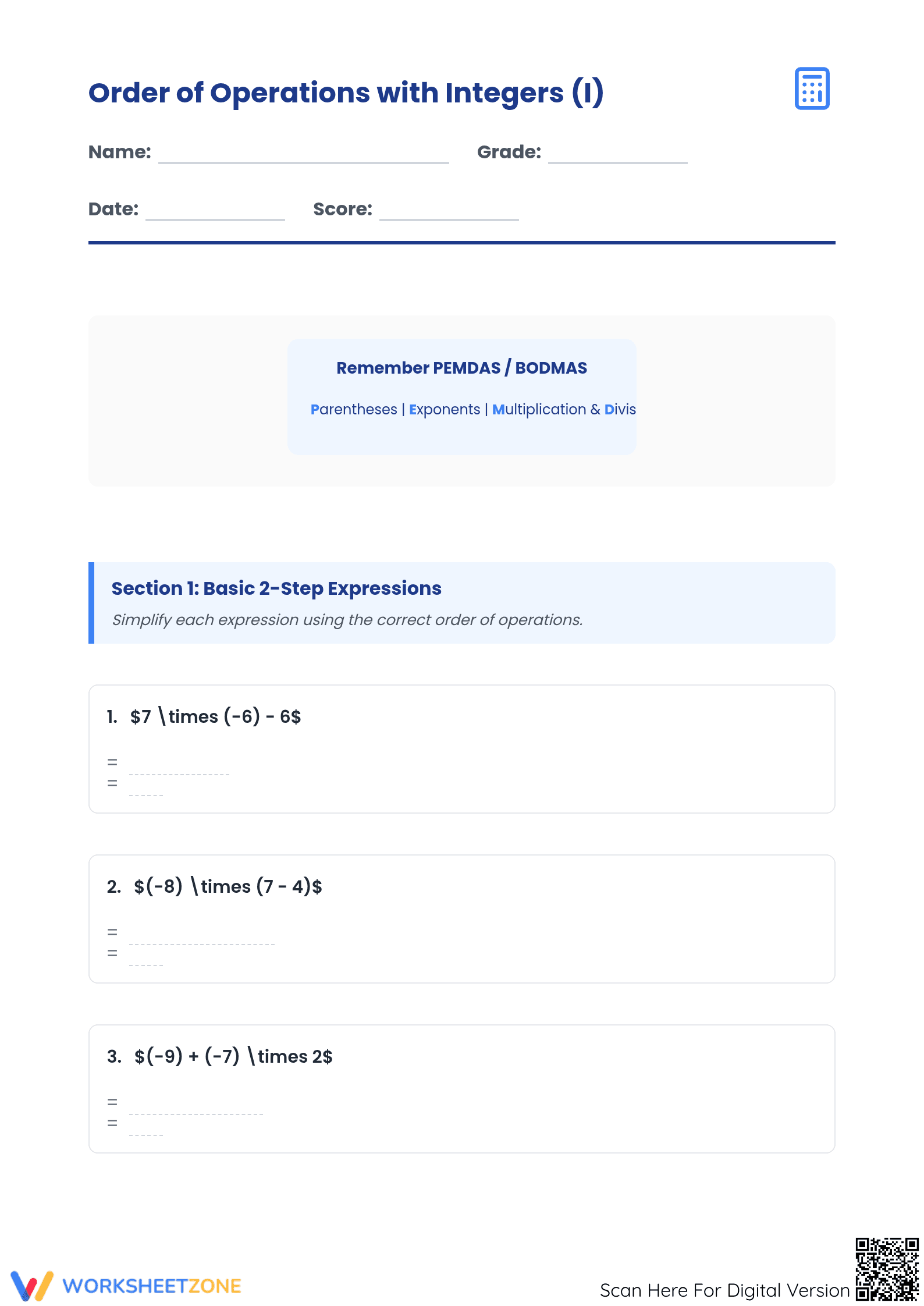
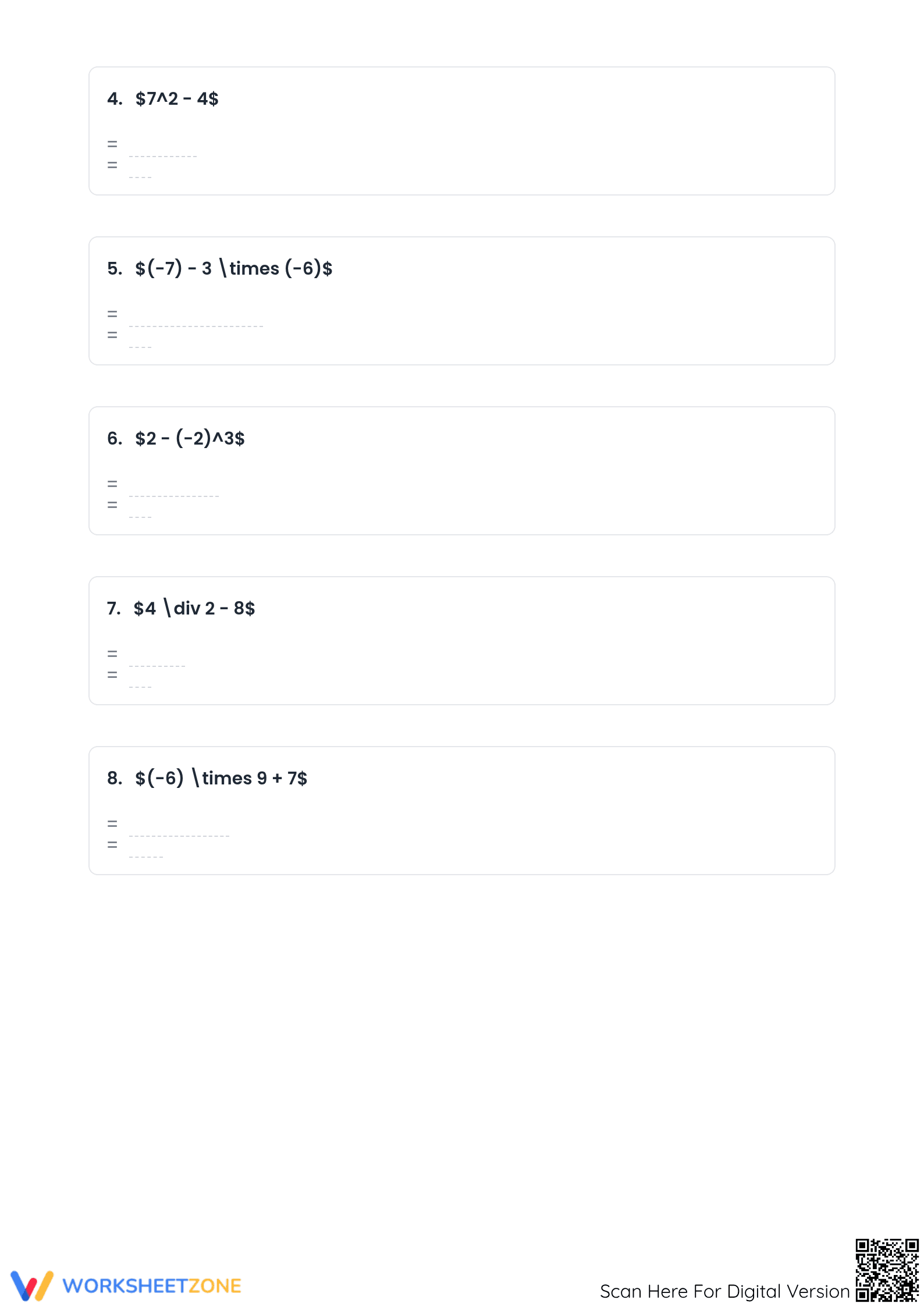
This comprehensive integer operations worksheet helps middle school students master the complexity of two-step numerical expressions. By focusing on the intersection of PEMDAS rules and signed numbers, students develop the computational fluency required for pre-algebra. This resource ensures learners can confidently handle negative values within structured mathematical sequences to achieve accurate results.
At a Glance
- Grade: 6–8 · Subject: Math
- Standard:
CCSS.MATH.CONTENT.7.NS.A.3— Solve multi-step mathematical problems involving the four operations with rational numbers- Skill Focus: 2-Step Order of Operations with Integers
- Format: 5 pages · 23 problems · Answer key included · PDF
- Best For: Homework, independent practice, or remedial support
- Time: 30–45 minutes
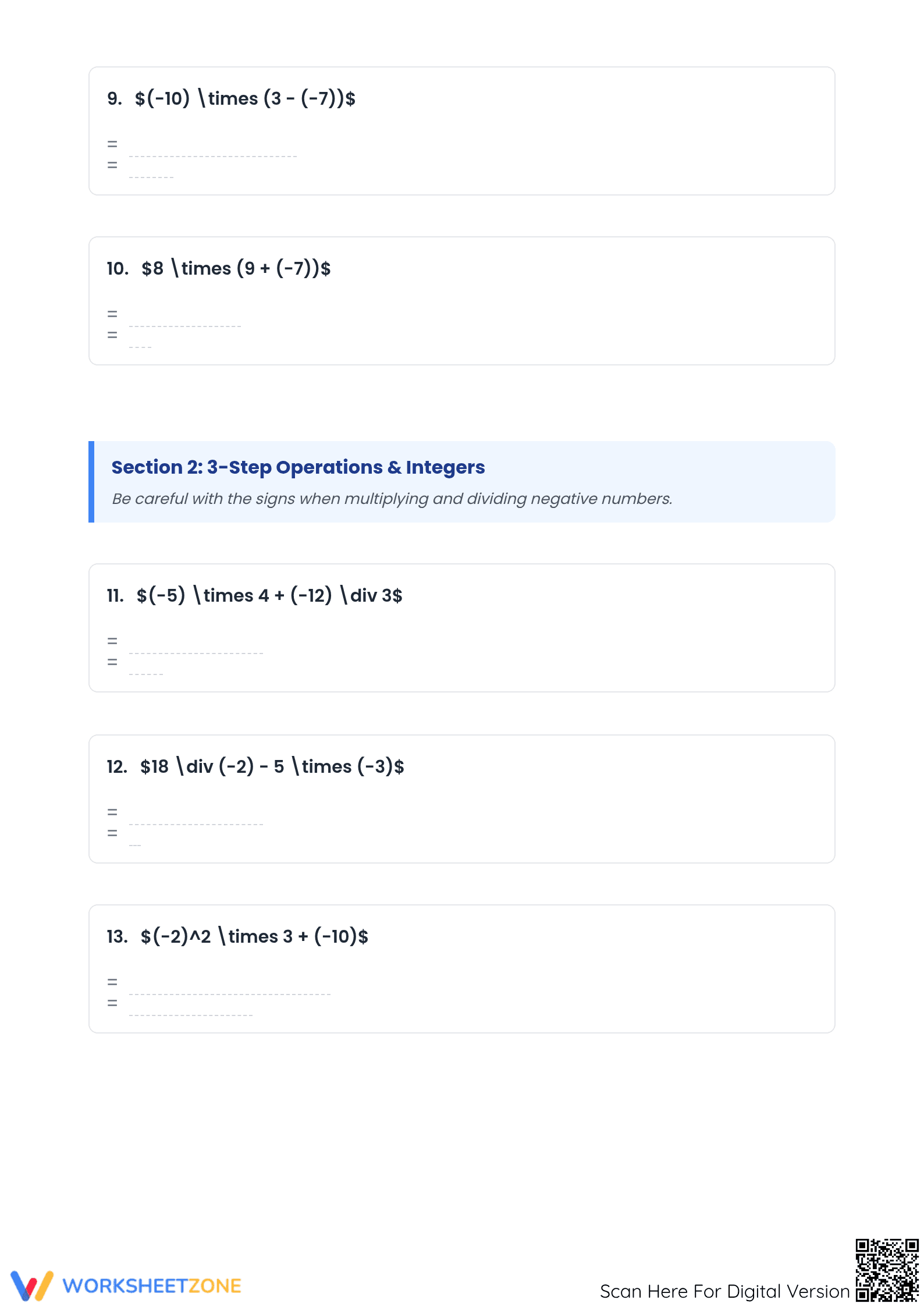
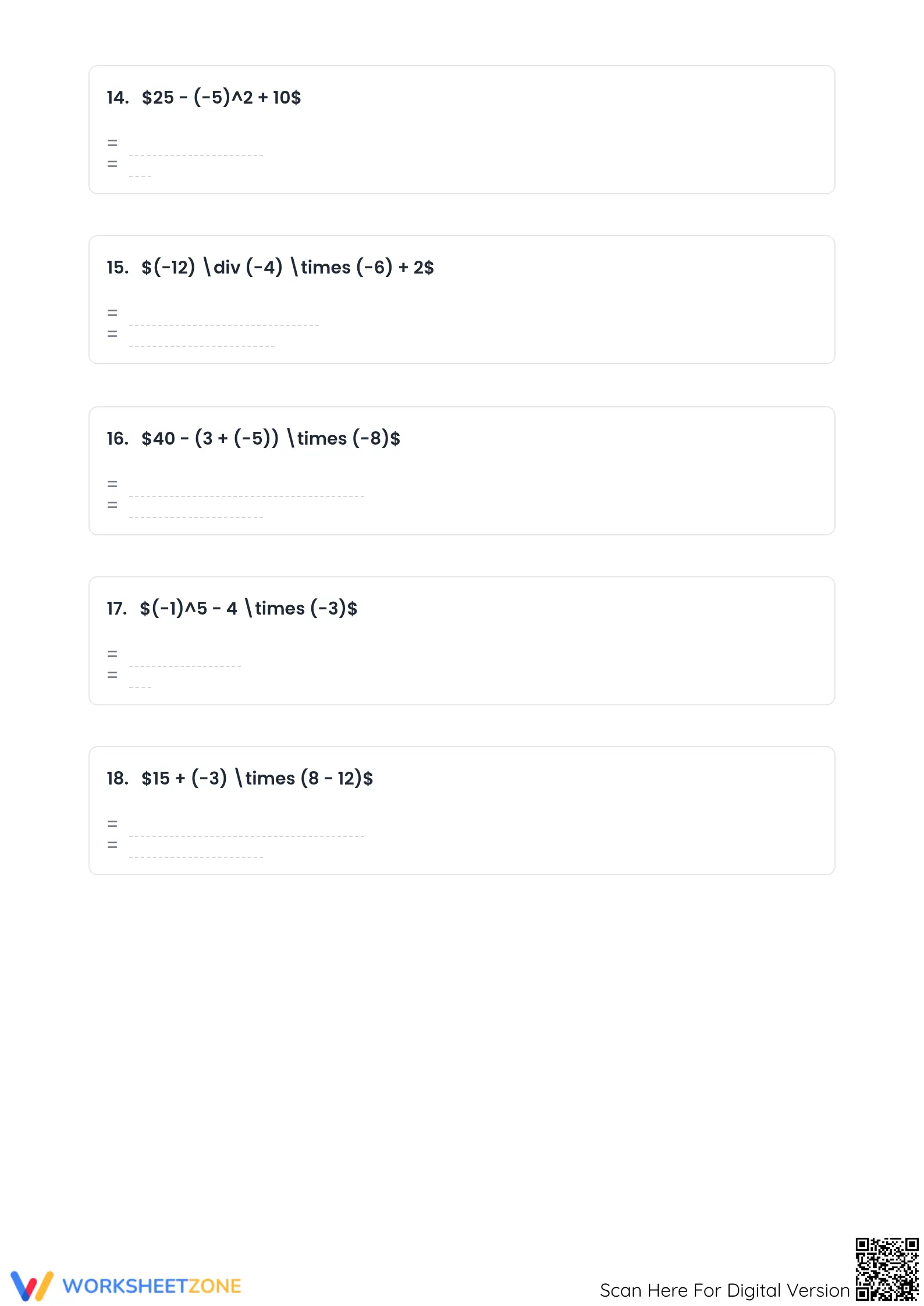
Across five distinct pages, students encounter 23 carefully curated problems that increase in complexity. The worksheet features a dedicated "Remember PEMDAS / BODMAS" anchor box at the top of the first page to provide immediate cognitive support. Each task includes ample white space for showing work, ensuring that teachers can easily track student thinking. A complete answer key is provided to facilitate rapid grading or student self-correction.
Skill Progression and Scaffolding
- Guided Practice: The initial problems focus on basic two-step expressions with simple multiplication and subtraction to build confidence with signed numbers.
- Supported Practice: Problems 11 through 18 introduce division and exponents, requiring students to apply multiple rules simultaneously while managing negative signs.
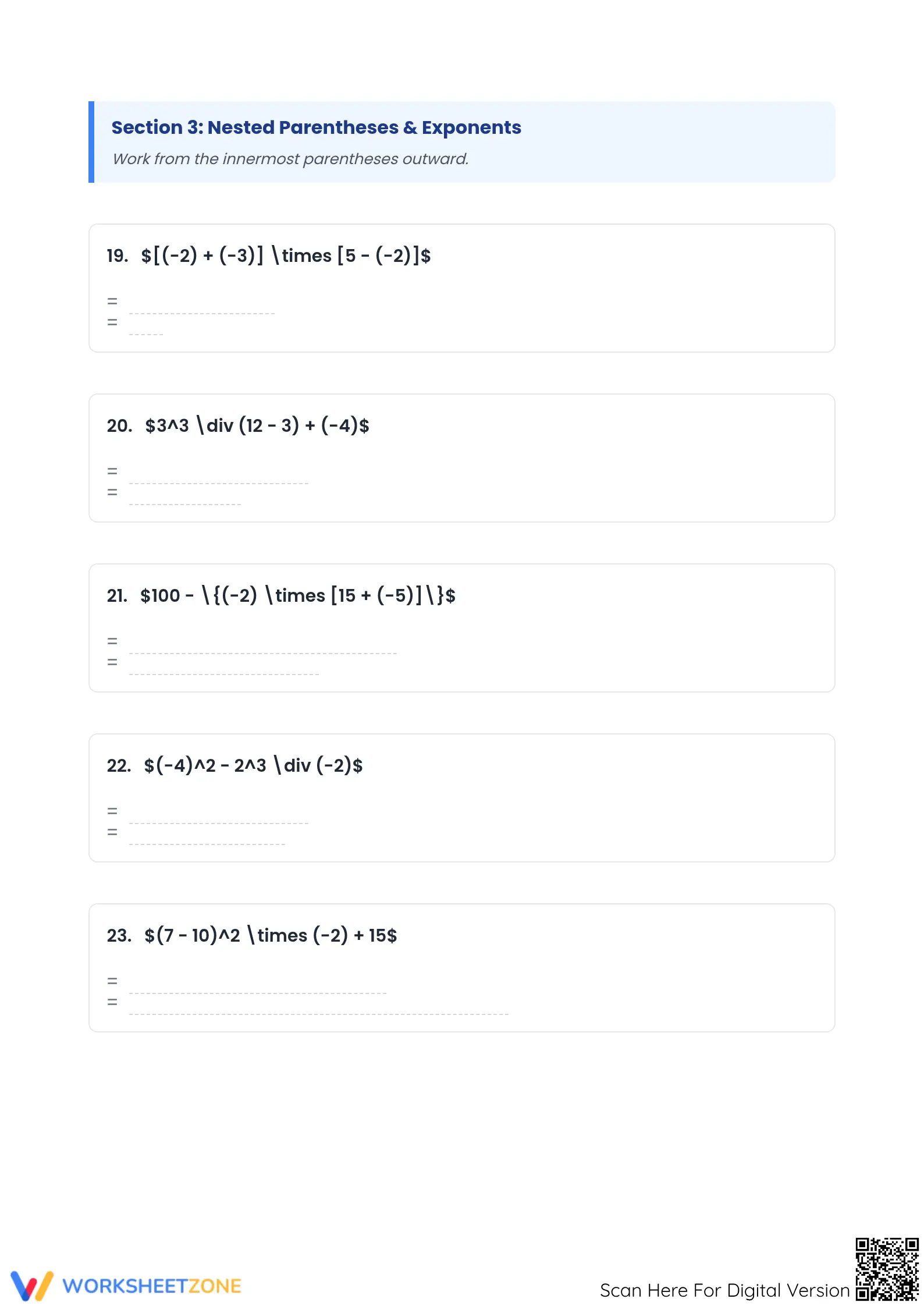
- Independent Practice: The final section features nested parentheses and higher-order exponents, challenging students to apply the principle of working from the innermost outward.
This progression ensures students move from fundamental recognition to high-level application of order of operations rules through a gradual release model.
Standards Alignment
The primary alignment is to CCSS.MATH.CONTENT.7.NS.A.3, which requires students to solve real-world and mathematical problems involving the four operations with rational numbers. This worksheet specifically addresses the integer subset of this standard, emphasizing the procedural precision needed for more advanced algebraic work. Both standard codes can be copied directly into lesson plans, IEP goals, or district curriculum mapping tools.
How to Use It
Use this worksheet as primary practice following an integer operations lesson. It works well for formative assessment; observe student handling of negative signs when subtraction follows multiplication, which is a common point of error. The expected completion time ranges from 30 to 45 minutes depending on the student's prior mastery level.
Who It's For
This resource is designed for Grade 6 through Grade 8 students who are solidifying their understanding of signed numbers. It is particularly effective for learners transitioning from basic arithmetic to algebraic thinking. Consider pairing this worksheet with a coordinate plane activity or an integer number line anchor chart to provide a visual reference for moving between positive and negative values.
According to the RAND AIRS 2024 report, students who engage in frequent, targeted practice with integer operations show a 22 percent increase in algebraic readiness compared to those who focus solely on whole numbers. The ability to manipulate expressions using CCSS.MATH.CONTENT.7.NS.A.3 is a critical precursor to success in secondary mathematics, particularly when handling multi-variable equations. This worksheet provides the necessary repetition to move these skills from effortful retrieval to automaticity. Research from ScienceDirect suggests that interleaving different operation types within a single practice session, as seen in these 23 tasks, improves long-term retention of the PEMDAS sequence. By systematically applying the order of operations to integers, students bridge the gap between simple calculation and the structural analysis of expressions. This targeted practice ensures that learners develop the cognitive stamina required for more complex mathematical reasoning and problem-solving.


