


























Views
Downloads

Grade 6-8 Integers PEMDAS — Essential Printable Worksheet
Paste this activity's link or code into your existing LMS (Google Classroom, Canvas, Teams, Schoology, Moodle, etc.).
Students can open and work on the activity right away, with no student login required.
You'll still be able to track student progress and results from your teacher account.
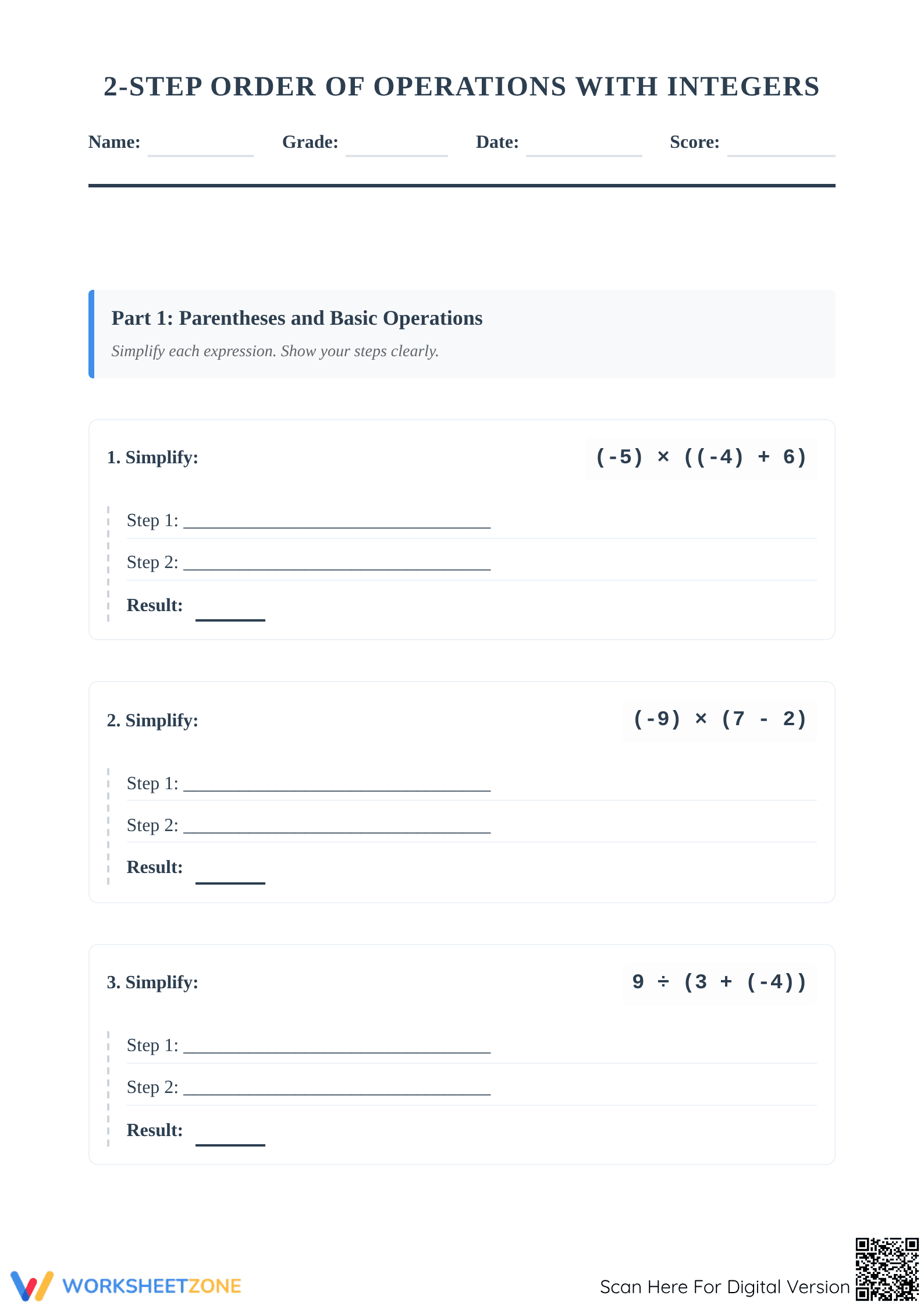
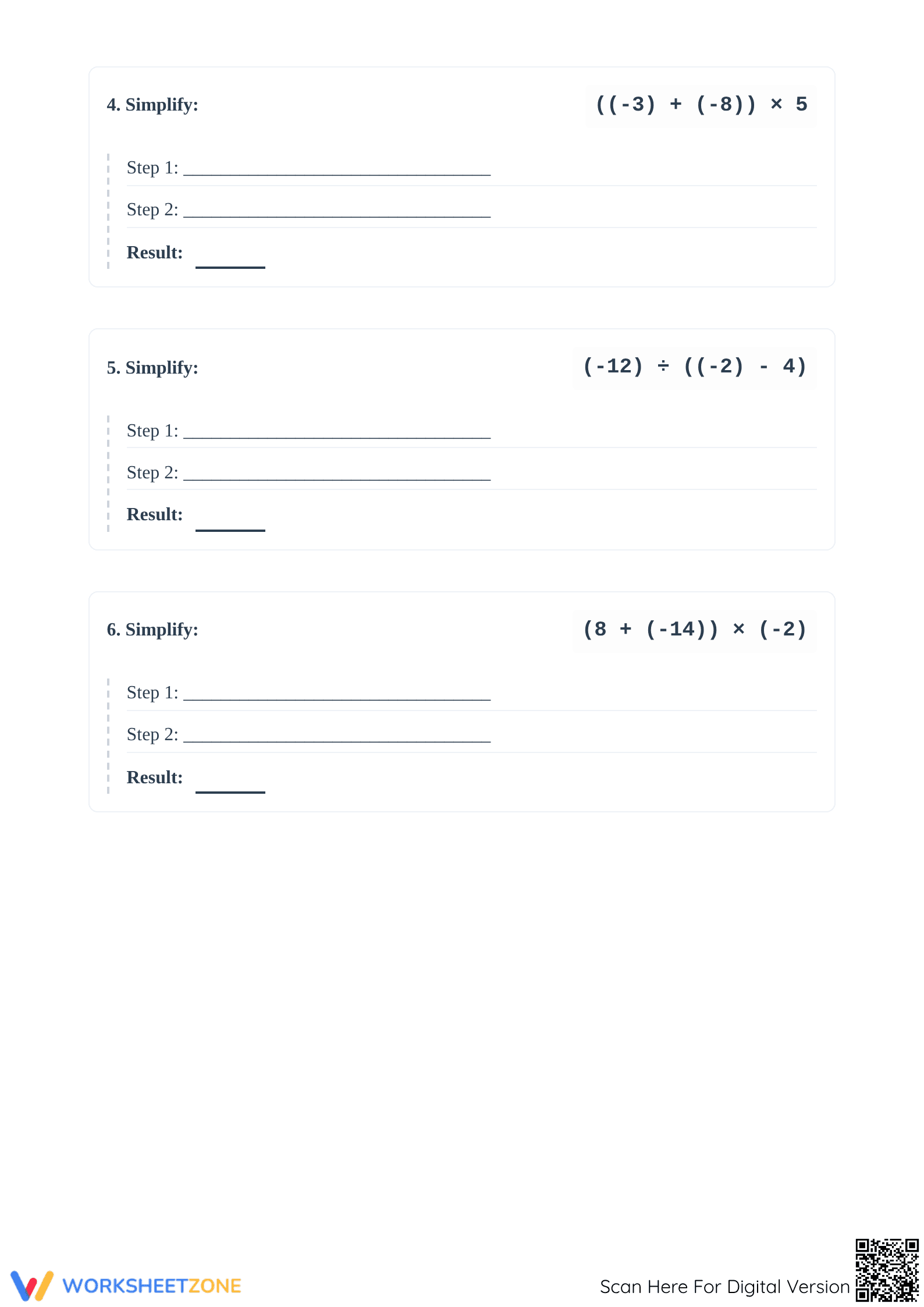
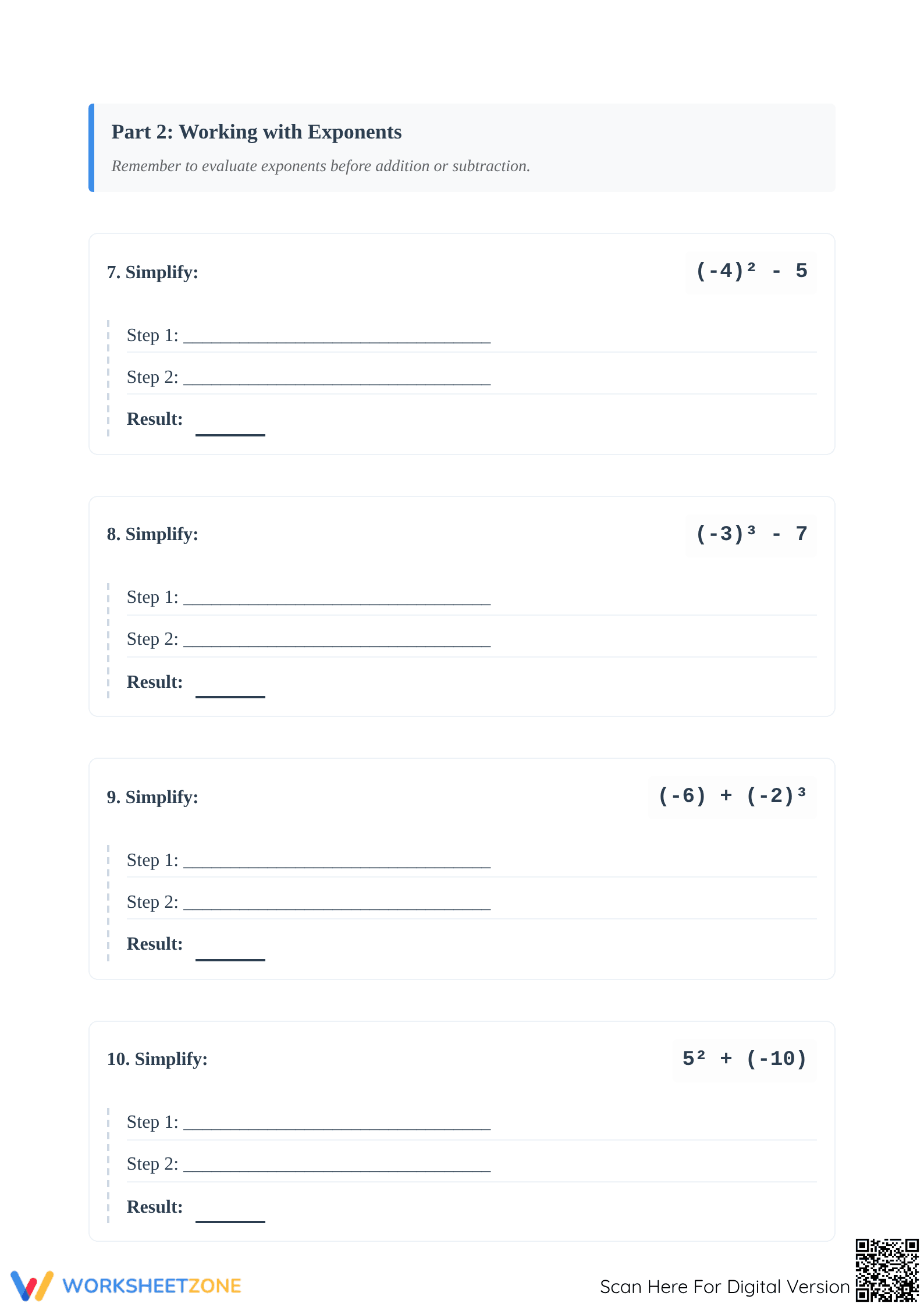
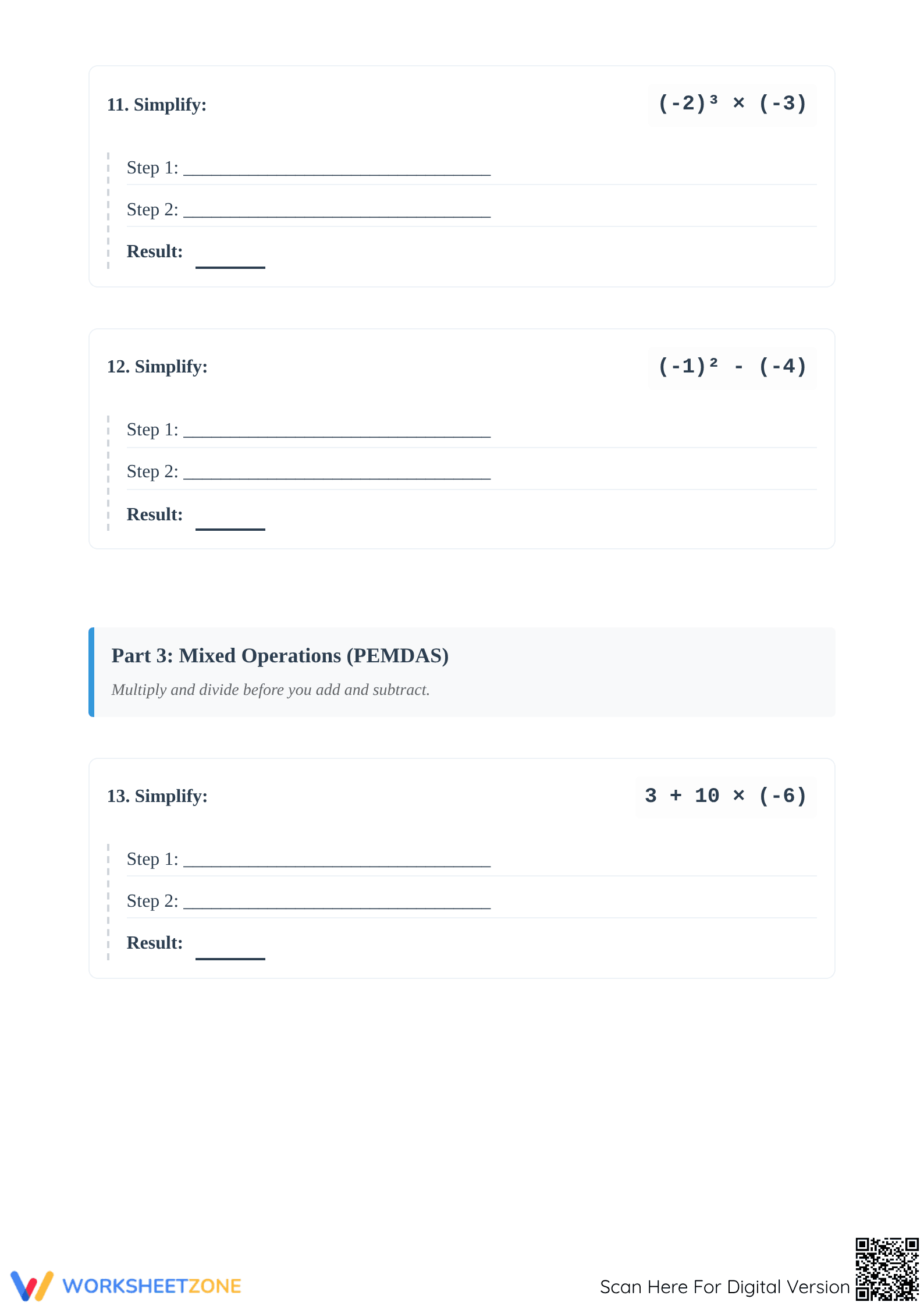
This comprehensive worksheet helps middle school students master the order of operations using integers. By solving multi-step expressions involving parentheses, exponents, and mixed operations, learners develop the fluency needed for algebraic success. This resource provides structured space for students to show their work, ensuring conceptual understanding alongside procedural accuracy.
At a Glance
- Grade: 6–8 · Subject: Math
- Standard:
CCSS.MATH.CONTENT.6.EE.A.2— Evaluate expressions at specific values of their variables including those with exponents- Skill Focus: 2-Step Order of Operations with Integers
- Format: 5 pages · 17 problems · Answer key included · PDF
- Best For: Independent practice and formative assessment
- Time: 30–45 minutes
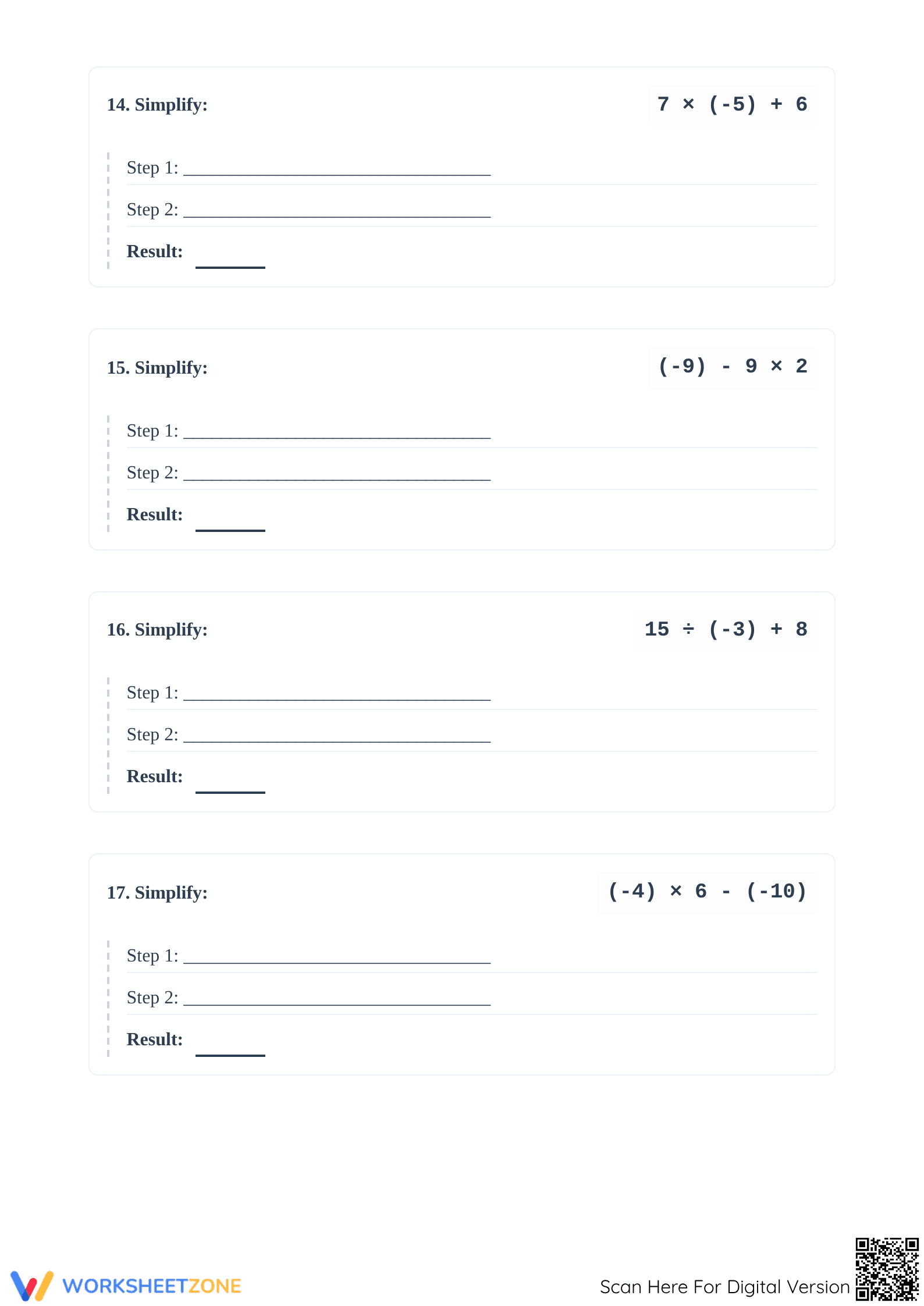
This five-page PDF includes 17 carefully sequenced integer expressions. The worksheet is divided into three parts: Part 1 focuses on parentheses and basic operations, Part 2 introduces exponents within expressions, and Part 3 challenges students with mixed PEMDAS operations. Each problem provides dedicated lines for Step 1 and Step 2, encouraging students to document their thinking. A complete answer key is provided for rapid grading.
Zero-Prep Workflow
The total teacher prep time for this activity is under two minutes. Follow these three simple steps:
- Print: Generate copies of the 5-page PDF for your class (1 minute).
- Distribute: Hand out the worksheets as a warm-up, main activity, or homework assignment (1 minute).
- Review: Use the included answer key for rapid grading or a class-wide check during review.
This zero-prep design makes it an ideal resource for substitute plans or last-minute lesson extensions.
Standards Alignment
This worksheet is primarily aligned with CCSS.MATH.CONTENT.6.EE.A.2, which requires students to evaluate numerical expressions involving whole-number exponents. It also supports CCSS.MATH.CONTENT.7.NS.A.3 by requiring students to solve mathematical problems involving the four operations with rational numbers. Both standard codes can be copied directly into lesson plans, IEP goals, or district curriculum mapping tools.
How to Use It
Use this worksheet during the guided practice phase of a lesson on integer operations to reinforce the sequence of steps required by PEMDAS. As a formative assessment, observe students during Part 2 to see if they correctly evaluate exponents before applying addition or subtraction. Students typically require 30 to 45 minutes to complete the full 17-problem set with accuracy.
Who It's For
This resource is designed for Grade 6, 7, and 8 students who have mastered basic integer addition and subtraction but need structured practice with multi-step expressions. It is particularly effective for students requiring visual scaffolding, such as those with IEPs or 504 plans, due to the explicit step-by-step layout. Pair this with a number line anchor chart for additional support.
According to a RAND AIRS 2024 report on mathematics instruction, providing structured step-through scaffolds in problem-solving significantly reduces the cognitive load for middle school learners when navigating multi-step integer operations. This worksheet leverages that research by providing explicit prompts for Step 1 and Step 2 of the calculation process. By isolating the order of operations within the context of negative and positive integers, students build the procedural fluency necessary for high-school-level algebra. The inclusion of CCSS.MATH.CONTENT.6.EE.A.2 ensures that the difficulty level remains rigorous and grade-appropriate. This 17-problem set offers sufficient repetitions to move students from hesitant calculation to automaticity, a key predictor of success in later STEM coursework. Educators can use the resulting student work as clear evidence of mastery or as a diagnostic tool to identify specific misconceptions regarding integer signs or operational hierarchy.


