


























Views
Downloads

Essential Grade 7 Order of Operations & Integers Worksheet
Paste this activity's link or code into your existing LMS (Google Classroom, Canvas, Teams, Schoology, Moodle, etc.).
Students can open and work on the activity right away, with no student login required.
You'll still be able to track student progress and results from your teacher account.
Master the complexities of numerical expressions with this comprehensive order of operations worksheet. Designed for middle school students, this resource focuses on combining integer arithmetic with exponents and multi-bracket logic. Students will build fluency in solving multi-step problems while adhering to PEMDAS rules to ensure mathematical accuracy in every calculation.
At a Glance
- Grade: 7 · Subject: Math
- Standard:
CCSS.MATH.CONTENT.7.NS.A.3— Solve multi-step mathematical problems involving the four operations with rational numbers- Skill Focus: Order of Operations with Integers
- Format: 5 pages · 25 problems · Answer key included · PDF
- Best For: Independent practice and skill reinforcement
- Time: 45–60 minutes
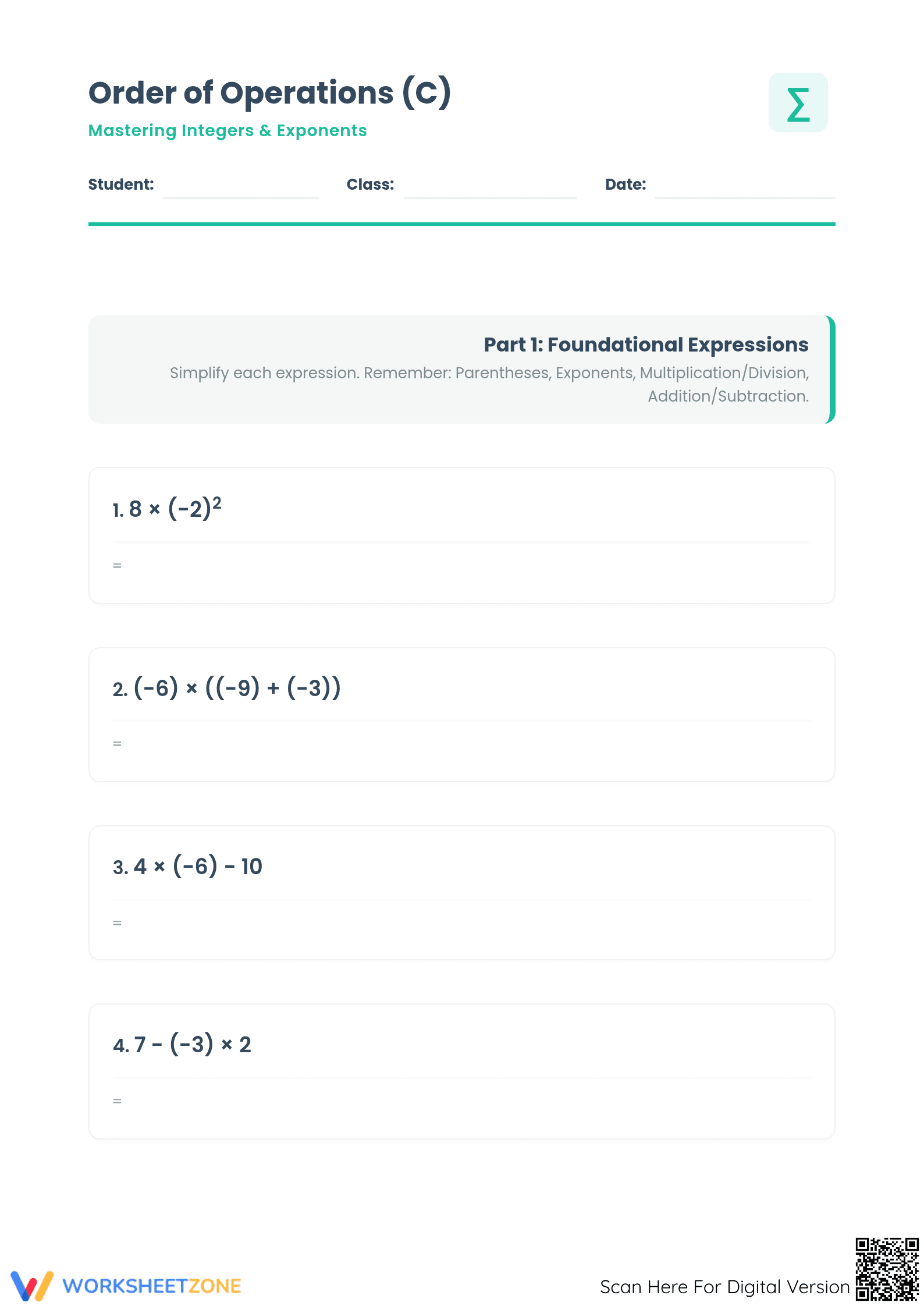
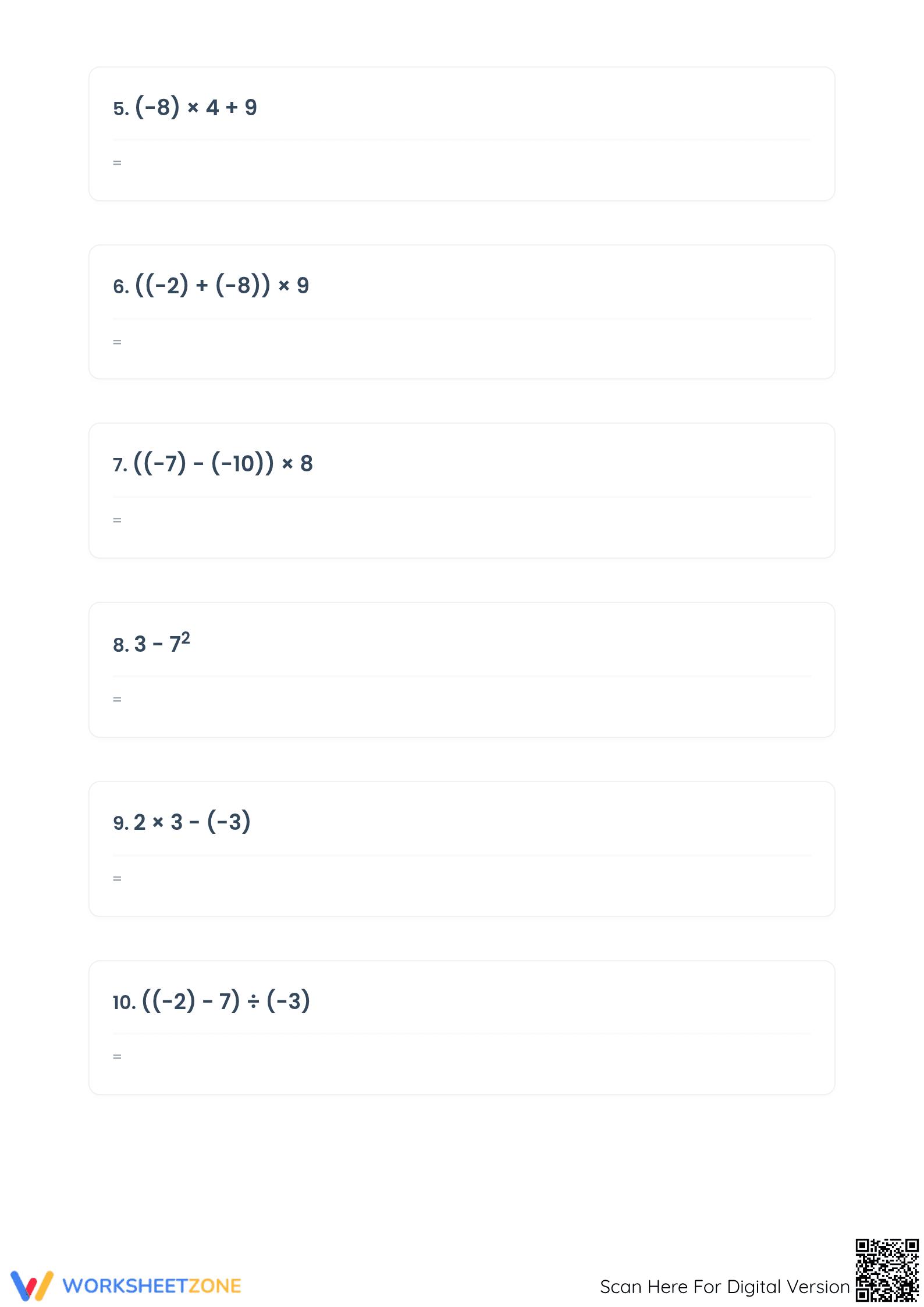
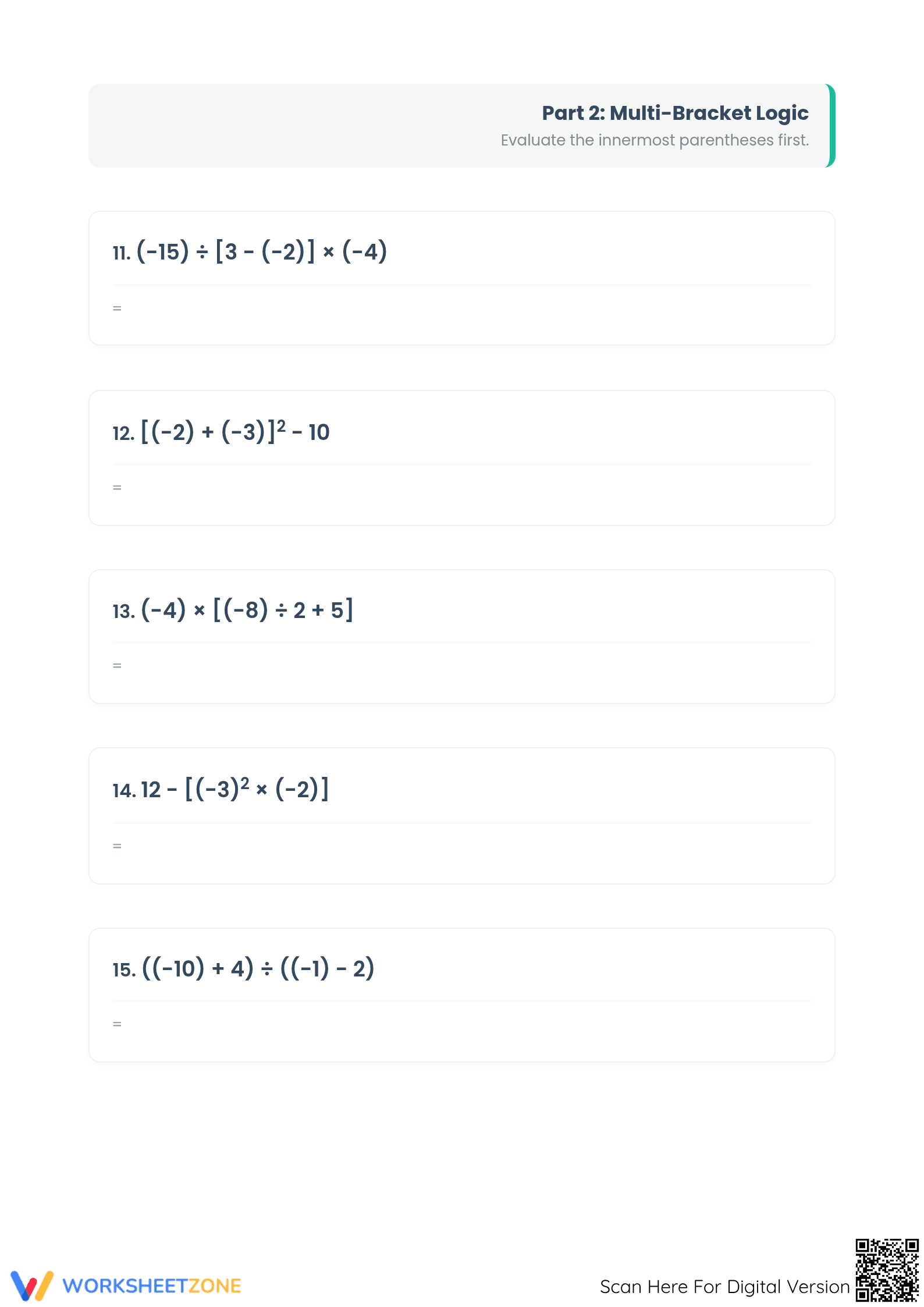
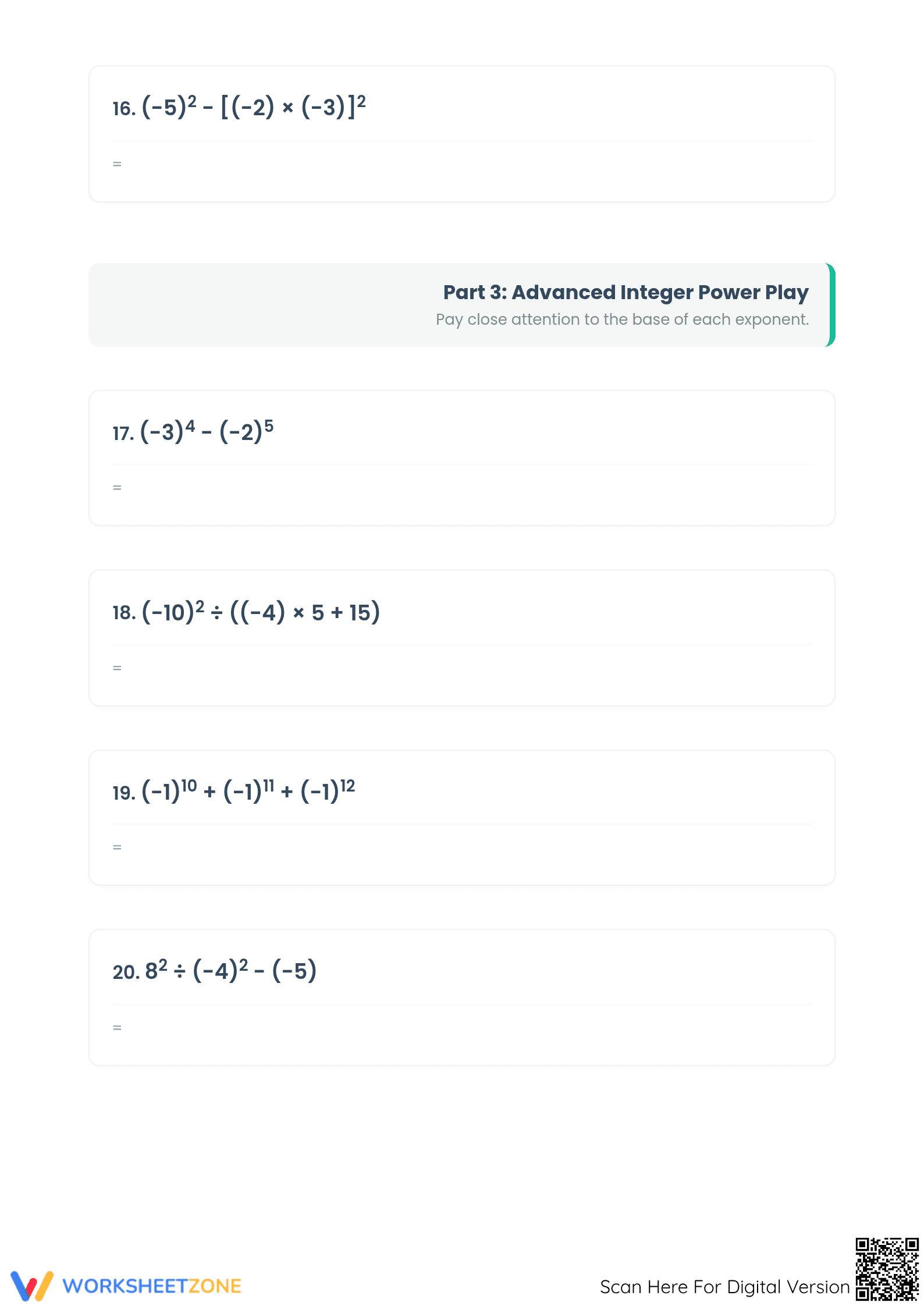
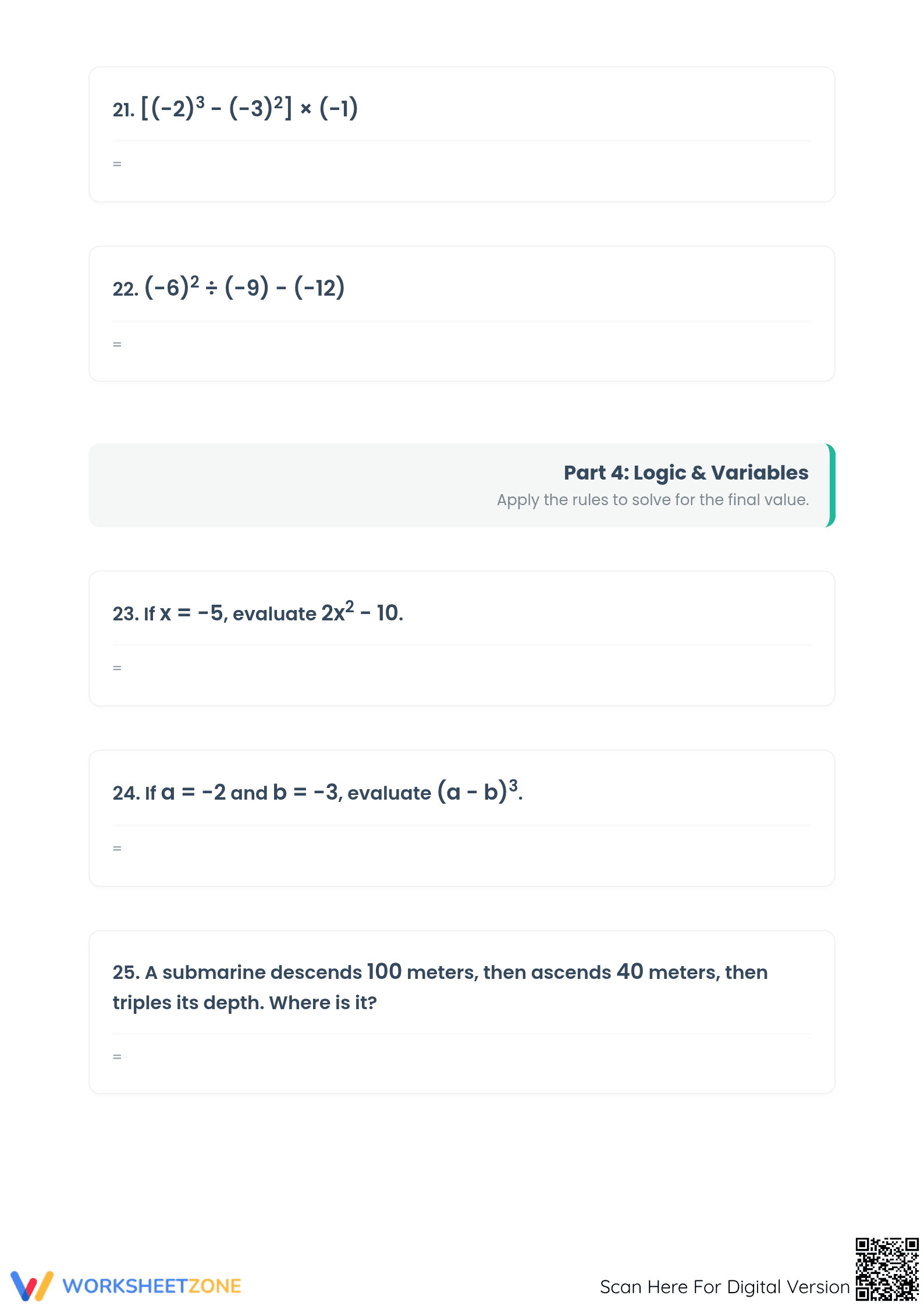
This extensive five-page PDF includes 25 structured problems divided into four thematic parts: Foundational Expressions, Multi-Bracket Logic, Advanced Integer Power Play, and Logic & Variables. The worksheet features clear workspaces for student calculations, a dedicated answer key for immediate feedback, and a final word problem that applies integer operations to a real-world submarine depth scenario.
Skill Progression
- Guided Practice: The first section provides 10 foundational expressions involving basic operations and exponents to establish the core PEMDAS workflow.
- Supported Practice: The middle sections introduce nested brackets and complex power rules, requiring students to carefully evaluate innermost parentheses first.
- Independent Practice: The final section challenges students with variable evaluation and application-based logic to confirm total mastery of the concept.
This structured approach follows the gradual release model, moving from basic computational tasks to higher-order mathematical reasoning.
Standards Alignment
The primary standard addressed is CCSS.MATH.CONTENT.7.NS.A.3, which requires students to solve real-world and mathematical problems involving the four operations with rational numbers. This includes maintaining the correct order of operations when working with negative numbers and exponents. This standard code can be copied directly into lesson plans, IEP goals, or district curriculum mapping tools.
How to Use It
Deploy this worksheet as a summative assessment after a unit on integer operations to verify student understanding of multi-step expressions. Teachers can also use the "Multi-Bracket Logic" section as a targeted small-group intervention for students struggling with nested grouping symbols. Expect completion in approximately 50 minutes, making it an ideal choice for a full-period independent work session.
Who It's For
This resource is tailored for seventh-grade students but is also appropriate for eighth-grade review or advanced sixth-grade learners. It serves as an excellent companion to a direct instruction lesson on the properties of exponents and serves as a vital bridge to more complex algebraic expressions found in secondary mathematics curricula.
Standard CCSS.MATH.CONTENT.7.NS.A.3 defines the critical middle school milestone of fluently navigating multi-step operations with rational numbers, including integers. Research conducted by Fisher & Frey (2014) emphasizes that the gradual release of responsibility—transitioning from scaffolded foundational tasks to independent variable-based logic—is essential for developing mathematical persistence. This worksheet implements that model by beginning with basic integer pairs before introducing the cognitive load of nested brackets and exponents. By requiring students to manage sign changes alongside operational priority, the resource builds the "procedural flexibility" cited in the NAEP framework as a predictor of success in high school algebra. The inclusion of a real-world application, such as the submarine depth problem, ensures that students translate abstract integer rules into situational understanding, meeting the rigorous demands of modern standards-based assessments and curriculum audits.


