


























Views
Downloads

Essential Order of Operations Integer Worksheet | Grade 7
Paste this activity's link or code into your existing LMS (Google Classroom, Canvas, Teams, Schoology, Moodle, etc.).
Students can open and work on the activity right away, with no student login required.
You'll still be able to track student progress and results from your teacher account.
This comprehensive Grade 7 resource provides structured practice for simplifying complex numerical expressions using the order of operations with integers. Students will master positive and negative number interactions while navigating exponents, parentheses, and multi-step calculations. The progression from basic operations to real-world applications ensures students build the computational fluency required for pre-algebra success.
At a Glance
- Grade: 7 · Subject: Math
- Standard:
CCSS.MATH.CONTENT.7.NS.A.3— Solve multi-step mathematical and real-world problems involving four operations with rational numbers- Skill Focus: Integer Order of Operations
- Format: 5 pages · 29 problems · Answer key included · PDF
- Best For: Middle school math independent practice
- Time: 45–60 minutes
What's Inside
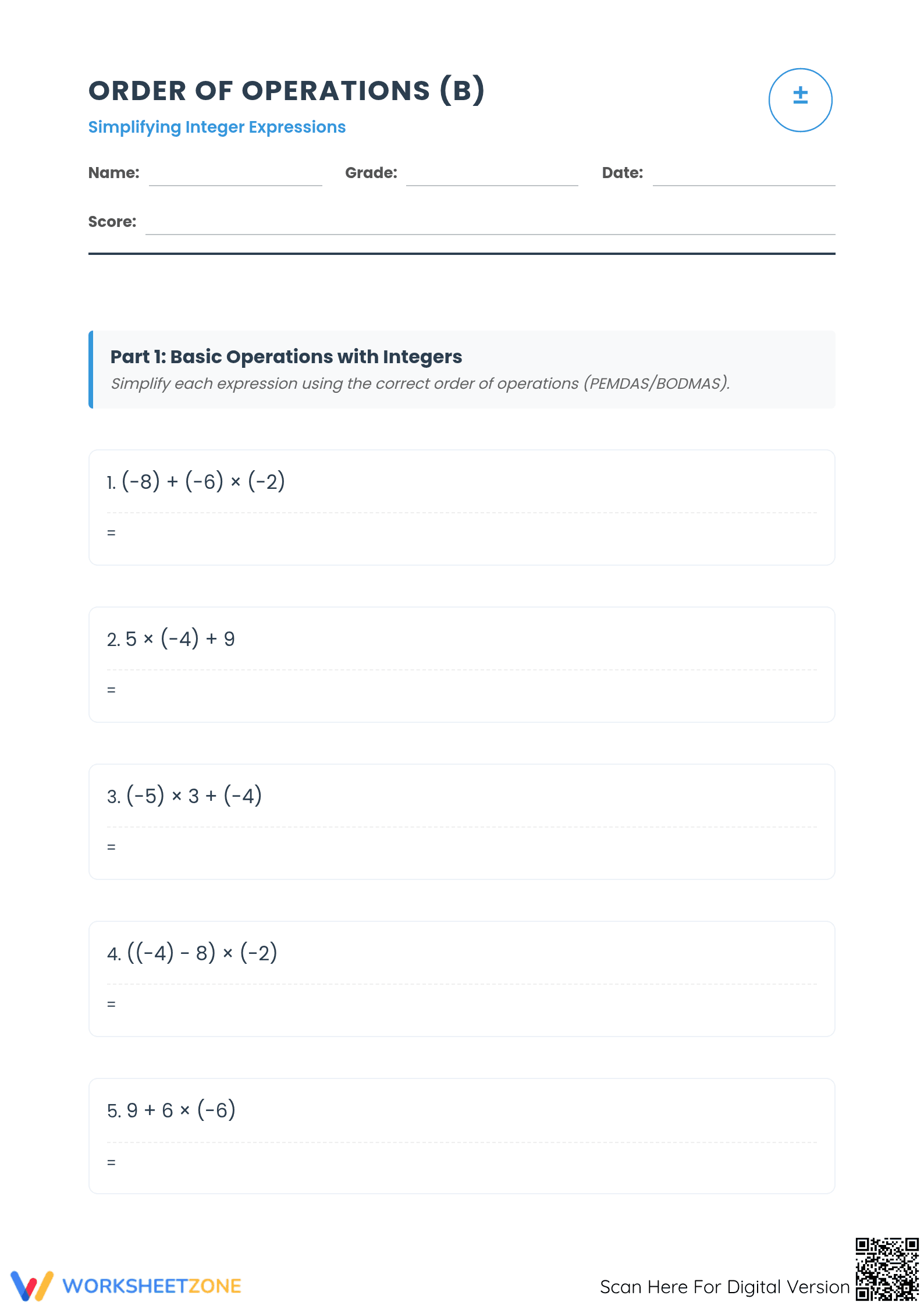
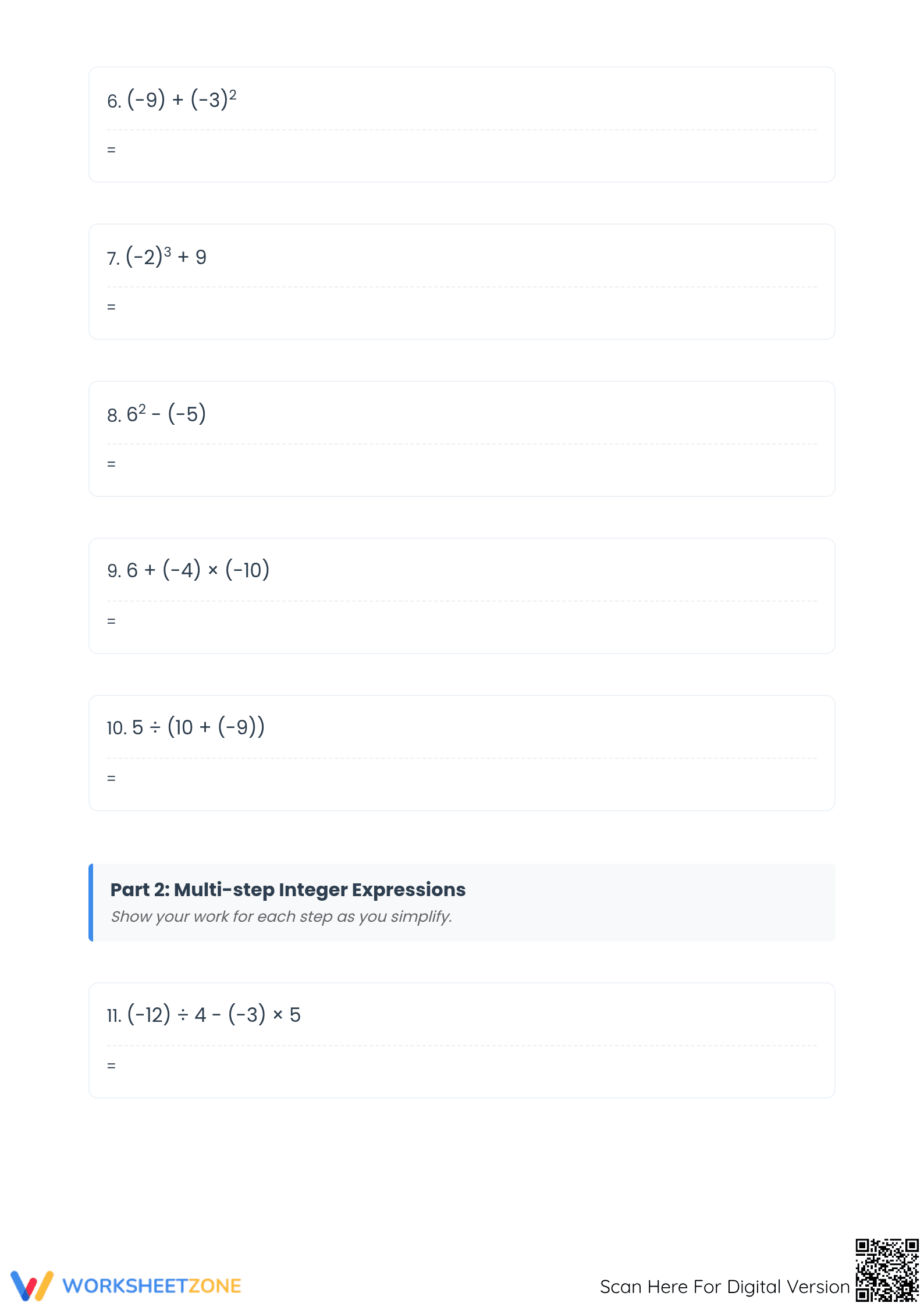
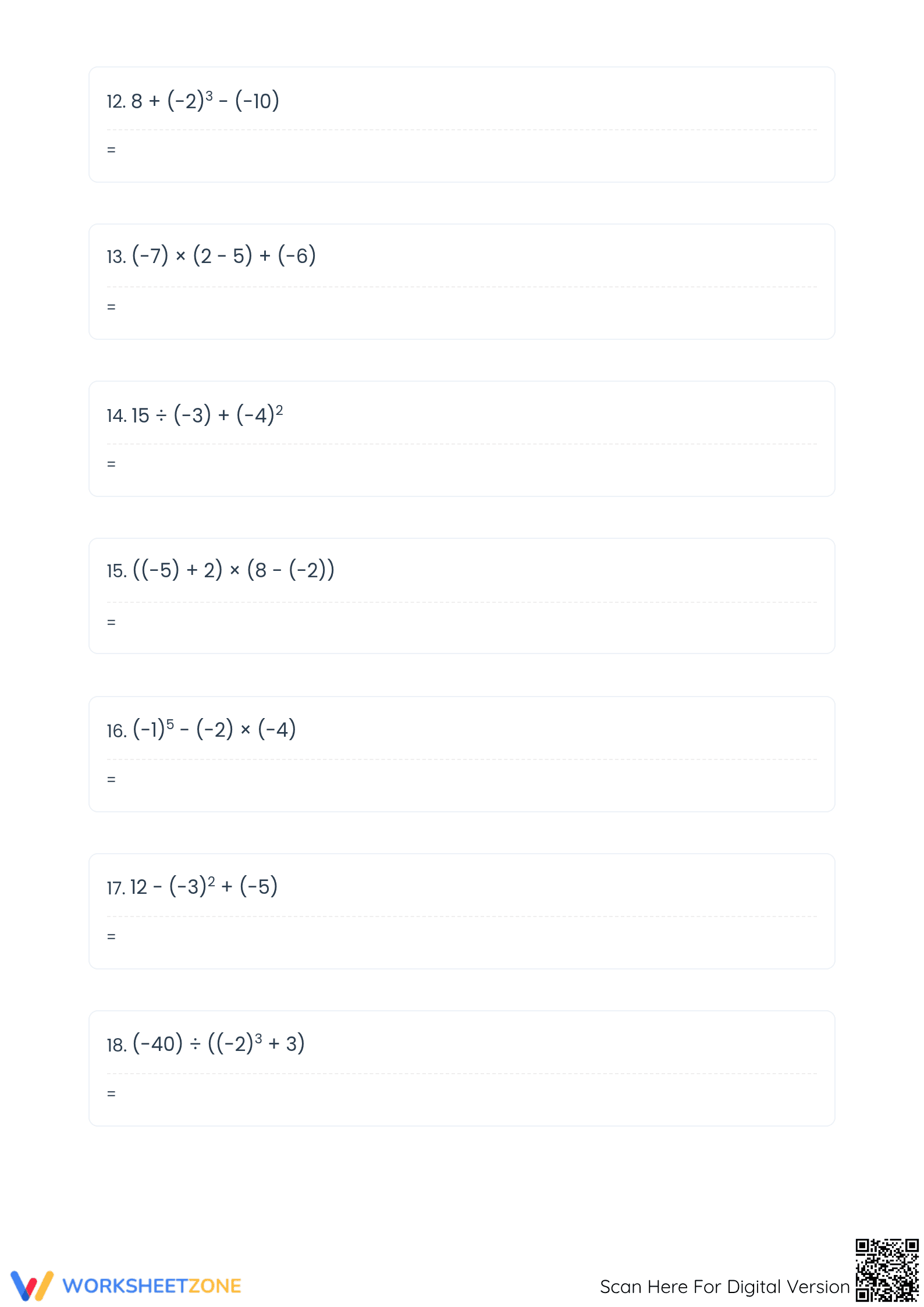
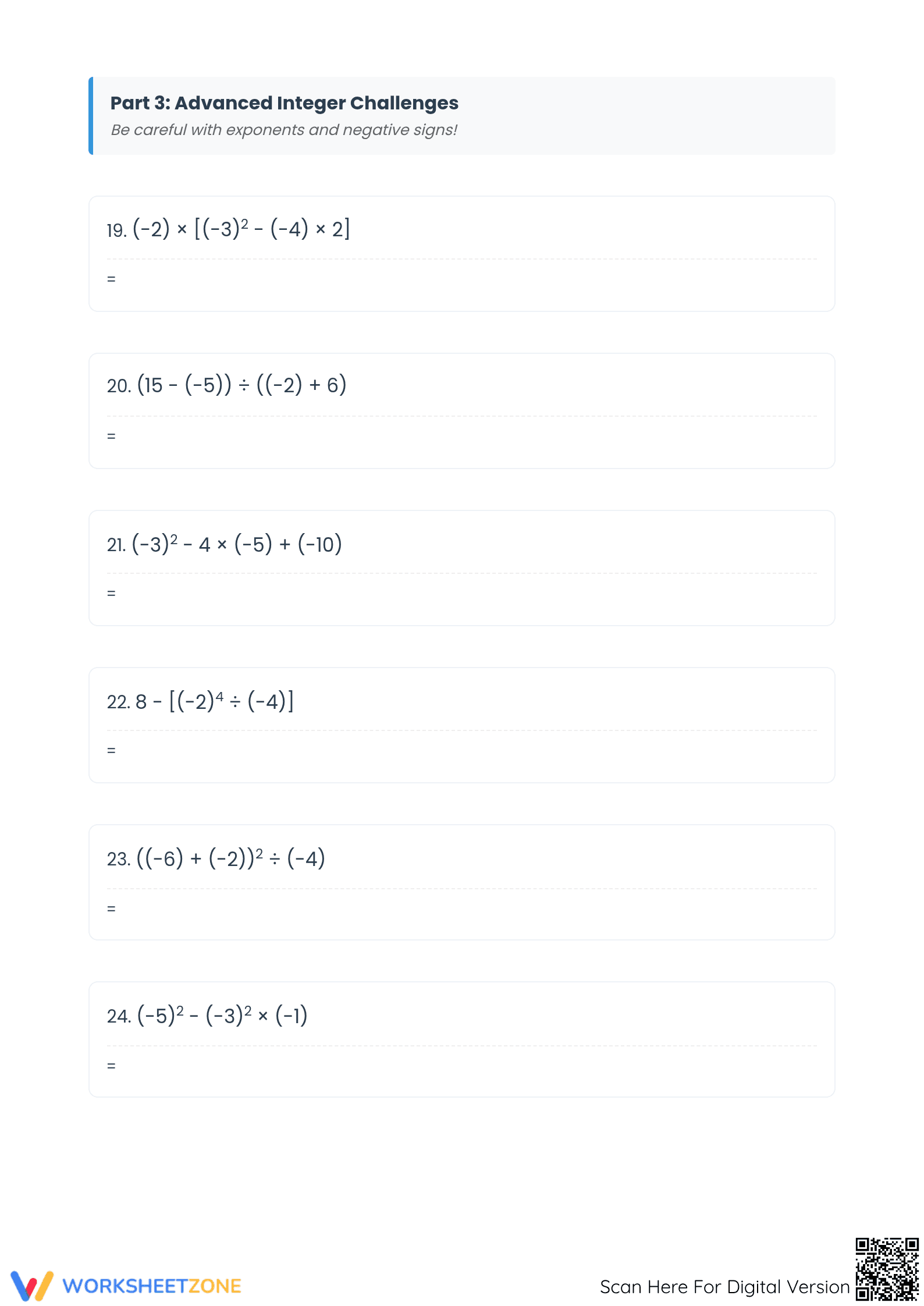
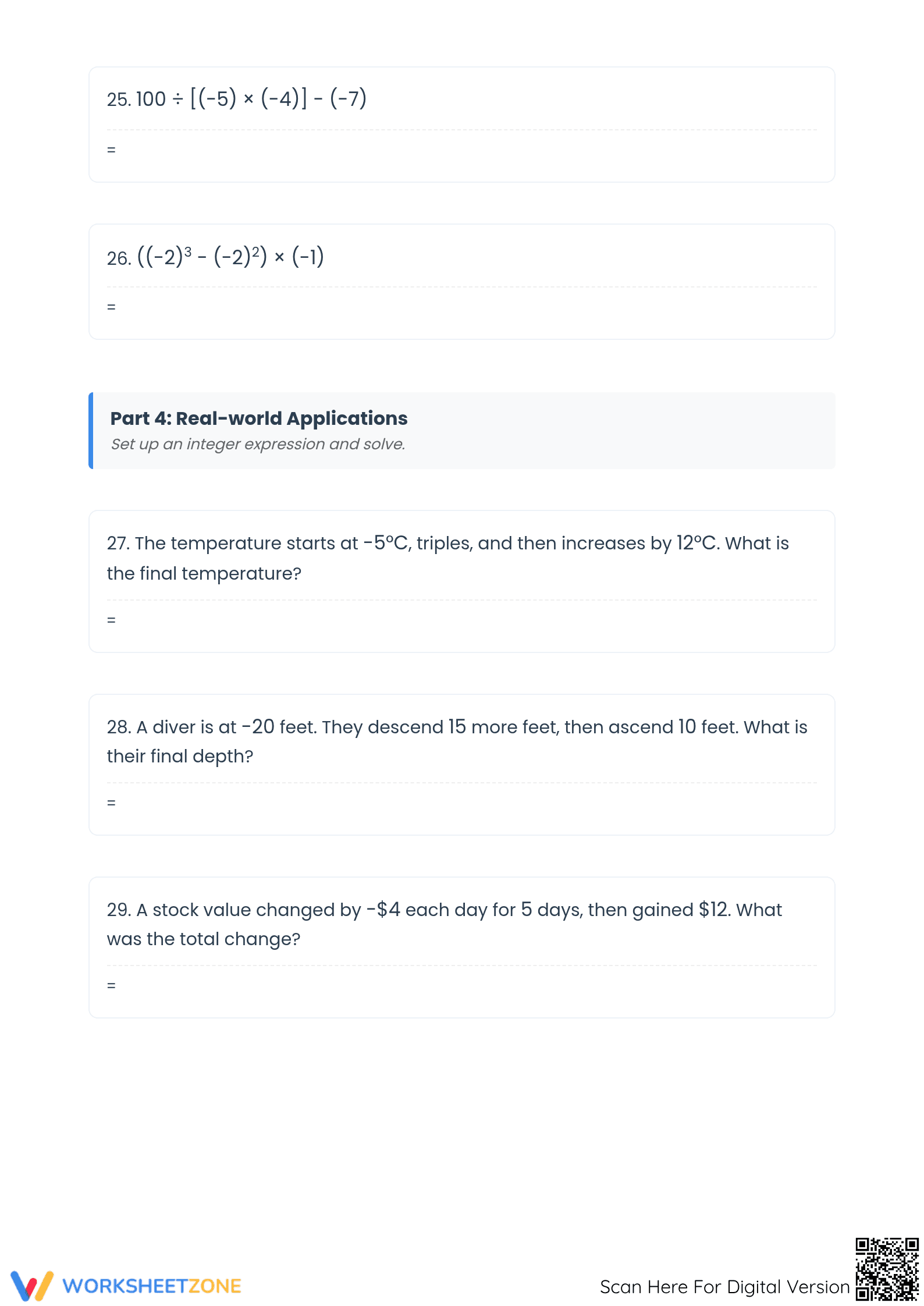
Inside this five-page PDF, educators will find 29 carefully sequenced problems divided into four distinct instructional sections. The worksheet begins with foundational two-step operations before moving into expressions with exponents and nested parentheses. A dedicated section for advanced challenges pushes student reasoning, while the final page connects abstract calculations to concrete scenarios through three integrated real-world word problems. A full answer key is provided for efficient grading.
Skill Progression
The instructional design follows a clear progression that supports learners through increasing cognitive demands:
- Guided Practice: 10 foundational problems focus on two-step operations, helping students stabilize their understanding of PEMDAS and integer signs.
- Supported Practice: 8 multi-step problems introduce exponents and larger grouping symbols, requiring students to track multiple operational layers carefully.
- Independent Practice: 11 advanced challenges and word problems remove scaffolding, tasking students with applying their knowledge to complex expressions and practical situational logic.
This gradual-release model ensures that students move confidently from initial recognition to independent mastery without frustration.
Standards Alignment
This worksheet is primarily aligned with standard `CCSS.MATH.CONTENT.7.NS.A.3`: "Solve multi-step mathematical and real-world problems involving four operations with rational numbers." It also supports `CCSS.MATH.CONTENT.6.EE.A.1` by requiring students to write and evaluate numerical expressions involving whole-number exponents. These standard codes can be copied directly into lesson plans, IEP goals, or district curriculum mapping tools to document rigorous student engagement.
How to Use It
Use this resource as a post-instructional activity once students have been introduced to the rules of integer multiplication and division. It serves as an excellent formative assessment tool; teachers should observe students during Part 2 to identify common errors in exponent placement or sign errors during subtraction. Expect a completion time of approximately 50 minutes, making it an ideal choice for a full-period independent desk-work session or a multi-day homework assignment.
Who It's For
This resource is designed for Grade 7 students but is highly effective for Grade 8 remediation or advanced Grade 6 learners. The inclusion of word problems makes it a valuable asset for students needing to bridge the gap between procedural fluency and conceptual application. Pair this worksheet with a coordinate plane activity or a rational number number-line passage to create a cohesive unit on the number system.
Middle school students often struggle with integer properties and operational hierarchy, frequently defaulting to left-to-right calculation. This worksheet directly addresses these common misconceptions through isolated practice on high-friction points, including negative bases with even exponents and the distributive property in multi-step simplification. Research underscores that procedural fluency in integer operations is a fundamental prerequisite for algebraic success. By scaffolding the transition from two-step arithmetic to complex challenges, this resource aligns with recommendations for high-dosage practice in foundational middle school mathematics. The inclusion of authentic word problems ensures students understand the utility of these rules in diverse quantitative contexts, balancing procedural skill with real-world application.


