


























Views
Downloads


Printable Order of Operations with Integers Worksheet
Paste this activity's link or code into your existing LMS (Google Classroom, Canvas, Teams, Schoology, Moodle, etc.).
Students can open and work on the activity right away, with no student login required.
You'll still be able to track student progress and results from your teacher account.
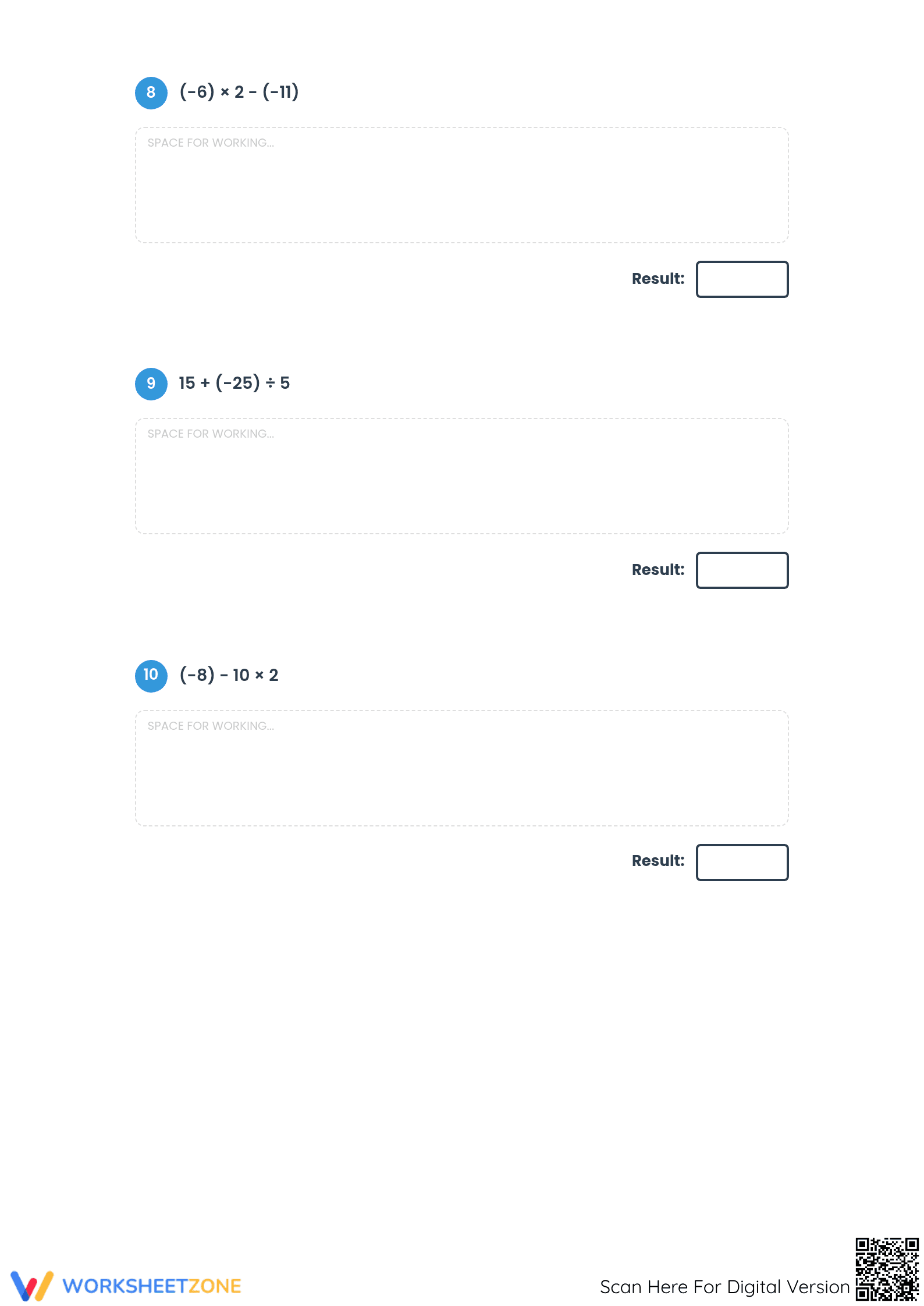
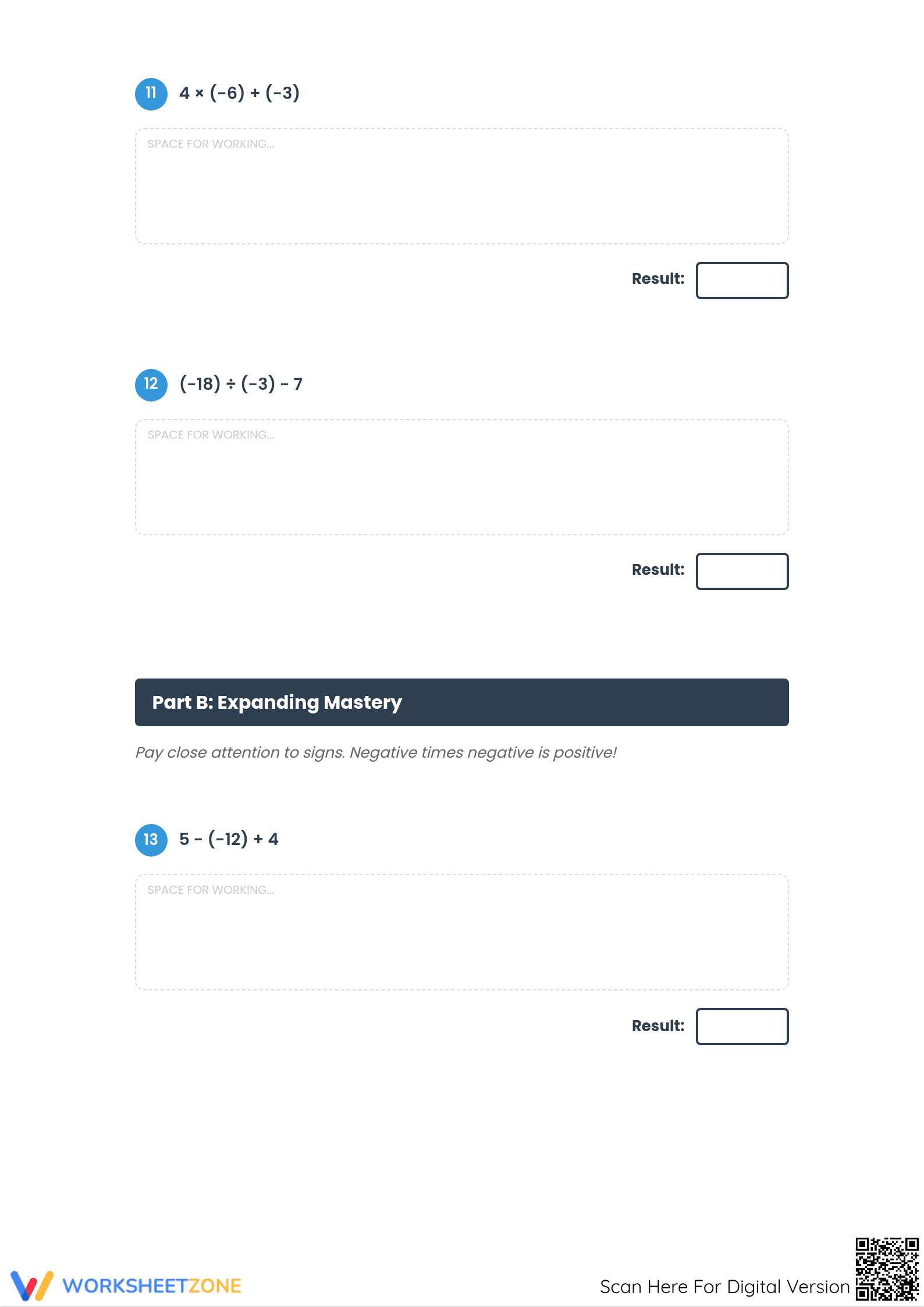
This comprehensive Grade 7 math worksheet provides targeted practice for mastering the 2-step order of operations involving integers. Students will navigate positive and negative numbers while applying PEMDAS/BODMAS rules to solve 20 structured problems. By isolating two specific operations per task, the worksheet ensures students build a firm foundation in signed number arithmetic before moving to more complex multi-step expressions.
At a Glance
- Grade: 7 · Subject: Math
- Standard:
CCSS.MATH.CONTENT.7.NS.A.3— Solve real-world and mathematical problems involving the four operations with rational numbers- Skill Focus: Integer Order of Operations (2-Step)
- Format: 5 pages · 20 problems · Answer key included · PDF
- Best For: Middle school independent practice or homework
- Time: 25–35 minutes
The worksheet is organized into five pages, each featuring four large, clear problems with dedicated "Space for Working" boxes. This layout encourages students to show their step-by-step process, which is critical for identifying sign errors. The final page provides a complete answer key, allowing for immediate feedback or self-grading. The problems specifically target common misconceptions, such as the interaction between subtraction and negative numbers.
Skill Progression
- Guided Practice: The first 8 problems utilize familiar operation pairings (addition and multiplication) to ease students into applying integer rules within the order of operations framework.
- Supported Practice: Problems 9 through 16 introduce division and subtraction of negative integers, requiring students to carefully manage double negatives and sign changes.
- Independent Practice: The final set of problems includes mixed operations with larger integer values to test fluency and operational accuracy without additional scaffolds.
This sequence follows a gradual-release model, moving students from basic recall of integer rules to the fluid application of mathematical properties.
Standards Alignment: This resource aligns primarily with `CCSS.MATH.CONTENT.7.NS.A.3`. Students must solve mathematical problems involving the four operations with rational numbers, specifically focusing on the properties of operations as they apply to integers. This standard code can be copied directly into lesson plans, IEP goals, or district curriculum mapping tools.
How to Use It: This worksheet is ideal for use after a direct instruction lesson on integer rules and the order of operations. Assign it as a mid-unit formative assessment to observe how well students manage signs during multiplication and division. Teachers should look for students who struggle with the "negative times negative" rule, as highlighted in the "Expanding Mastery" section cue. Expected completion time is approximately 30 minutes.
Who It's For: This is designed for Grade 7 students, but it serves as an excellent remedial tool for Grade 8 students or an enrichment task for advanced Grade 6 learners. It pairs naturally with an integer number line anchor chart or a direct instruction lesson on PEMDAS.
According to NAEP research on middle school mathematics achievement, fluency with signed numbers is a significant predictor of success in high school algebra. This Grade 7 worksheet addresses that need by providing 20 rigorous 2-step problems focused on `CCSS.MATH.CONTENT.7.NS.A.3`. By requiring students to solve order of operations problems involving integers, the resource builds the operational stamina required for multi-step algebraic equations. Fisher & Frey (2014) emphasize that providing dedicated space for mathematical scratchpad work reduces cognitive load and helps students track multiple sign changes accurately. This printable PDF includes a full answer key for teacher efficiency or student-led correction. It serves as a high-quality bridge between basic arithmetic and the abstract reasoning demanded in later grades, ensuring that students treat the negative sign as an operational instruction rather than just a label.


