


























Views
Downloads

Order of Operations with Integers Worksheet | Printable Math
Paste this activity's link or code into your existing LMS (Google Classroom, Canvas, Teams, Schoology, Moodle, etc.).
Students can open and work on the activity right away, with no student login required.
You'll still be able to track student progress and results from your teacher account.
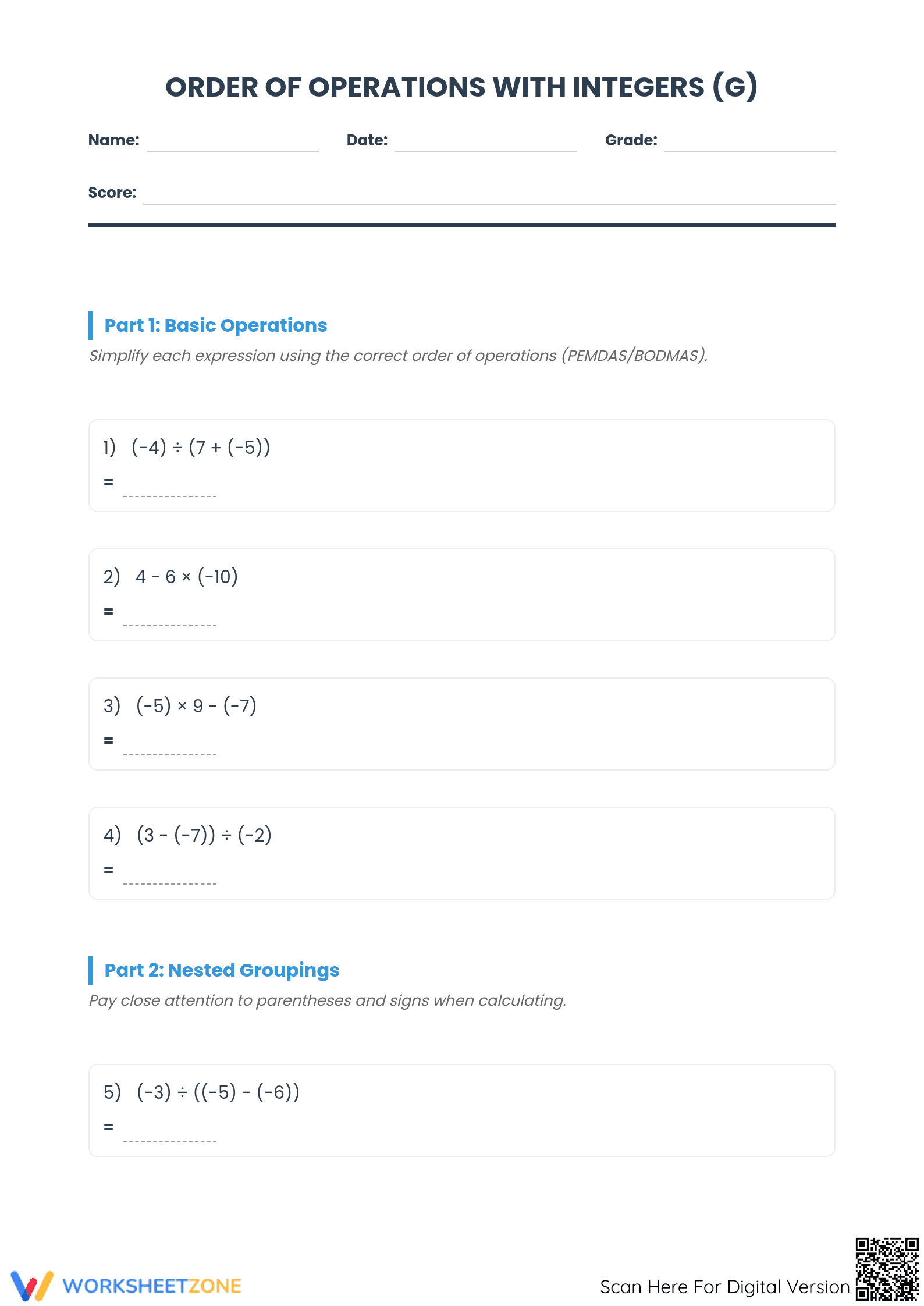
Master the complexities of integer calculations with this comprehensive order of operations worksheet. Students will systematically progress through basic calculations to nested groupings and challenge expressions, ensuring a deep understanding of PEMDAS and BODMAS rules. This resource provides the structured practice necessary for middle school learners to gain computational fluency with positive and negative numbers.
At a Glance
- Grade: 7 · Subject: Math
- Standard:
CCSS.MATH.CONTENT.7.NS.A.3— Solve mathematical problems involving the four operations with rational numbers- Skill Focus: Order of Operations (PEMDAS)
- Format: 4 pages · 28 problems · Answer key included · PDF
- Best For: Middle school math independent practice
- Time: 35–45 minutes
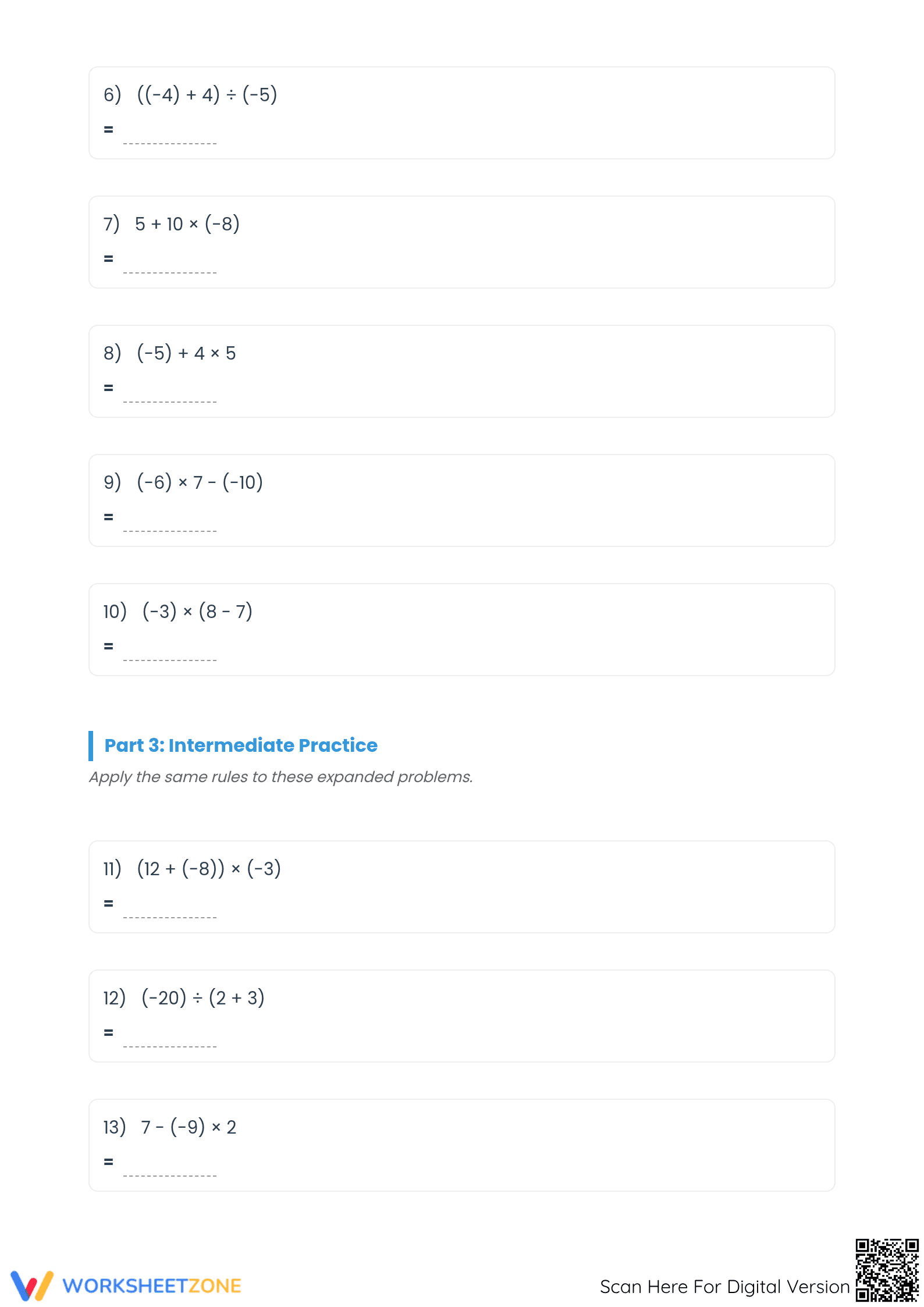
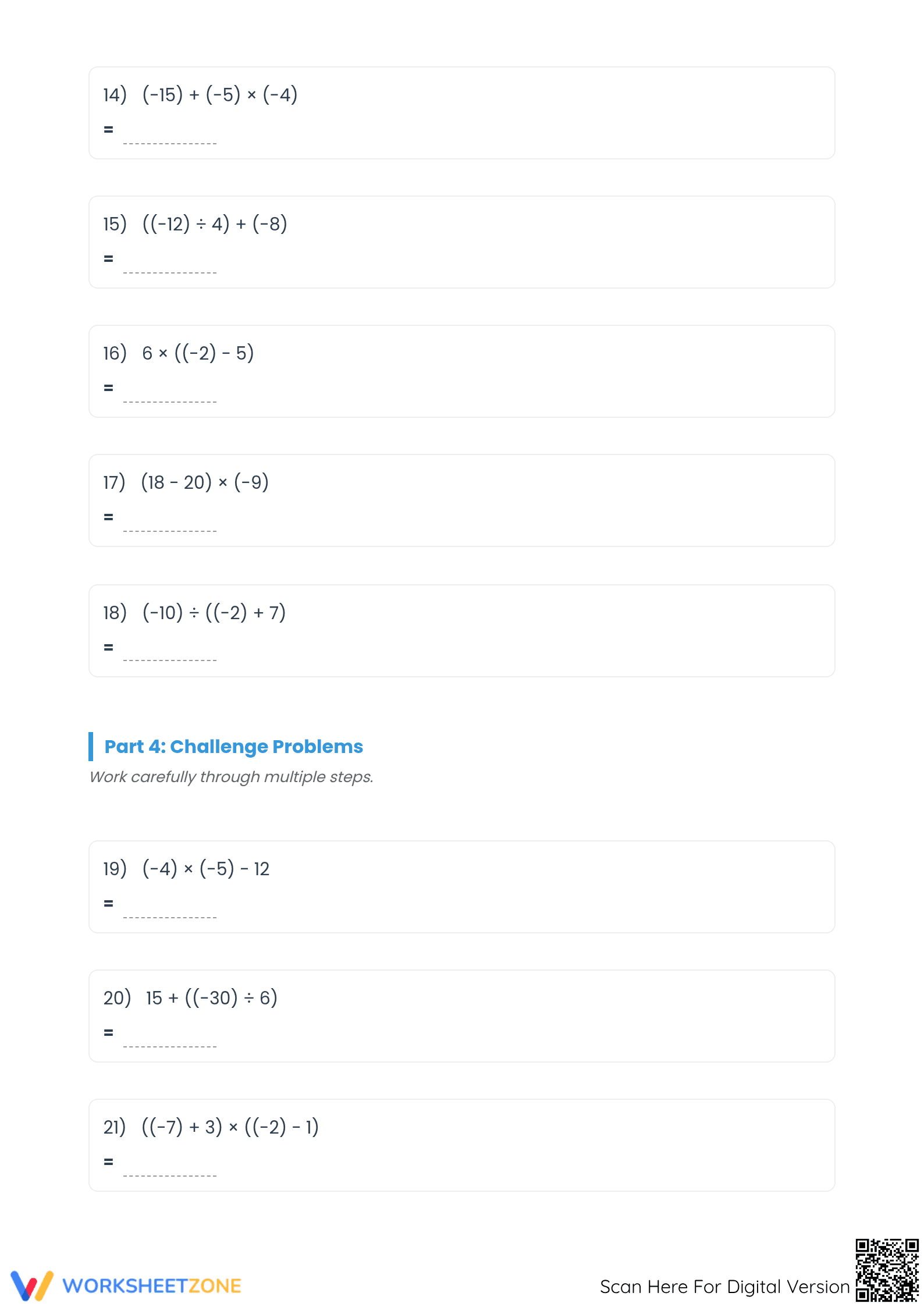
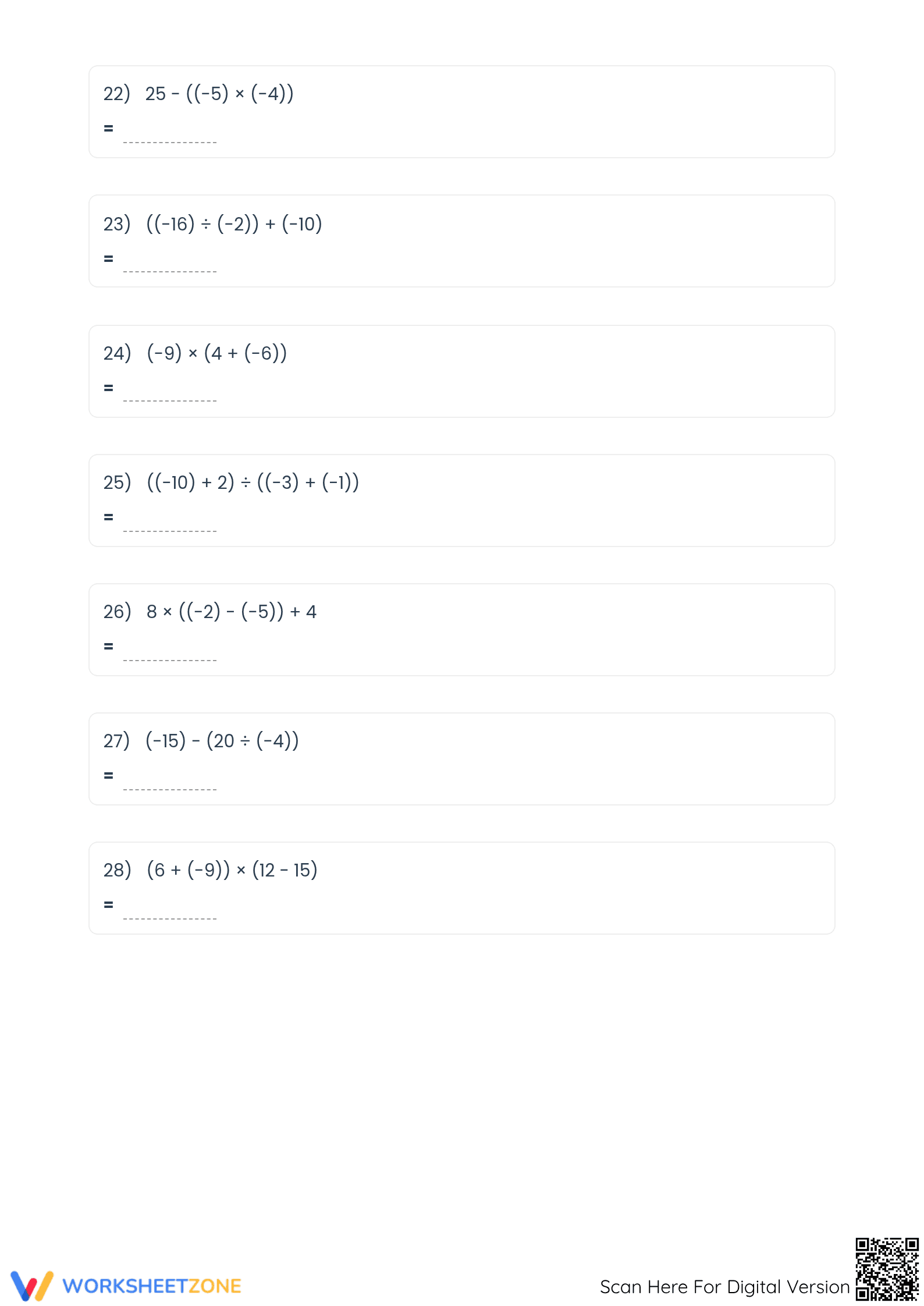
This 4-page PDF resource contains 28 carefully sequenced problems divided into four distinct phases. It begins with basic two-step operations before introducing nested groupings, intermediate practice with expanded expressions, and high-level challenge problems. The layout provides ample workspace for each calculation, and a full answer key is provided for immediate feedback and easy grading.
- Guided practice: The first section focuses on 4 fundamental problems involving basic operations with integers to establish baseline confidence and sign rule review.
- Supported practice: Students then tackle 14 intermediate problems that introduce nested parentheses and multiple grouping symbols, requiring careful sign management and procedural attention.
- Independent practice: The final 10 challenge problems present complex, multi-step expressions that test total mastery of the mathematical hierarchy and integer arithmetic.
This progression follows a gradual-release model, moving from isolated skill checks to integrated application of numerical operations.
This worksheet is specifically designed to meet `CCSS.MATH.CONTENT.7.NS.A.3`, which requires students to solve mathematical problems involving the four operations with rational numbers. By focusing on integers, it builds the necessary prerequisite skills for working with broader rational number sets. Both standard codes can be copied directly into lesson plans, IEP goals, or district curriculum mapping tools.
Use this worksheet as a summative assessment after a unit on integer operations or as a targeted intervention for students struggling with sign errors in multi-step problems. During instruction, observe how students handle nested parentheses in Part 2; if they struggle, use these examples for small-group re-teaching. Expect students to complete the full set in 35-45 minutes.
This resource is ideal for Grade 7 students learning integer rules, though it serves as an excellent review for Grade 8 or high school Algebra 1 students. It pairs naturally with an integer sign rules anchor chart or a direct instruction lesson on the hierarchy of operations. The clear partitioning allows teachers to assign specific sections based on current lesson goals.
According to research from EdReports 2024, high-quality instructional materials in mathematics must balance procedural fluency with conceptual understanding. This worksheet achieves that balance by forcing students to reconcile the order of operations with the specific rules governing signed numbers. The CCSS.MATH.CONTENT.7.NS.A.3 standard emphasizes the application of operations to rational numbers, a skill that Fisher & Frey (2014) identify as a critical gatekeeper for success in secondary algebra. By providing 28 structured tasks that increase in complexity, this resource ensures that students encounter a wide variety of sign interactions within the PEMDAS framework. Systematic practice with integers reduces the cognitive load during more complex algebraic manipulation, allowing learners to focus on higher-order problem-solving strategies rather than basic arithmetic errors during standardized testing or classroom assessments.


