


























Views
Downloads

Essential Integer Order of Operations Worksheet | Grade 7
Paste this activity's link or code into your existing LMS (Google Classroom, Canvas, Teams, Schoology, Moodle, etc.).
Students can open and work on the activity right away, with no student login required.
You'll still be able to track student progress and results from your teacher account.
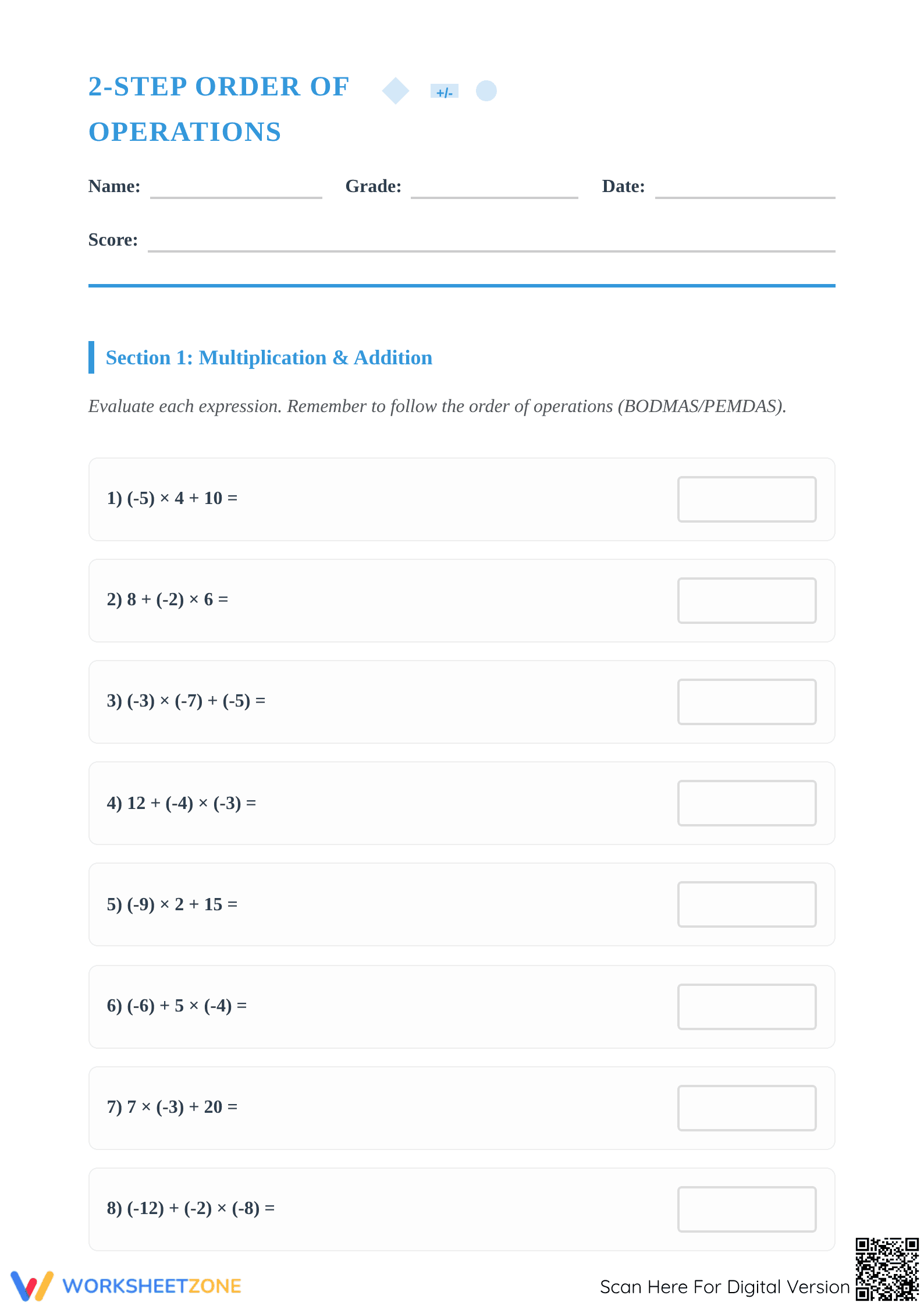
Evaluate complex numerical expressions with this comprehensive integers worksheet. Students master the order of operations by solving multi-step problems involving addition, subtraction, multiplication, and division of signed numbers. This resource ensures students build the procedural fluency required for algebra by anchoring their understanding in the fundamental rules of PEMDAS and BODMAS.
At a Glance
- Grade: 7 · Subject: Math
- Standard:
CCSS.MATH.CONTENT.7.NS.A.3— Solve mathematical problems involving the four operations with rational numbers- Skill Focus: Integer Order of Operations (PEMDAS/BODMAS)
- Format: 4 pages · 36 problems · Answer key included · PDF
- Best For: Independent practice and skills reinforcement
- Time: 25–40 minutes
What's Inside
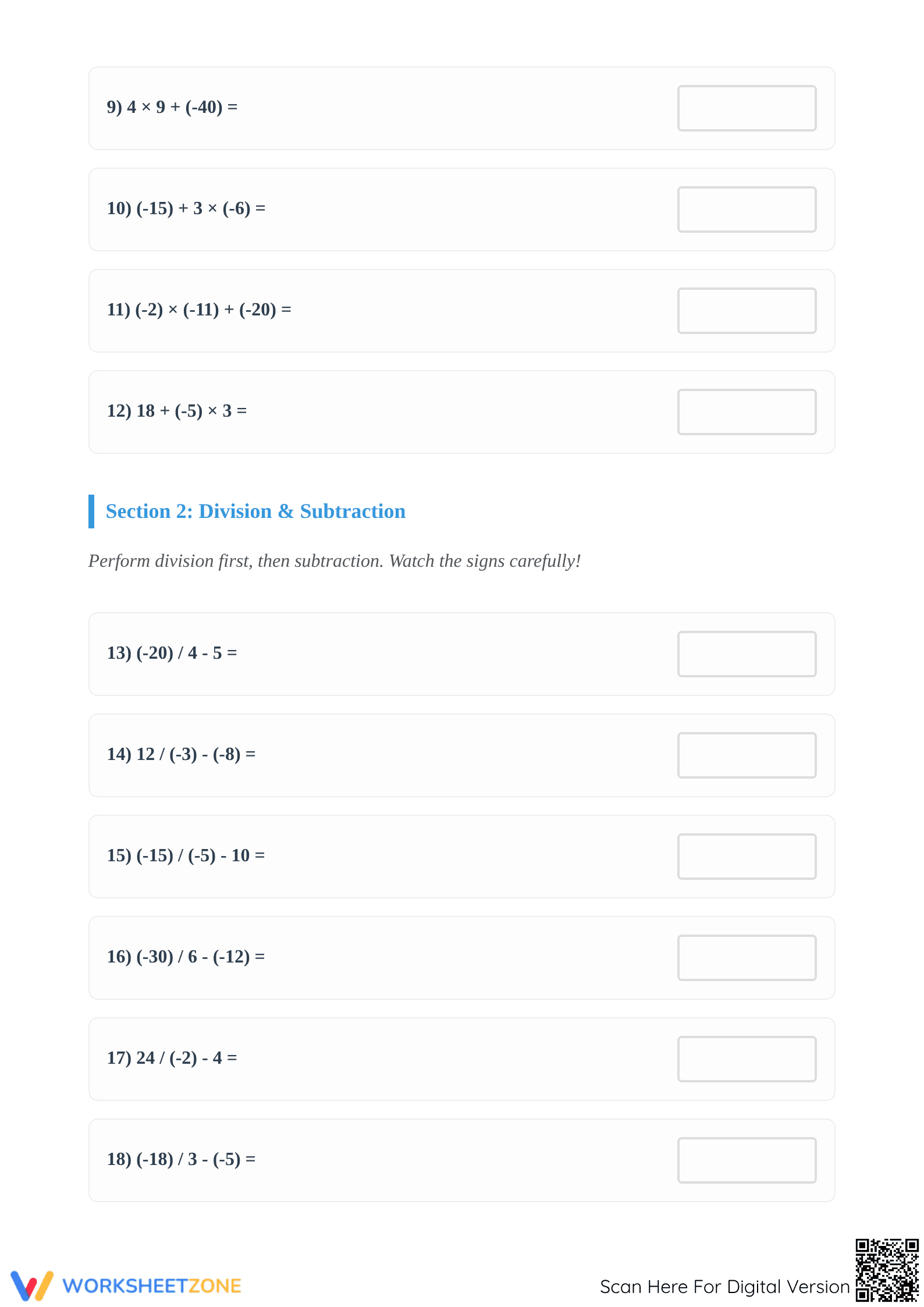
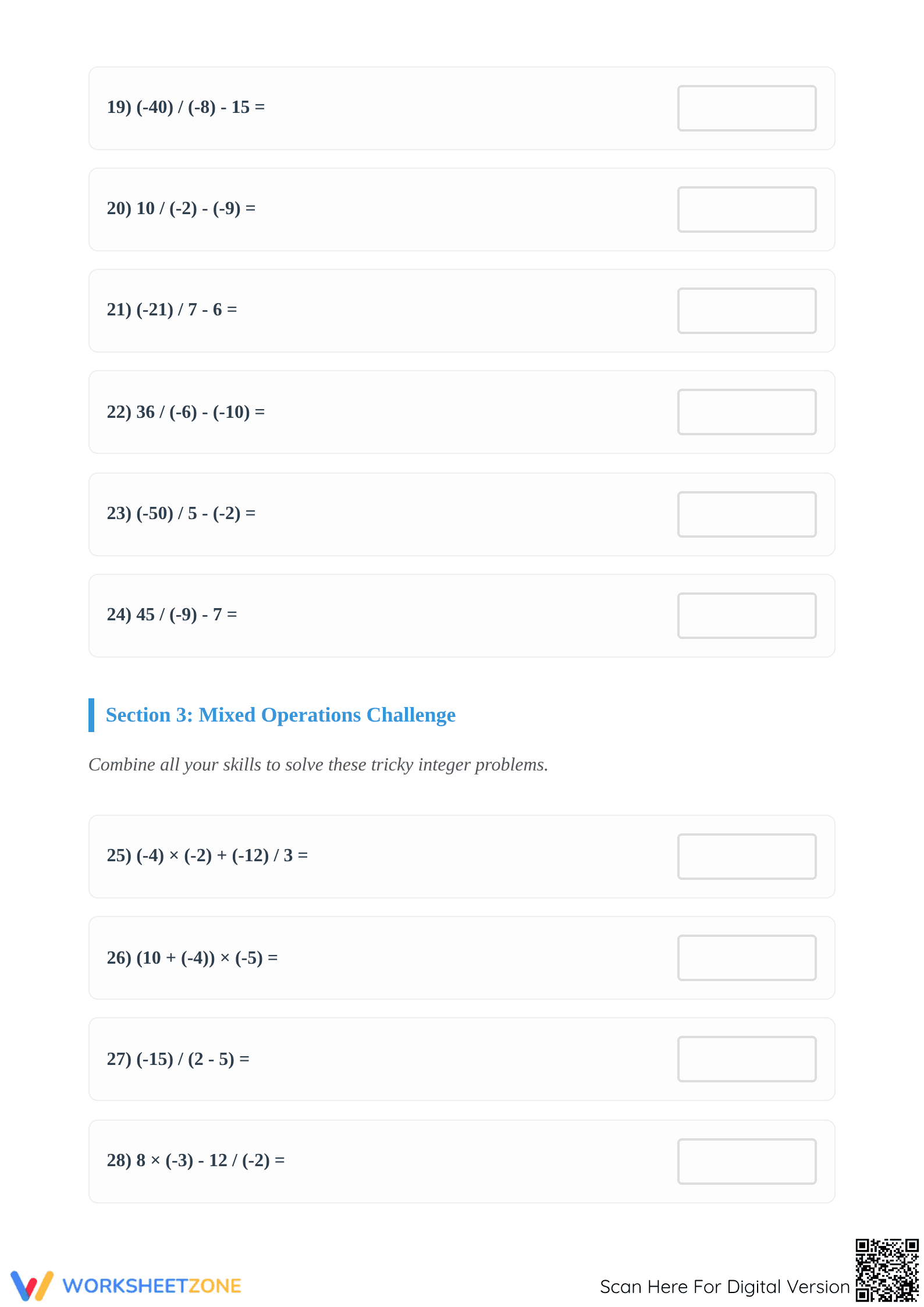
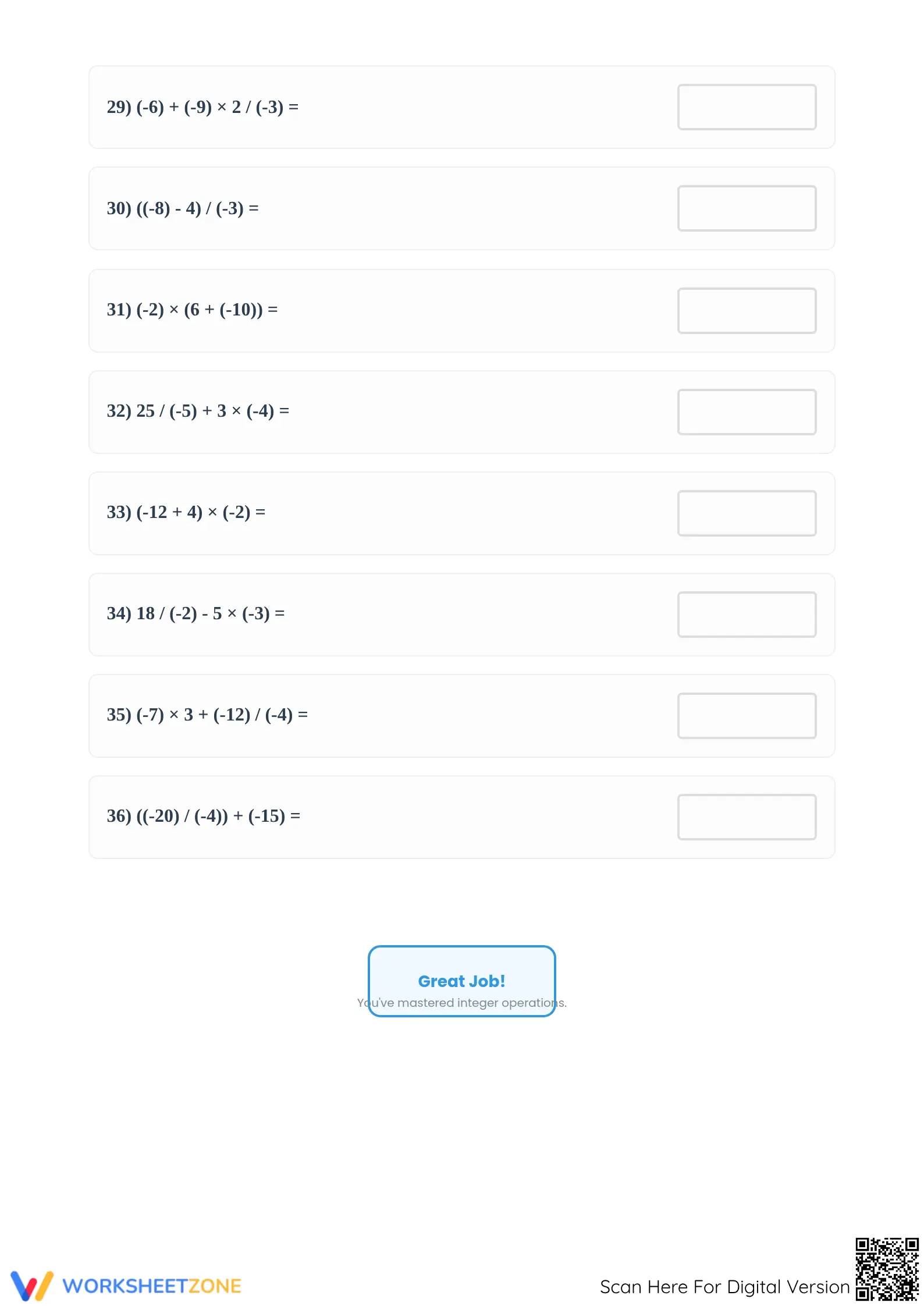
This four-page PDF contains 36 structured mathematical expressions designed to challenge and equip middle school learners. The worksheet is organized into three distinct sections: Multiplication & Addition, Division & Subtraction, and a Mixed Operations Challenge. Each page features clear evaluation boxes for student answers, ensuring a clean and organized workspace. A complete answer key is included for rapid grading and immediate student feedback.
Skill Progression
- Guided Practice: Twelve problems focus on multiplication and addition, stabilizing understanding of sign rules for positive and negative numbers.
- Supported Practice: Section two transitions into division and subtraction, requiring students to manage negative signs during inverse operations.
- Independent Practice: The challenge section introduces mixed operations with parentheses, pushing students toward full mastery of multi-step evaluation.
This gradual-release approach facilitates a transition from basic arithmetic to algebraic thinking by building confidence through structured success.
Standards Alignment
This resource is aligned to `CCSS.MATH.CONTENT.7.NS.A.3`, requiring students to solve mathematical problems involving the four operations with rational numbers. It specifically addresses the complexity of integers within multi-step expressions. This standard code can be copied directly into lesson plans, IEP goals, or district curriculum mapping tools to ensure instructional coherence and compliance with core curriculum requirements.
How to Use It
This worksheet is ideal for the "You Do" phase of a lesson. After instruction on PEMDAS, assign the first sections to monitor for sign errors. For an effective formative-assessment observation, check if students correctly identify which operation to perform first in the challenge section. The 30-minute expected completion time makes it perfect for a standard class period or as a substantial homework assignment.
Who It's For
Designed primarily for Grade 7 math students, this resource is also suitable for Grade 6 acceleration or Grade 8 remediation. It provides excellent support for students who struggle with the cognitive load of tracking multiple signs. Pair this worksheet with an integer number line anchor chart to provide additional scaffolding for diverse learners in inclusive classroom settings.
The development of procedural fluency in evaluating expressions with integers is a critical milestone for middle school mathematics. Research from RAND AIRS 2024 highlights that students who achieve early mastery of integer operations are significantly more likely to succeed in high school Algebra I. This worksheet targets the CCSS.MATH.CONTENT.7.NS.A.3 standard, focusing on the plain-English skill of solving multi-step mathematical problems with signed numbers. By isolating the order of operations within a 2-step framework, the resource minimizes cognitive overload while maximizing student engagement with core arithmetic properties. Effective instructional design, as noted in ScienceDirect TpT Analysis, emphasizes the importance of structured workspaces and clear sectioning to support learners in self-monitoring their progress. This 36-problem set provides the necessary volume of practice to move students from hesitant calculation to automaticity, creating a robust foundation for future explorations of variables and functions.


