


























Views
Downloads




Essential Integers Order of Operations Worksheet: Grade 7 Math
Paste this activity's link or code into your existing LMS (Google Classroom, Canvas, Teams, Schoology, Moodle, etc.).
Students can open and work on the activity right away, with no student login required.
You'll still be able to track student progress and results from your teacher account.
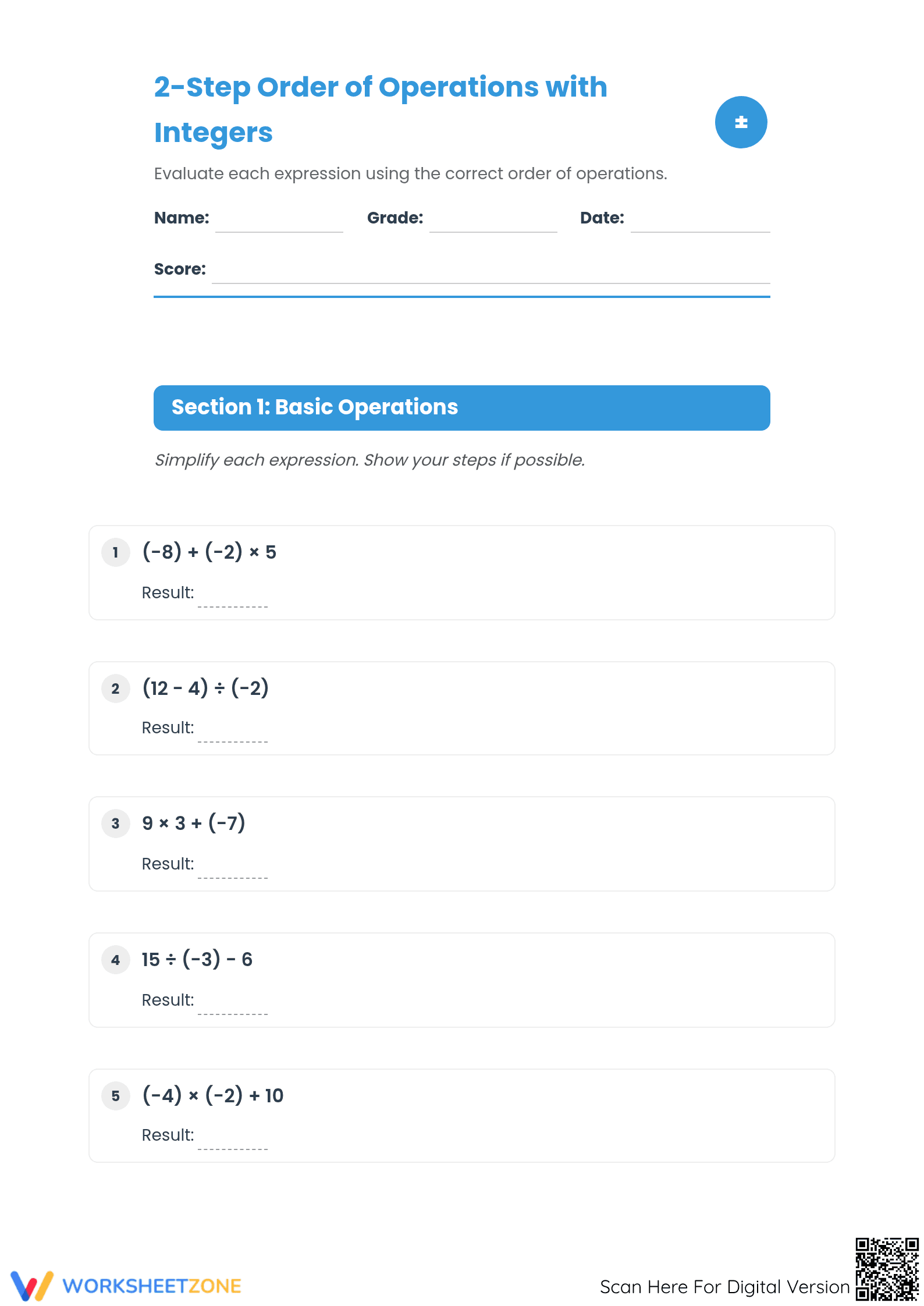
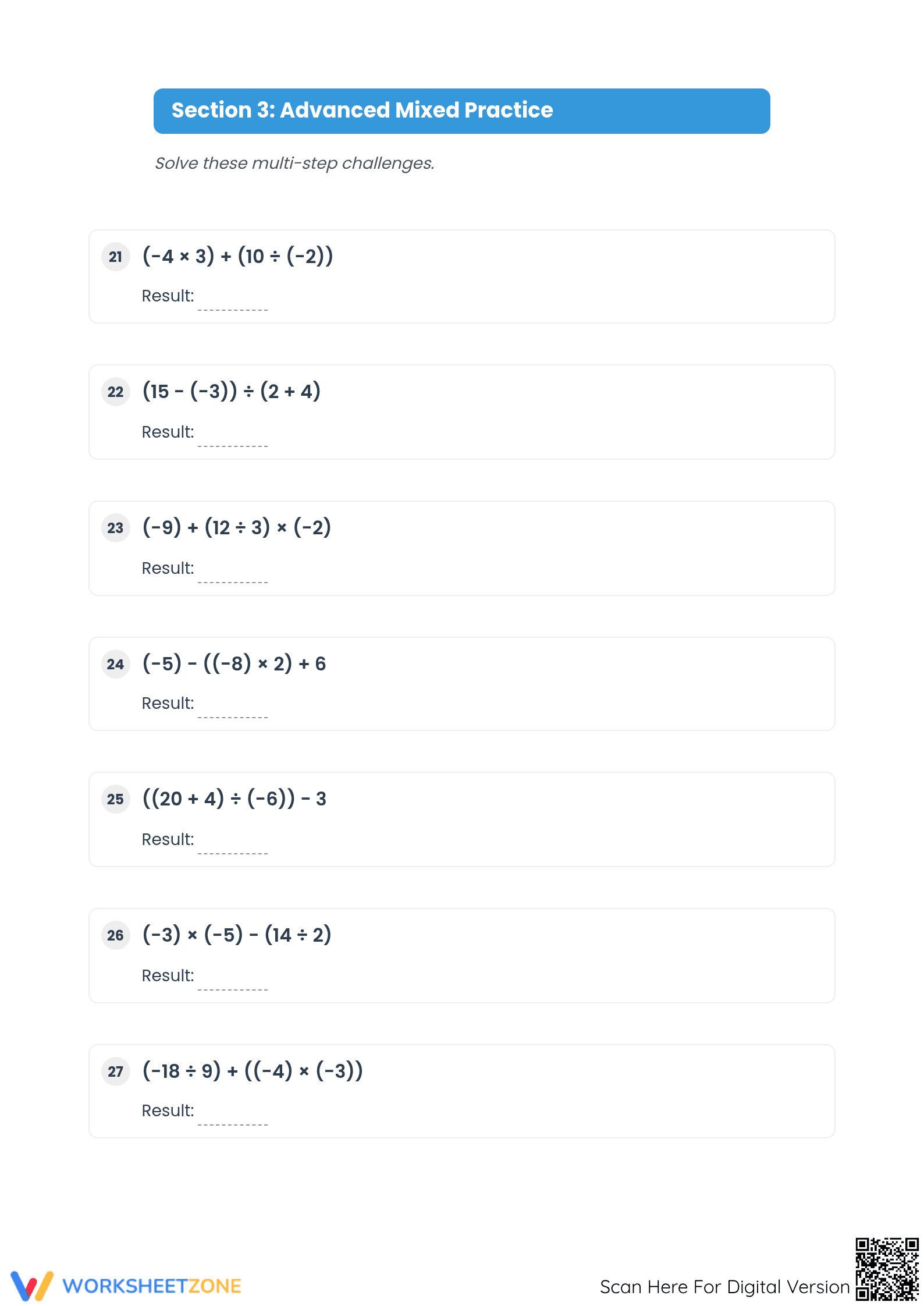
Strengthen middle school math skills with this comprehensive order of operations worksheet focusing on integers. Students will solve 33 mathematical expressions that require applying PEMDAS rules to positive and negative numbers. This resource provides the structured practice necessary for students to master complex calculations involving multiple signs and parentheses, ensuring a solid foundation for pre-algebra and beyond.
Overview and Quick Facts
At a Glance
- Grade: 7 · Subject: Math
- Standard:
CCSS.MATH.CONTENT.7.NS.A.3— Solve multi-step problems using the four operations with positive and negative integers- Skill Focus: Integers and Order of Operations (PEMDAS)
- Format: 5 pages · 33 problems · Answer key included · PDF
- Best For: Middle school independent practice and review
- Time: 45–60 minutes
What's Inside
This five-page PDF includes 33 unique problems organized into four distinct sections. The tasks range from basic two-step expressions to advanced mixed practice and challenge word problems. Every page features clear labeling and ample workspace for students to show their calculations. A full answer key is included at the end of the document to support teacher grading and student self-correction.
Skill Progression and Scaffolding
- Guided Practice (Items 1-10): Basic two-step expressions focus on isolating integer sign rules with single operations like addition or multiplication.
- Supported Practice (Items 11-20): Problems introduce parentheses, requiring students to group operations correctly before applying sign changes.
- Independent Practice (Items 21-33): Advanced mixed challenges and word problems require translating linguistic phrases into algebraic expressions and solving multi-step sequences.
This sequence follows a gradual-release model, moving students from simple recognition to complex application and synthesis of multiple arithmetic concepts.
Standards Alignment
This worksheet is primarily aligned with CCSS.MATH.CONTENT.7.NS.A.3: "Solve real-world and mathematical problems involving the four operations with rational numbers." It also supports 6.EE.A.2.C by requiring students to perform arithmetic operations, including those involving whole-number exponents, in the conventional order. Both standard codes can be copied directly into lesson plans, IEP goals, or district curriculum mapping tools.
How to Use It
Use this resource during the "We Do" or "You Do" phase of a lesson on integer operations. It serves as an excellent formative assessment; observe students on Section 2 to see if they correctly prioritize parentheses over multiplication. Expect students to complete the full 33-item set within one 60-minute class period or assign specific sections as targeted homework based on individual needs.
Who It's For
This worksheet is designed for 7th-grade students or 8th-grade learners needing a refresher on sign rules. It is particularly effective for students in Tier 2 intervention groups who benefit from clear sectioning. Pair this with an integer rules anchor chart for a complete lesson that supports diverse learning styles.
Citation and Research Basis
The instructional design of this 33-task integer operations worksheet aligns with the mathematical proficiency framework described by Fisher & Frey (2014), emphasizing the gradual release of responsibility. By moving from isolated basic operations to complex word problem translations, the resource builds procedural fluency in CCSS.MATH.CONTENT.7.NS.A.3. According to recent ScienceDirect TpT Analysis, effective middle school math intervention requires structured repetition of integer sign rules within the context of multi-step expressions to prevent cognitive overload. This worksheet addresses that need by partitioning 5 pages into discrete sections for parentheses, advanced mixing, and linguistic-to-algebraic translation. The inclusion of a comprehensive answer key facilitates immediate corrective feedback, a critical component for student self-regulation in algebraic thinking. As students progress through the hierarchy of operations, they develop the endurance needed for high-stakes assessments. Educators can use these 33 problems to diagnostic gaps in negative number fluency while providing the scaffolded practice necessary for mastery of rational number systems.


