


























Views
Downloads

Essential Order of Operations 7.NS.A.3 Grade 7 Aligned
Paste this activity's link or code into your existing LMS (Google Classroom, Canvas, Teams, Schoology, Moodle, etc.).
Students can open and work on the activity right away, with no student login required.
You'll still be able to track student progress and results from your teacher account.
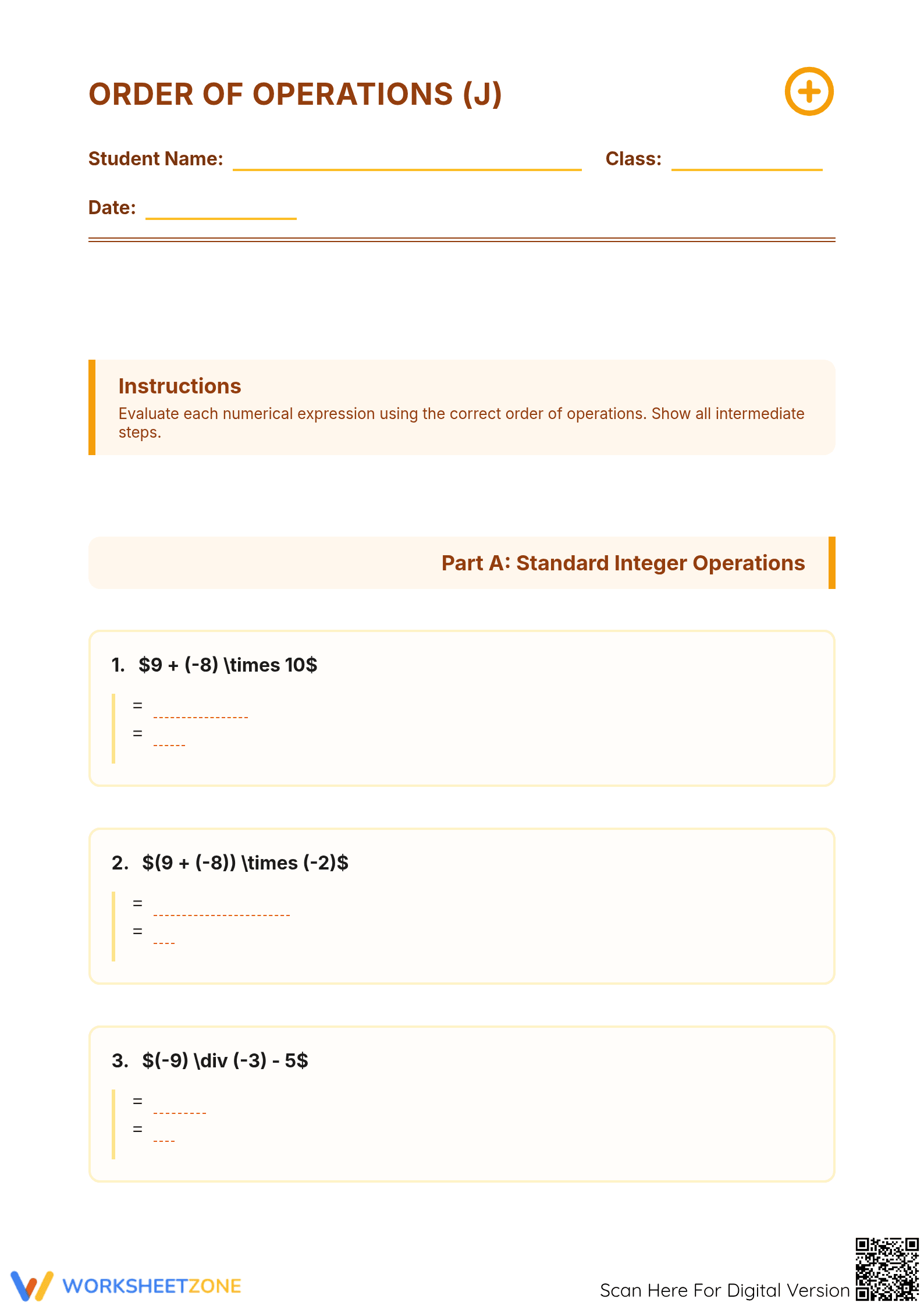
This comprehensive Grade 7 math worksheet equips students with the fluencies needed to evaluate complex numerical expressions involving integers. By focusing on the order of operations, learners move beyond simple arithmetic to master the hierarchical logic of PEMDAS. The clear structure ensures students build confidence as they tackle increasingly difficult multi-step problems.
At a Glance
- Grade: 7 · Subject: Math
- Standard:
CCSS.MATH.CONTENT.7.NS.A.3— Solve mathematical problems involving the four operations with rational numbers- Skill Focus: Order of Operations with Integers
- Format: 5 pages · 21 problems · Answer key included · PDF
- Best For: Middle school math mastery and assessment
- Time: 45–60 minutes
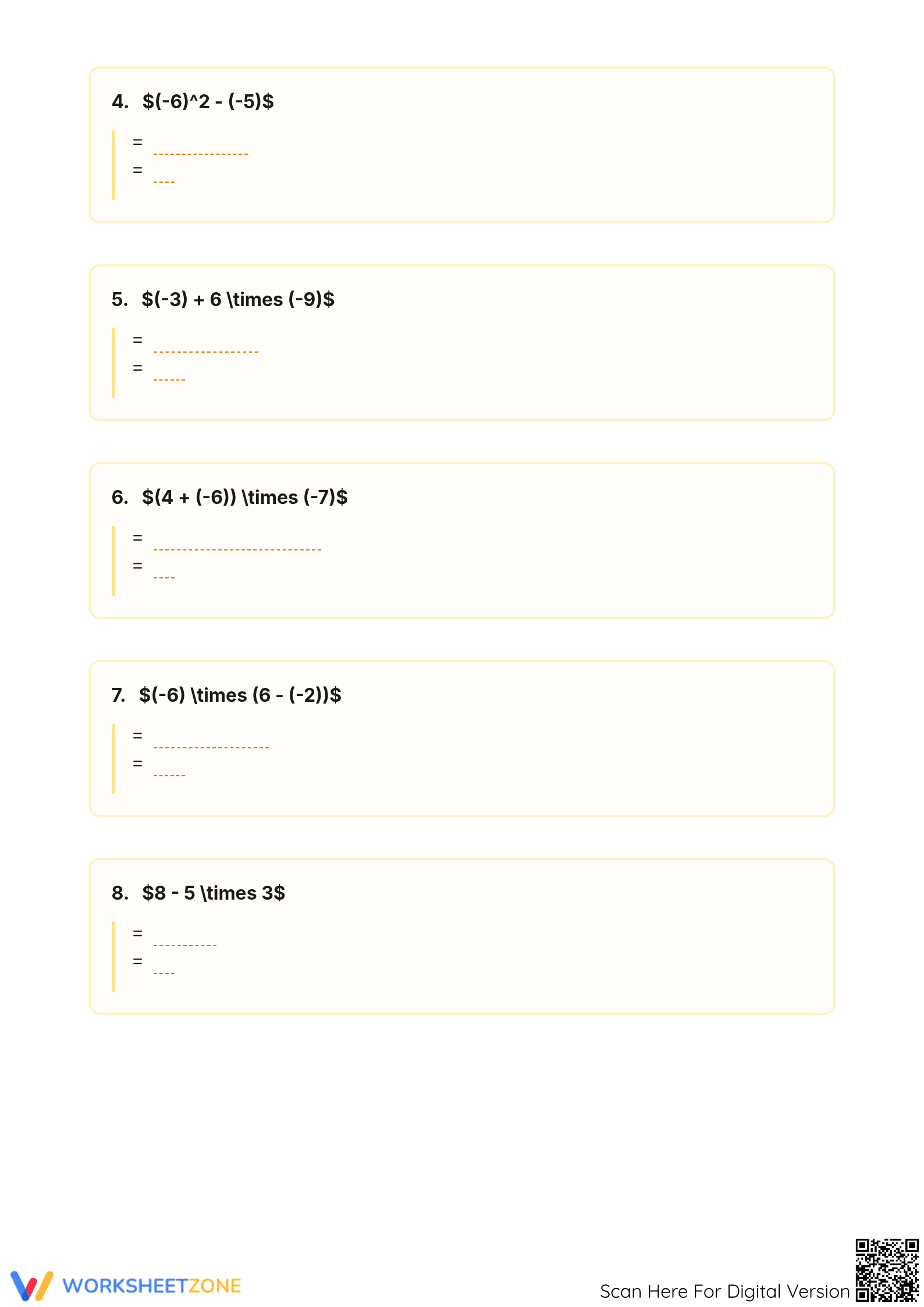
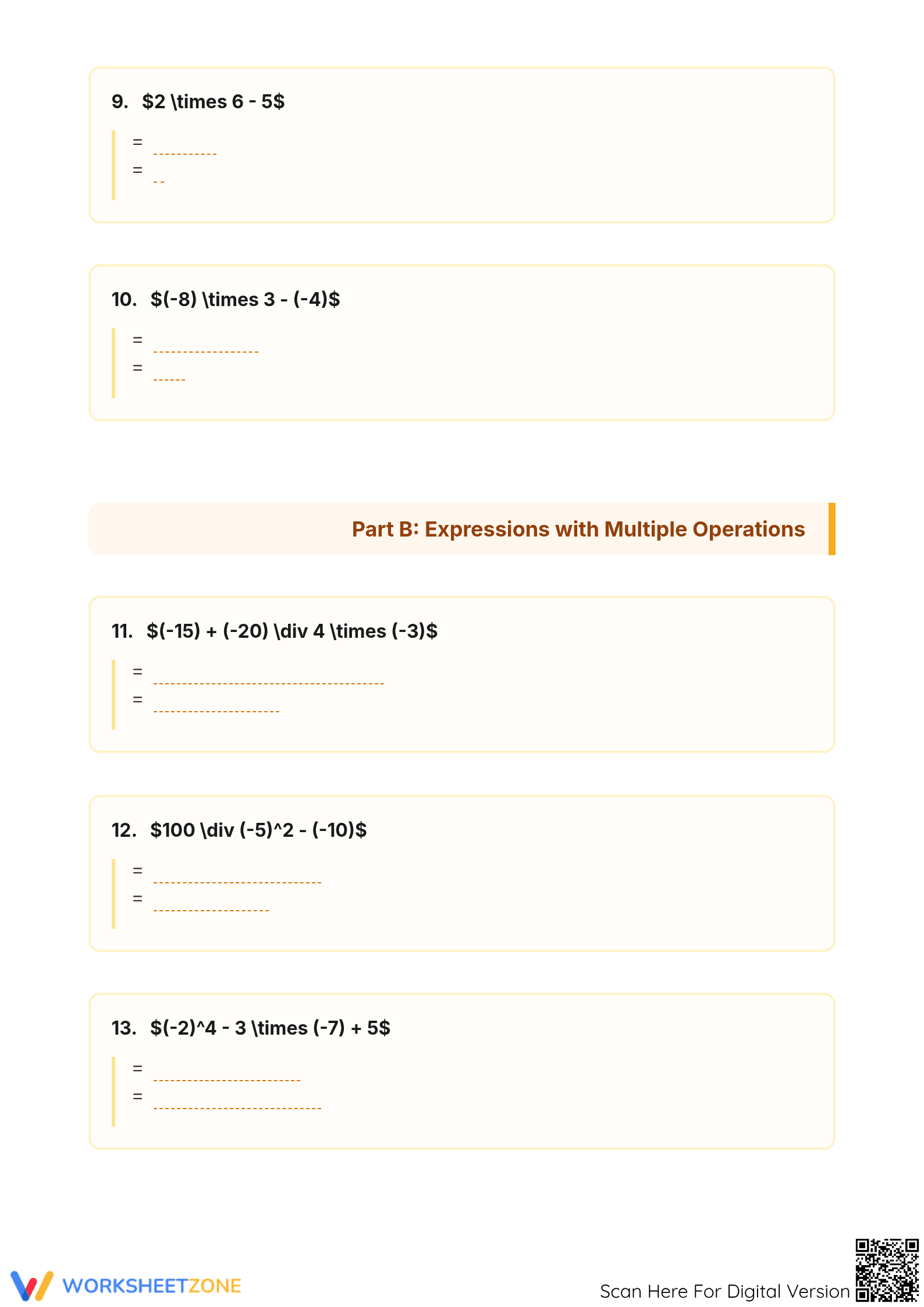
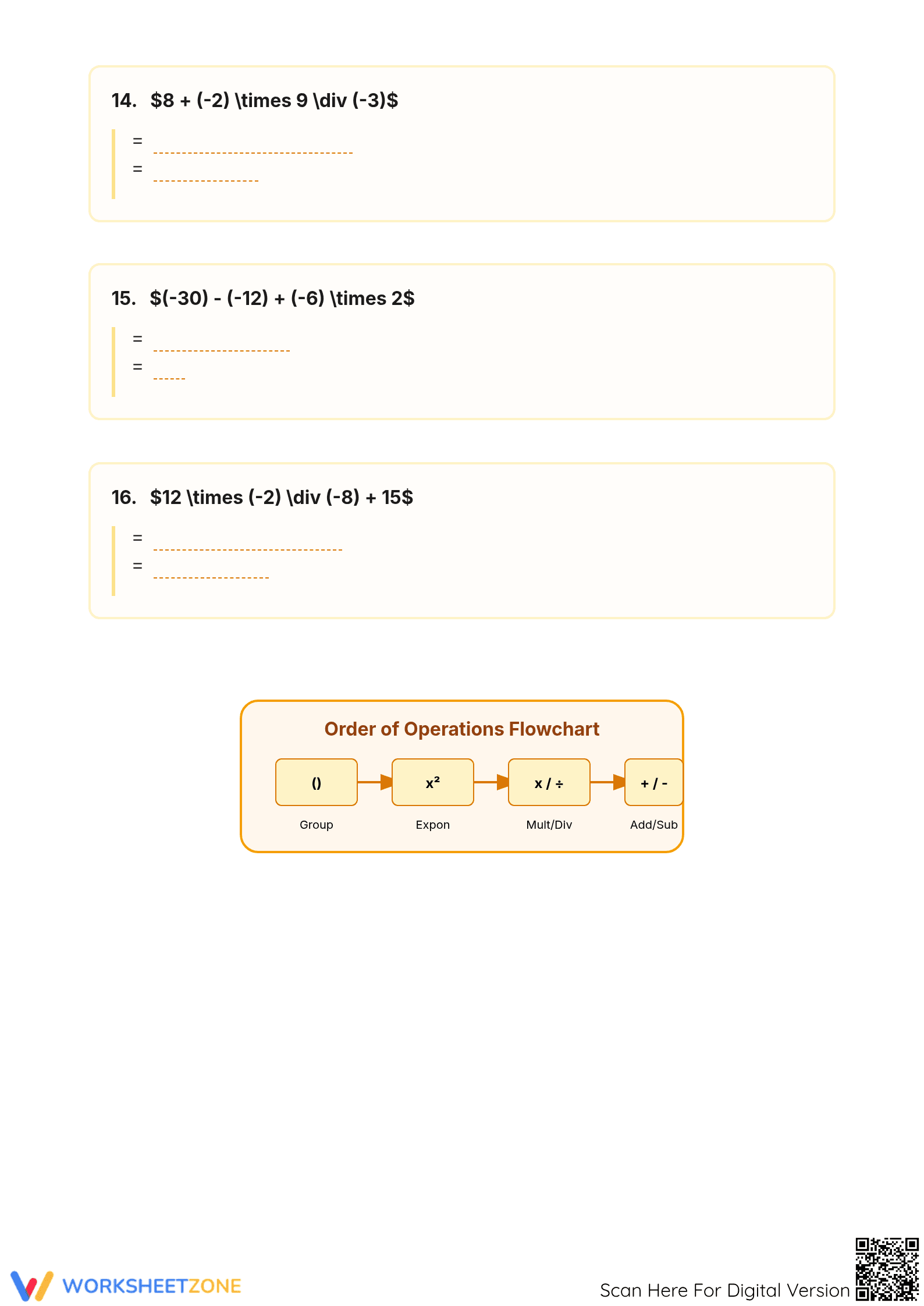
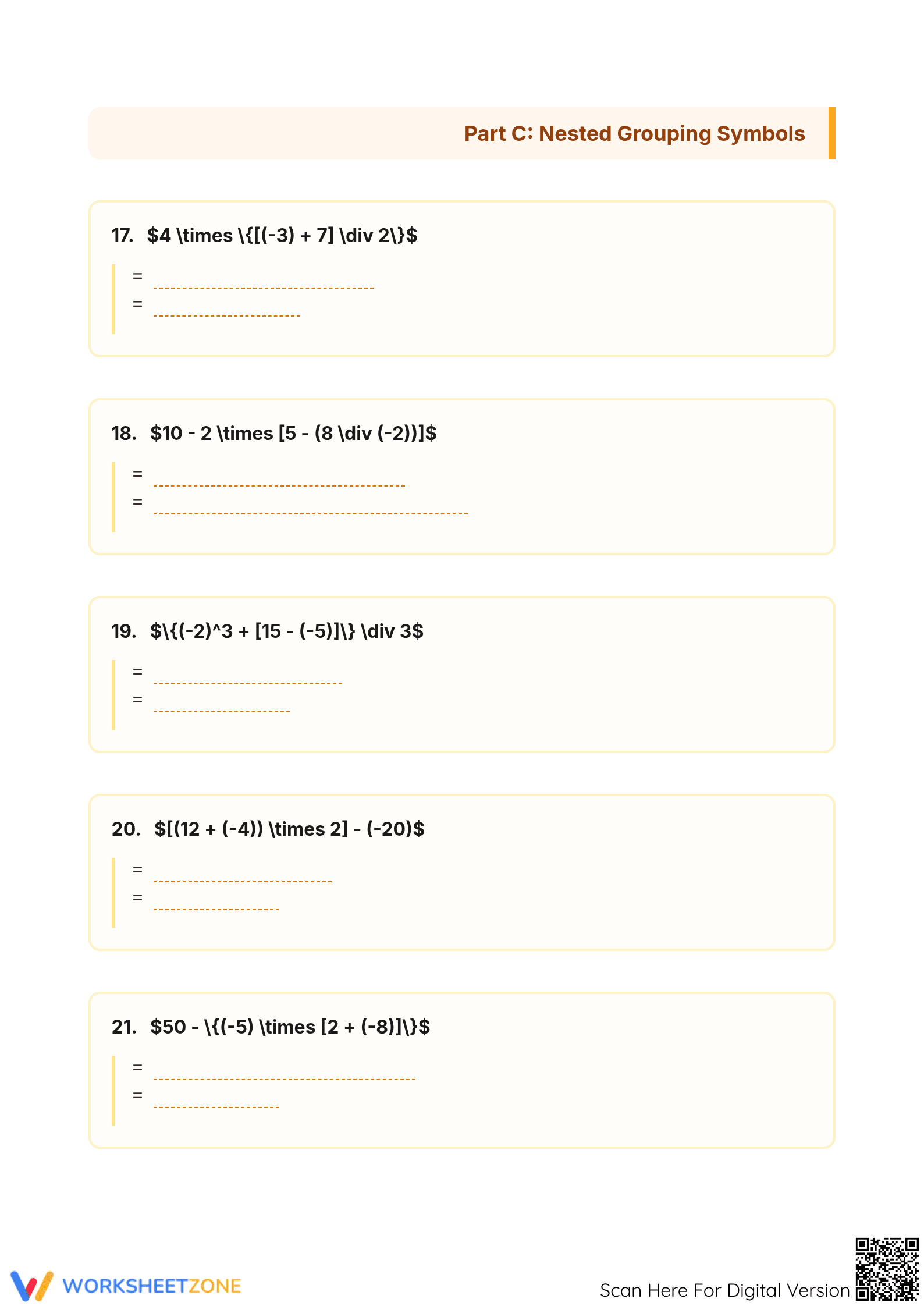
Across five detailed pages, students engage with 21 curated problems that transition from standard two-step operations to complex nested grouping symbols. The worksheet features dedicated spaces for showing intermediate steps, reinforcing the importance of mathematical process over mere answers. A visual flowchart on page four serves as a permanent anchor, guiding students through the priority of parentheses, exponents, multiplication, division, addition, and subtraction.
The curriculum is organized into three distinct tiers of mastery. Part A focuses on standard integer operations, establishing a baseline for sign rules and basic hierarchy. Part B introduces multiple operations, including exponents, mapping directly to early algebraic thinking. Part C challenges students with nested grouping symbols, requiring high-level precision. This progression allows teachers to enter scores directly into gradebooks or IEP progress notes to document specific sub-skill achievement.
This resource is primary aligned to `CCSS.MATH.CONTENT.7.NS.A.3`, which requires students to solve mathematical problems involving the four operations with rational numbers. It also supports `CCSS.MATH.CONTENT.6.EE.A.1` by incorporating exponents into multi-step numerical expressions. Both standard codes can be copied directly into lesson plans, IEP goals, or district curriculum mapping tools for seamless administrative integration.
Use this worksheet as a summative assessment following a unit on rational numbers to gauge student readiness for pre-algebra. Alternatively, distribute it as a guided practice tool during direct instruction, utilizing the included flowchart to model the gradual release of scaffolds. For formative observation, monitor students during Part C to see if they correctly prioritize the innermost grouping symbols before moving outward.
This resource is designed for middle school students in grades 6 through 8, providing the rigorous practice necessary for high school algebra readiness. It is particularly effective for students requiring visual aids, as the flowchart simplifies abstract rules. Pair this worksheet with a whiteboard number line or integer chips to support kinesthetic learners who may struggle with sign changes during subtraction.
Mathematical fluency in the middle grades is a critical predictor of later success in advanced STEM coursework. According to the EdReports 2024 analysis of instructional materials, high-quality alignment to the Common Core State Standards requires a balance of procedural skill and conceptual understanding. This worksheet achieves that balance by requiring students to show intermediate steps, which prevents the "black box" effect of calculating final answers without understanding the underlying logic. By systematically introducing exponents and nested symbols within the integer domain, the resource addresses the NAEP 2022 framework's emphasis on numerical operations as a foundation for algebraic reasoning. Research from Fisher & Frey (2014) underscores that structured, multi-step practice with immediate visual feedback—such as the flowchart included here—significantly reduces cognitive load during the acquisition of complex mathematical procedures. This self-contained module provides 21 opportunities for rigorous practice, ensuring students internalize the hierarchy of operations.


