


























Views
Downloads


Printable 2+2 Addition Practice Worksheet | Grade K Math
Paste this activity's link or code into your existing LMS (Google Classroom, Canvas, Teams, Schoology, Moodle, etc.).
Students can open and work on the activity right away, with no student login required.
You'll still be able to track student progress and results from your teacher account.
This essential Kindergarten math worksheet helps early learners master basic sums through 14 visual problems. Using oranges to represent numbers, students build a concrete understanding of how two sets combine, developing foundational arithmetic skills.
At a Glance
- Grade: Kindergarten · Subject: Math
- Standard:
K.OA.A.1— Represent addition with objects, drawings, and equations to find the sum- Skill Focus: Visual Addition Facts within 15
- Format: 2 pages · 14 problems · Answer key included · PDF
- Best For: Early math center or independent practice
- Time: 15–20 minutes
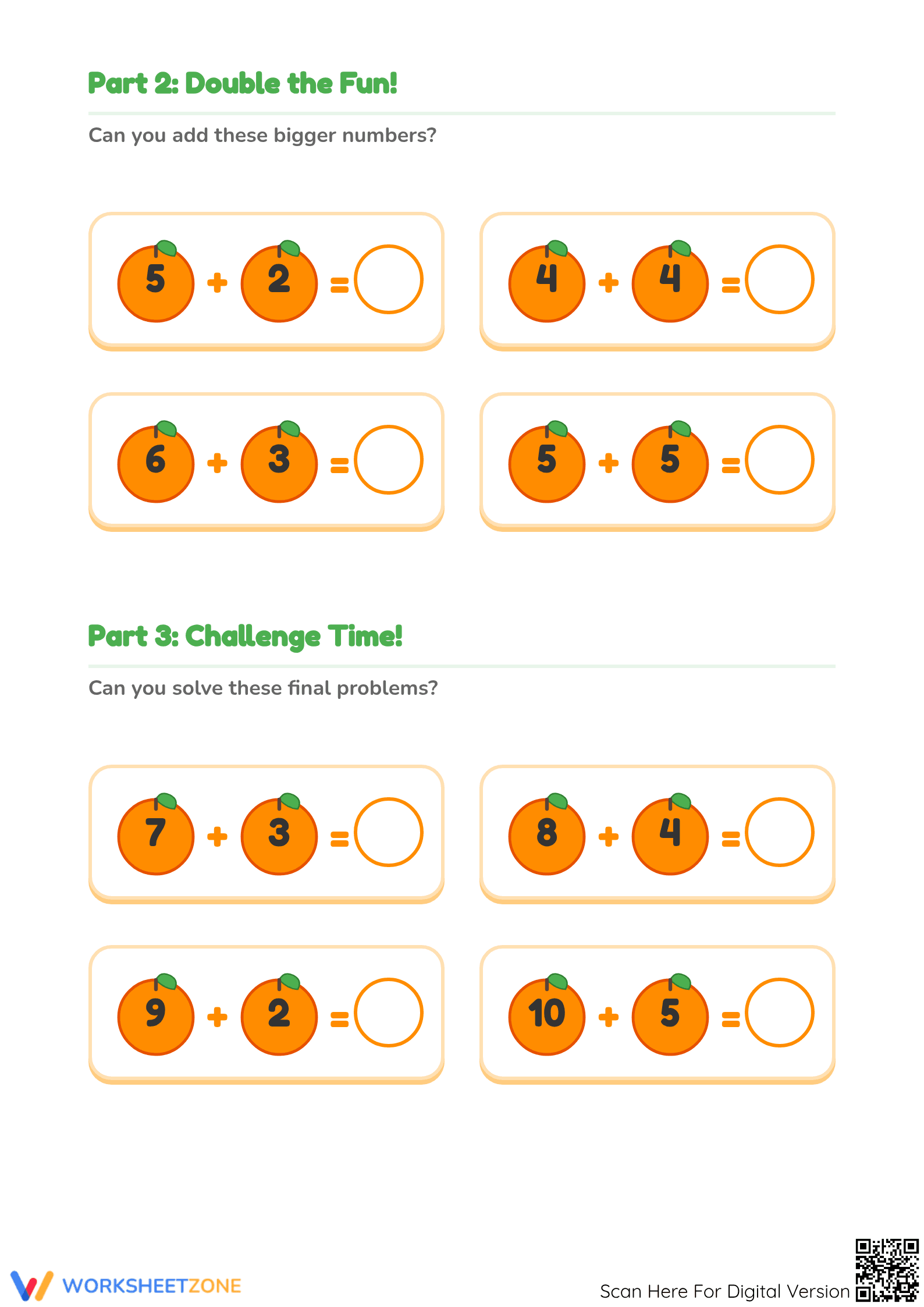
What's Inside: This two-page PDF uses a vibrant "Counting Game" theme with numbered oranges. The first page has six problems for small totals, while the second introduces larger numbers and a "Challenge Time" section. Each problem includes a clear workspace circle for students to record their final answers independently.
Skill Progression
- Guided Practice: First 6 tasks reinforce numbers 1-4, allowing students to count orange leaves or shapes to verify digits in the equation.
- Supported Practice: Tasks 7-10 increase complexity with numbers up to 6, requiring students to hold the first value while adding the second visual set.
- Independent Practice: Final 4 challenge problems push students to sums of 15, removing scaffolds to test application of addition strategies.
This resource follows a gradual-release model, moving from teacher modeling to independent mastery of single-digit and introductory double-digit totals.
Standards Alignment
Primary Standard: `CCSS.MATH.CONTENT.K.OA.A.1` - Represent addition and subtraction with objects, drawings, mental images, drawings, sounds, acting out situations, verbal explanations, expressions, or equations. This worksheet uses the "drawings" and "objects" modality to bridge physical counting and abstract numerical symbols. This code can be copied into lesson plans, IEP goals, or curriculum maps.
How to Use It
For direct instruction, use the first page as a guided activity. For a math center, provide manipulatives like orange counters for modeling. Observe if students count every orange or "count on" from the first number. Most students finish all 14 problems in about 18 minutes.
Who It's For
Designed for Kindergarten students beginning operations, this resource supports English Language Learners and students with IEPs who benefit from high-contrast visuals. Pair with a ten-frame anchor chart or counting-to-20 number line for extra support in the challenge section.
Research supports visual representations in early math, with concrete-to-representational-to-abstract (CRA) sequences improving retention in Preschool and Kindergarten. This worksheet ensures students develop a deep understanding of addition, not just memorizing facts. Studies show that mastering visual grouping in early grades leads to better performance in complex word problems. The worksheet bridges this gap by requiring students to use numbers on objects to find totals, building cognitive flexibility. An answer key provides immediate feedback, crucial for preventing early math misconceptions.


