


























Views
Downloads


Computer Modeling Crossword | Essential College Guide
Paste this activity's link or code into your existing LMS (Google Classroom, Canvas, Teams, Schoology, Moodle, etc.).
Students can open and work on the activity right away, with no student login required.
You'll still be able to track student progress and results from your teacher account.
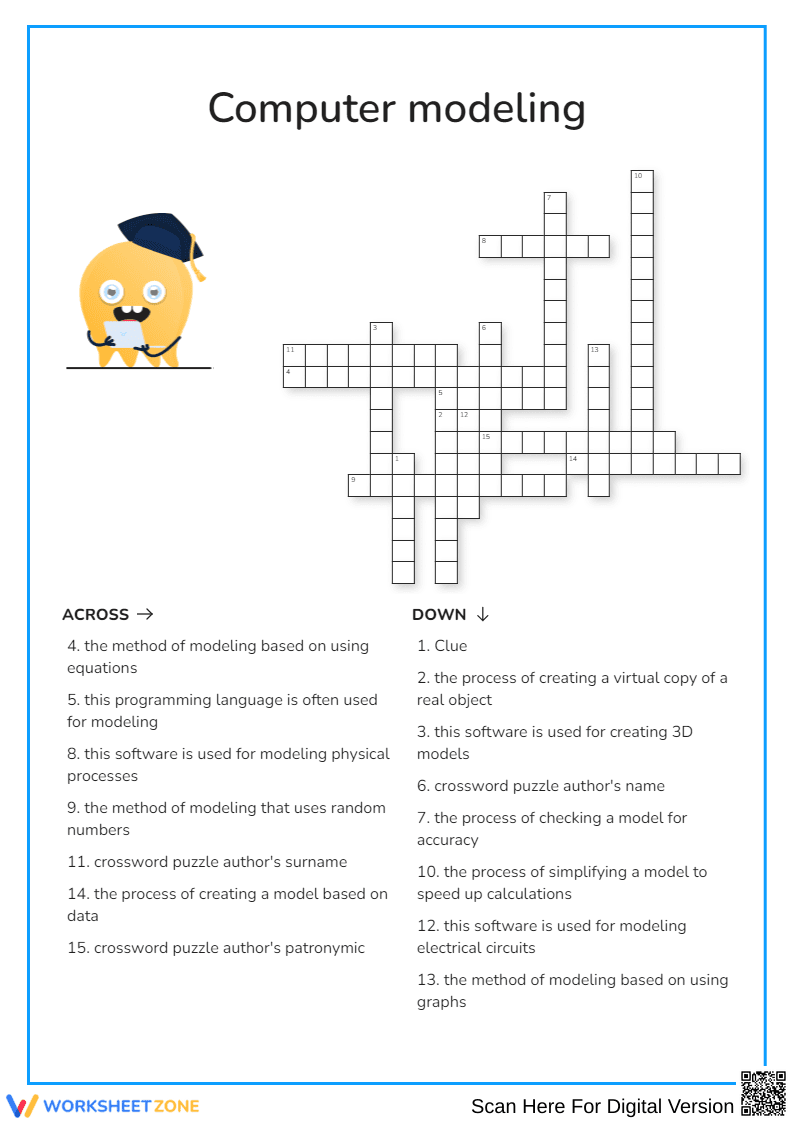
This computer modeling crossword provides a structured way for college students to reinforce technical vocabulary and conceptual frameworks. By identifying key terms like Monte Carlo methods, validation, and specific software tools, learners solidify their understanding of simulation processes. This worksheet ensures students can accurately define the components of virtual object creation and mathematical modeling.
At a Glance
- Grade: College · Subject: Computer Science
- Standard:
HS-ETS1-4— Use computer simulations to model impacts of proposed solutions- Skill Focus: Technical Vocabulary & Modeling Concepts
- Format: 2 pages · 15 problems · Word Bank included · PDF
- Best For: Vocabulary review and introductory terminology
- Time: 20–30 minutes
The resource consists of a 15-clue crossword puzzle and a comprehensive word bank. The first page features the puzzle grid with descriptive clues for both horizontal and vertical entries. The second page provides a word bank containing 15 specific terms, including software names like MATLAB and Blender, and methodological terms like approximation and validation. This structure supports students in bridging the gap between definitions and technical nomenclature.
This zero-prep worksheet is designed for immediate classroom implementation. Teachers can print the two-page PDF in less than 1 minute. Distribution takes approximately 30 seconds, and the self-contained word bank allows students to work independently without additional resources. Reviewing the completed puzzle as a whole-class activity typically requires 5 minutes, making the total teacher engagement time under 7 minutes. It serves as an ideal sub plan or warm-up activity.
This worksheet aligns with HS-ETS1-4, which requires students to use computer simulations and iterative modeling to analyze complex systems. While designed for college-level introductory courses, it mirrors the rigor of high school engineering standards by focusing on the process of creating virtual copies and checking models for accuracy. Both standard codes can be copied directly into lesson plans, IEP goals, or district curriculum mapping tools.
Use this worksheet as a formative assessment after a lecture on simulation methodologies. It is particularly effective during the instructional phase of a lesson. Teachers should observe whether students can distinguish between different modeling methods, such as equation-based versus random-number-based approaches. Completion usually takes 20 to 30 minutes, providing a quiet, focused interval for students to process complex terminology.
This resource is tailored for college students in introductory computer science or engineering programs. It is also suitable for advanced high school students in CTE pathways. The inclusion of a word bank provides necessary scaffolding for English Language Learners (ELL) or students new to technical modeling. It pairs naturally with a direct instruction lesson on numerical methods or 3D modeling software.
The use of crossword puzzles in higher education technical courses is supported by research into active learning and retrieval practice. According to Fisher & Frey (2014), structured vocabulary tasks help students transition from surface-level recognition to conceptual mastery of domain-specific language. This worksheet specifically targets the HS-ETS1-4 standard by requiring students to identify the tools and processes necessary for computer simulations, such as validation and mathematical approximation. By engaging with 15 distinct modeling terms, students build the linguistic foundation required for advanced engineering tasks. Research from the RAND AIRS 2024 report suggests that low-stakes retrieval activities, like this crossword, reduce cognitive load and improve long-term retention of technical definitions. This resource provides a clear pathway for students to demonstrate their understanding of how virtual models represent real-world physical processes through equations and data-driven algorithms.


