


























Views
Downloads

Essential Animal Diets Worksheet | Grade 1 Science
Paste this activity's link or code into your existing LMS (Google Classroom, Canvas, Teams, Schoology, Moodle, etc.).
Students can open and work on the activity right away, with no student login required.
You'll still be able to track student progress and results from your teacher account.
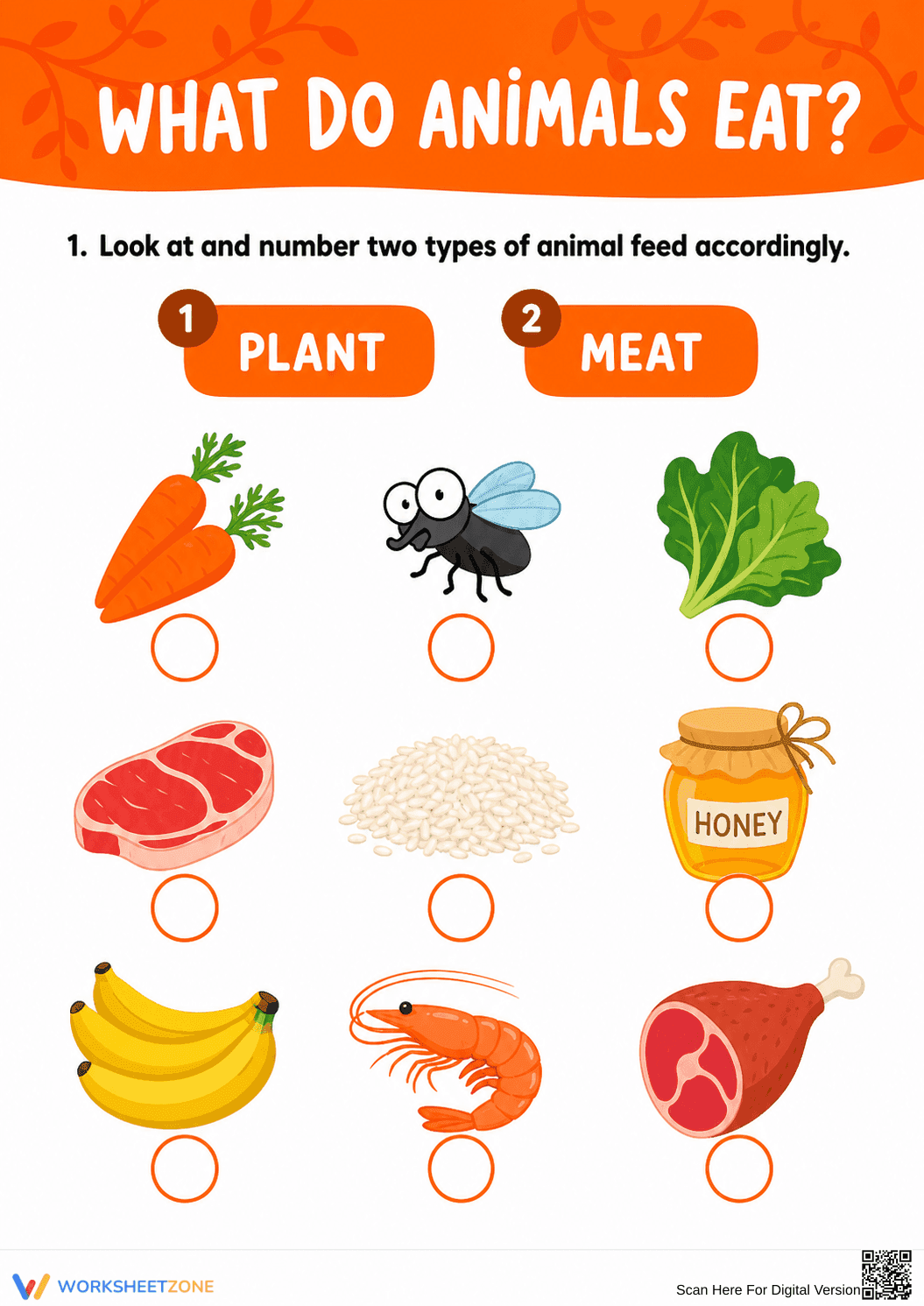
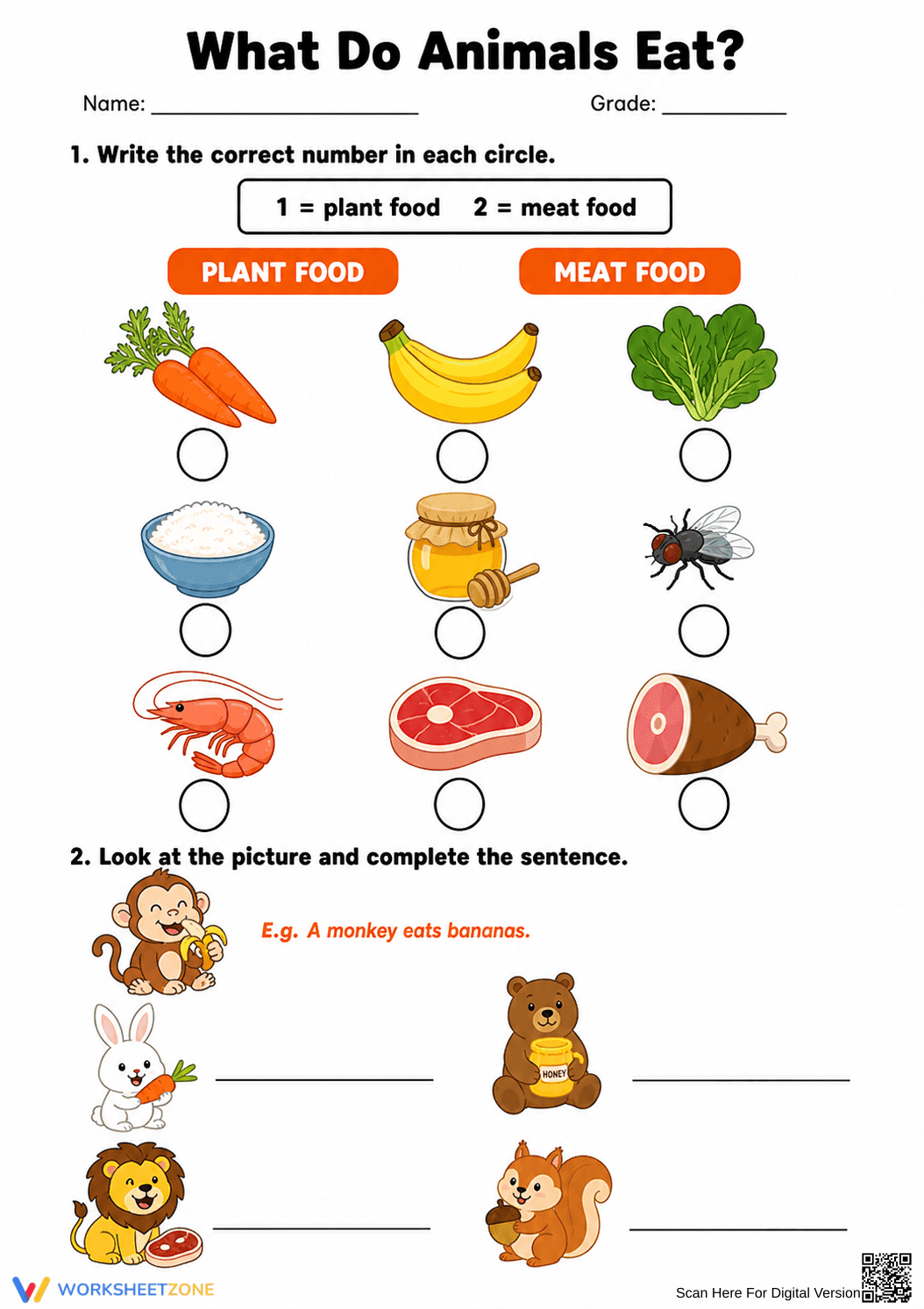
This Grade 1 science worksheet helps students identify and classify animal food sources. By distinguishing between plant-based and meat-based nutrition, learners build a foundational understanding of how different organisms survive in their environments. It provides immediate practice in categorization and basic sentence structure to support early literacy and scientific inquiry.
At a Glance
- Grade: 1 · Subject: Science
- Standard:
K-LS1-1— Use observations to describe patterns of what plants and animals need to survive- Skill Focus: Animal diet classification
- Format: 2 pages · 13 problems · Answer key included · PDF
- Best For: Introduction to herbivores and carnivores
- Time: 15–20 minutes
The resource consists of two high-quality PDF pages. The first page features nine vibrant illustrations of food items like carrots, steak, and honey, requiring students to code them as plant or meat. The second page reinforces this classification and adds four sentence-completion exercises where students describe the specific diets of a monkey, rabbit, lion, bear, and squirrel using visual prompts.
Zero-Prep Workflow
- Print: Generate copies of the two-page set in under 1 minute for your entire class.
- Distribute: Hand out the sheets as a standalone activity or a supplement to a lesson on living things.
- Review: Spend 5 minutes checking the classification numbers and sentences as a whole group to verify student mastery.
This workflow makes the worksheet an ideal choice for substitute teacher folders or unexpected schedule changes.
Standards Alignment
Primary standard K-LS1-1: "Use observations to describe patterns of what plants and animals (including humans) need to survive." This worksheet supports the standard by requiring students to observe various food sources and recognize the patterns in animal consumption. Both standard codes can be copied directly into lesson plans, IEP goals, or district curriculum mapping tools.
How to Use It
Use this during the "Explore" phase of a 5E science lesson on living things. After a brief discussion about what students ate for breakfast, assign the classification page to see if they can identify the origins of animal feed. It also works well as a formative assessment at the end of a unit on animal habitats to gauge understanding of dietary needs.
Who It's For
This is perfect for Kindergarten and Grade 1 students, as well as English Language Learners (ELL) who benefit from the clear visual cues. It pairs naturally with an anchor chart showing different animal teeth or a read-aloud book about food chains and forest ecosystems.
According to Fisher & Frey (2014), the use of visual scaffolds and classification tasks is essential for developing academic vocabulary in early childhood science. This worksheet aligns with the K-LS1-1 standard by focusing on the observable needs of organisms, a core component of the Next Generation Science Standards (NGSS). Research from the NAEP suggests that early exposure to biological classification helps bridge the gap between everyday observations and scientific reasoning. By identifying 13 distinct food sources, students engage in the crosscutting concept of patterns, which is a fundamental building block for later mastery of ecosystems and energy transfer. This resource provides a structured environment for students to practice these skills without the cognitive load of complex text, making it an effective tool for diverse learners in the primary classroom. The inclusion of sentence frames further supports the integration of science and literacy.


