


























This unit introduces students to the idea of measuring an object in both standard and nonstandard units. Students are going to:
- Frequently use a single nonstandard unit when measuring an object's length.
- Utilizing a standard one-inch, determine the length of an object.
- Give measured objects the proper label.
- How precise must measurements and calculations be?
- How are mathematical properties of things or processes measured, computed, and/or interpreted?
- What does it mean to evaluate or estimate a numerical quantity?
- What qualifies a tool or approach as suitable for a particular task?
- When is it appropriate to compute instead of estimate?
- Why does "how" we measure differ depending on "what" we measure?
- Inch: (Abbreviation: in.) A unit of length in the U.S. Customary and British Imperial systems is equal to 1/12 of a foot (2.54 centimeters).
- Measure: The extent, quantity, amount, or degree of something, as determined by measurement or calculation.
- box of tissues
- modeling clay
- large paper clips
- toothpicks/straws
- colored rods of varying lengths or plastic links
- pennies or counters
- connecting cubes
- Measurement Worksheet 2 (M-1-5-3_Measurement Worksheet 2)
- two different-colored 1-inch squares of card stock or paper (M-1-5-3_Colored Squares)
- 12-inch strip of tagboard per student with 1-inch boxes (M-1-5-3_12-Inch Ruler)
- Inch Worksheet (M-1-5-3_Inch Worksheet and KEY)
- Inch Worksheet 2 (M-1-5-3_Inch Worksheet 2 and KEY)
- Lesson 3 Assessment worksheet (M-1-5-3_Lesson 3 Assessment)
- You could use the information you observe from the lesson activities and class discussions to assess how well the students understand the subject matter.
- For an additional evaluation of student mastery, utilize the Lesson 3 Assessment (M-1-5-3_Lesson 3 Assessment).
Explicit instruction, modeling, scaffolding, and active engagement
W: Students learn how to measure using a standard unit and then review measuring with a nonstandard unit. When measuring length, students move from using several instances of a nonstandard unit to repeatedly using one instance of a unit.
H: Students will use one-inch squares to make their rulers.
E: Students measure a range of objects using modeling clay and a single nonstandard unit.
R: After completing the task, students gather to discuss their findings and go over what they learned. Students learn that when two students measure the same item, their measurements should be the same by using a standard unit measurement.
E: Assess students' comprehension through dialogue to ascertain what they know about measurement. Keep an eye on the students throughout the exercise to see if they are measuring by placing the standard and nonstandard square units end to end.
T: The lesson can be modified to fit the needs of the students. Students can work in small groups to complete an activity using square tiles for a less challenging option. Students measure lengths longer than a 12-inch ruler for an even greater challenge.
O: To practice measuring a variety of objects, students will work both individually and in pairs.
Note: If students have never worked with modeling clay before, allow them some time to practice creating "snakes" using the material.
"We'll keep measuring objects today. We intend to employ a marginally distinct method of measuring the objects. Let's go over how we measured the objects earlier." Assign a student to measure the length of a tissue box in front of the class using several examples of an unconventional unit, like a big paper clip. Ask the students to report the object's length and count the number of units arranged end to end. Make a note of the answer on the board. Discuss with the class the significance of making sure that every new paper clip is inserted precisely where the previous one ended, avoiding any spaces or overlaps. Explain to the class the significance of labeling the answers (e.g., large paper clips). "How could you possibly measure the same object if I only gave you one large paper clip? I'll demonstrate how to accomplish this for you." Using modeling clay, create a snake that is the object's length. Describe how the length of the snake must match the object's length. Line it up with the object's edge, then press the same paper clip into the snake, beginning at one end. Repetitively move the unit, finishing each movement with a fresh impression. Ask students to report the length once more, using the snake's impressions as a guide. "Is this the same length as the object that we measured the first time around?"
Consider the following:
Why does the quantity of impressions match the quantity of units initially counted?
An unconventional measuring device is the modeling clay snake.
"You can now work in pairs to complete the same task. You will use one nonstandard unit and modeling clay to measure objects." Give Measurement Worksheet 2 (M-1-5-3_Measurement Worksheet 2) to each pair. Assign modeling clay to each pair, along with one of several nonstandard units—a colored rod, straw, toothpick, penny, connecting cube, paper clip, or plastic link—for each pair. Explain to students that they will not be measuring the images of the book, shoe, and crayon, but rather a real book, shoe, and crayon. Ask students to use their objects to recreate the previous demonstration with clay snakes. Ask students to complete Measurement Worksheet 2 in pairs so they can present their results. Make sure that students are placing their units end to end, measuring accurately, and that their snakes are the same length as their objects by reviewing their work.
Regroup the students after they have completed the worksheet. "Why were the measurements different for us?" Students need to understand that the length of their books, shoes, and crayons may vary slightly. Additionally, there is a difference in their measuring units (pennies versus paper clips).
"Let's act as though we are going to construct something. You use your giant steps to determine the length of a board you require. You tell the clerk at the lumber yard that you need a board that is five giant steps long when you arrive. The clerk measures the board with his or her giant steps. What potential issue do you have?" Help students understand that the steps will have different lengths because the giant steps of the clerk and the students are different. "People created a standard measuring unit ages ago after making the same discovery that you did. We don't experience issues like the lumber yard because we use standard units. The inch is one of those common measurements. We are going to construct our inch ruler today and utilize it for measurement. Now would be a good time to read How Big is a Foot? by Muller Rolf."
Give each student twelve one-inch squares (six of each of two distinct colors) (see M-1-5-3_Colored Squares). (Or, using construction paper, create your 1-inch colored squares.) Utilizing the individual 1-inch squares, instruct students to measure the lengths in the M-1-5-3_Inch Worksheet and KEY.
For instance: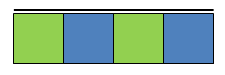
Once students have completed the Inch Worksheet, have one volunteer indicate how long the first line is. If every student answered correctly, ask them to raise their hands. "What makes every measurement identical?" (The same unit of measurement is used.)
Giving each student a prepared 12-inch tagboard strip (M-1-5-3_12-Inch Ruler), instruct them to paste their 1-inch squares, in alternating colors, along the tagboard strip's edge to create their rulers. Verify that students are switching colors and not overlapping the squares by monitoring their progress. Students can make the connection between the real units and the spaces on a ruler by fastening the individual units together. Students can recognize and count the individual units in the continuous configuration by switching up the colors on the strips. This first basic ruler should not have any numbers on it because numbers tend to direct students' attention away from the intervals and toward the endpoints of the units. Students should measure the objects on M-1-5-3_Inch Worksheet 2 and KEY) using this basic ruler. They will also use it for the Performance Assessment at the end of the unit (M-1-5_Performance Assessment and KEY).
Instruct students to line up the object with the ruler's edge, starting at the left end of the ruler. Once the students have finished the worksheet, make sure every student has the same answers. Discuss the differences in answers and how students measured their objects. Describe the benefits of using end-to-end attached units.
Students can finish the Lesson 3 Assessment (M-1-5-3_Lesson 3 Assessment) after they have finished discussing the findings. Students must use simple rulers to measure two pictures on the assessment.
Extension:
Routine: Cut different lengths of yarn and have students measure them with simple rulers.
Small Group: Have students measure each line and place their colored squares under the line using the Inch Worksheet (M-1-5-3_Inch Worksheet and KEY) and the two colored squares. Once the colored squares are glued down, have the students measure each line with their basic ruler. The answers that students provide ought to be identical.
Expansion: All of the items that students have been measuring in class are shorter than twelve inches. Give students a simple ruler and instruct them to measure objects that are longer than the ruler. They can measure curved distances as well.

Snake Imprints (M-1-5-3)
This unit introduces students to the idea of measuring an object in both standard and nonstandard units. Students are going to:
- Frequently use a single nonstandard unit when measuring an object's length.
- Utilizing a standard one-inch, determine the length of an object.
- Give measured objects the proper label.


