


























Views
Downloads
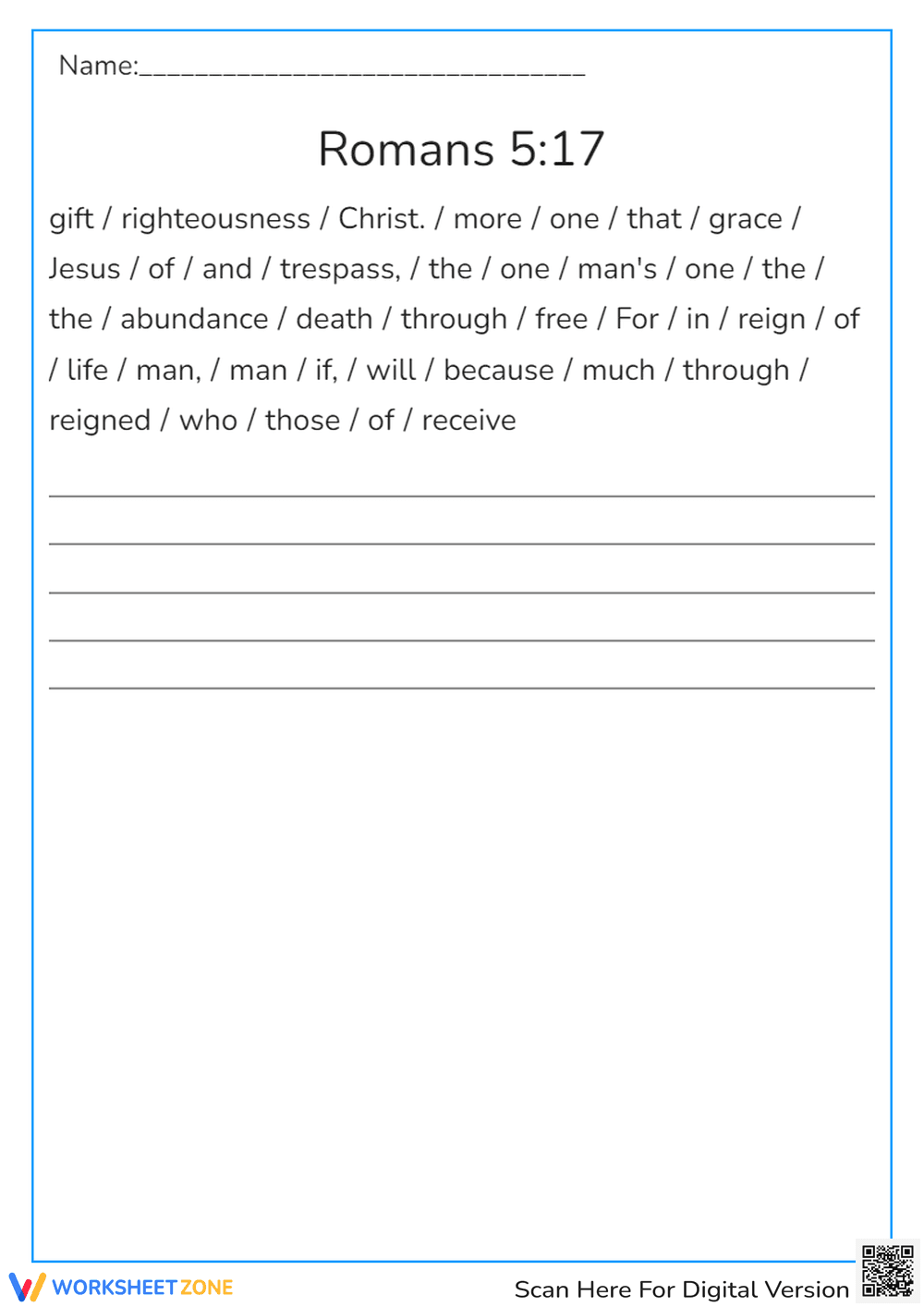

Romans 5:17 Sentence Scramble | Grade 3 Essential
Paste this activity's link or code into your existing LMS (Google Classroom, Canvas, Teams, Schoology, Moodle, etc.).
Students can open and work on the activity right away, with no student login required.
You'll still be able to track student progress and results from your teacher account.
This Grade 3 sentence scramble worksheet challenges students to reconstruct the text of Romans 5:17 from a randomized word bank. By organizing complex clauses into a coherent passage, learners strengthen their understanding of English syntax and sentence boundaries. It provides a meaningful way to practice grammar while engaging with a specific text.
At a Glance
- Grade: 3 · Subject: ELA
- Standard:
CCSS.ELA-LITERACY.L.3.1— Demonstrate command of standard English grammar and usage when writing- Skill Focus: Sentence structure and syntax
- Format: 1 page · 1 complex task · Answer key included · PDF
- Best For: Morning work or grammar practice
- Time: 10–15 minutes
Inside this resource, you will find a single-page PDF featuring a comprehensive word bank derived from Romans 5:17. The worksheet includes clear horizontal lines for students to rewrite the unscrambled passage. The layout is clean and distraction-free, ensuring students focus entirely on the linguistic task of ordering nouns, verbs, and prepositional phrases correctly. A full answer key is provided to facilitate quick grading or student self-correction.
The zero-prep workflow for this activity is designed for maximum efficiency. First, print the single-page PDF (30 seconds). Next, distribute the sheets to your students as they enter the classroom or transition between subjects (1 minute). Finally, review the completed sentences as a whole group to check for proper capitalization and punctuation (2 minutes). Total teacher preparation time is under two minutes, making it an ideal choice for busy mornings or unexpected sub plans.
This activity is aligned with `CCSS.ELA-LITERACY.L.3.1`, which requires students to demonstrate command of the conventions of standard English grammar. By identifying the subject-verb relationships within the scrambled text, students apply their knowledge of sentence patterns and word functions. This standard code can be copied directly into lesson plans, IEP goals, or district curriculum mapping tools to ensure all activities meet rigorous academic requirements.
Use this worksheet as a formative assessment during a unit on sentence structure. It works exceptionally well as a "bell ringer" to settle the class or as a quiet activity for early finishers. Observe whether students identify the capitalized "For" as the starting word, which serves as a key indicator of their understanding of sentence mechanics and visual cues. Completion typically takes 12 minutes for most third-grade learners.
This worksheet is ideal for third-grade students who are moving beyond simple sentences into more complex structures. It is particularly useful for learners who benefit from tactile or logic-based language puzzles. Pair this with a short lesson on coordinating conjunctions or use it alongside a Bible study curriculum to reinforce both literacy and content knowledge simultaneously. It is also a helpful tool for English Language Learners practicing word order.
Research by Fisher & Frey (2014) emphasizes that scrambled sentence tasks are highly effective for developing syntactic awareness in elementary learners. By requiring students to manipulate word order to create meaning, this Romans 5:17 worksheet directly supports the mastery of CCSS.ELA-LITERACY.L.3.1. The task forces students to attend to grammatical markers and logical flow, which are foundational components of reading fluency and writing clarity. According to the RAND AIRS 2024 report, structured practice with complex sentence reconstruction significantly improves a student's ability to decode difficult informational and literary texts. This resource provides a focused, low-stakes environment for students to experiment with word placement while ensuring they reach a correct, standardized outcome. It serves as a practical tool for teachers looking to integrate grammar conventions into daily routines without the need for extensive instructional overhead or complicated grading rubrics.


