


























Views
Downloads

Patterns of Natural Selection Worksheet | Essential Biology
Paste this activity's link or code into your existing LMS (Google Classroom, Canvas, Teams, Schoology, Moodle, etc.).
Students can open and work on the activity right away, with no student login required.
You'll still be able to track student progress and results from your teacher account.
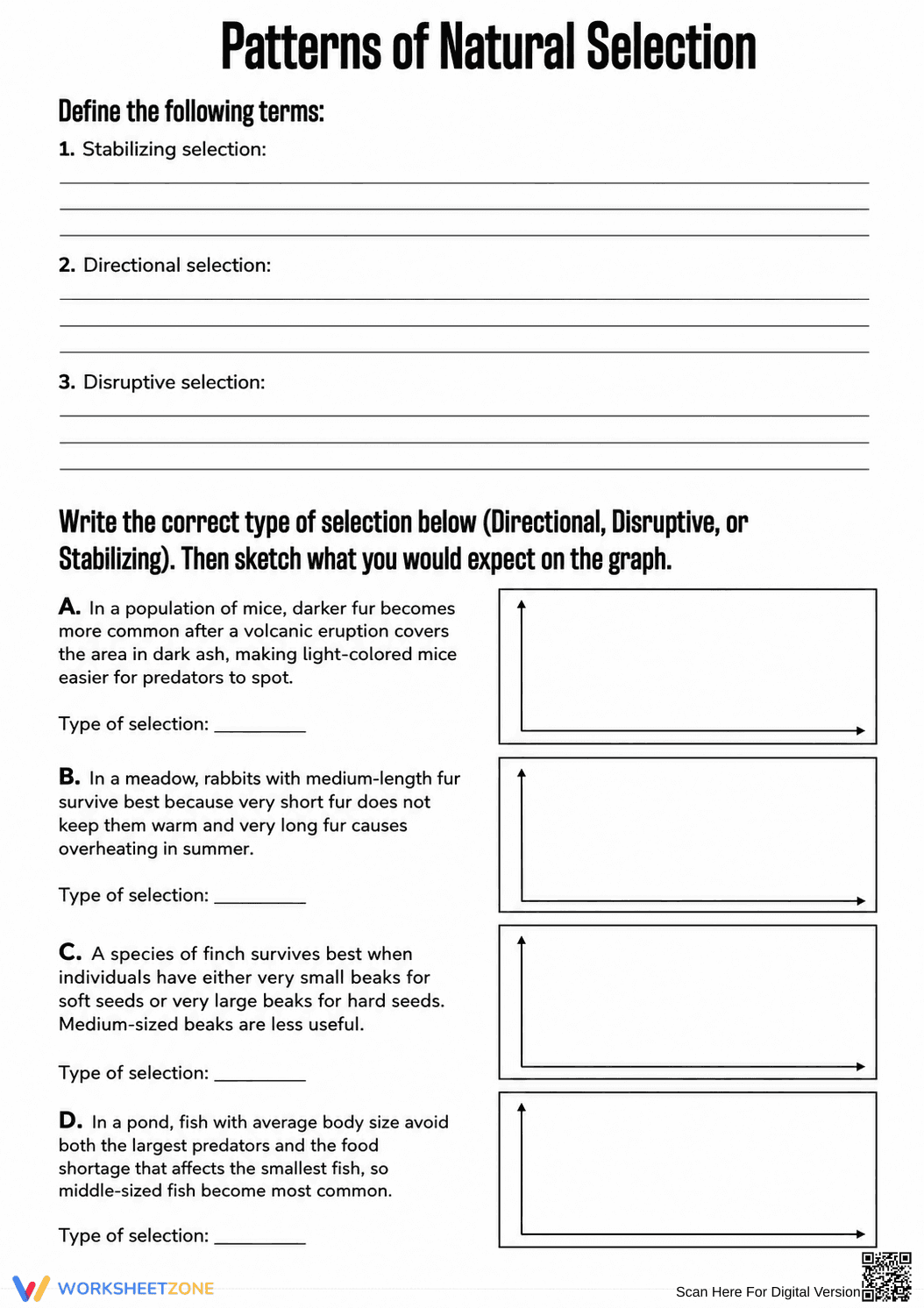
This Essential biology worksheet provides a structured framework for students to master the three primary modes of natural selection. By requiring students to define key terms and apply concepts to specific environmental scenarios, the resource ensures learners can visualize how selective pressures drive evolutionary change within a population over time.
At a Glance
- Grade: 7–12 · Subject: Biology
- Standard:
HS-LS4-3— Explain how advantageous heritable traits increase in proportion within a population- Skill Focus: Natural Selection Patterns
- Format: 1 page · 7 tasks · Answer key included · PDF
- Best For: Formative assessment and graphing practice
- Time: 15–20 minutes
What's Inside
The worksheet is divided into two high-impact sections. The first features three writing prompts for defining stabilizing, directional, and disruptive selection. The second presents four biological scenarios involving mice, rabbits, finches, and fish. Each scenario includes space for identifying the selection type and a coordinate plane for sketching the predicted population shift, providing a dual-modality approach to learning.
Zero-Prep Workflow
This resource is designed for immediate classroom implementation with minimal preparation. Follow these steps for seamless integration:
- Print: Select the single-page PDF and print enough copies. No collating or stapling is required.
- Distribute: Hand out the worksheet as a mid-lesson check for understanding or independent practice.
- Review: Use the included answer key to facilitate a quick whole-class review, allowing students to self-correct their graphs and definitions.
Standards Alignment
This resource aligns with `HS-LS4-3`: "Apply concepts of statistics and probability to support explanations that organisms with an advantageous heritable trait tend to increase in proportion to organisms lacking this trait." It also supports MS-LS4-4 by focusing on how genetic variations increase survival probability. These codes can be copied directly into lesson plans or curriculum mapping tools.
How to Use It
Use this worksheet as a formative assessment following a lecture on evolutionary mechanisms. As students work through the scenarios, circulate to observe if they are correctly shifting the bell curve on their graphs; this provides an instant visual cue of comprehension. It also serves as an excellent homework assignment to reinforce the distinction between selection types before a unit exam.
Who It's For
This worksheet is tailored for middle and high school biology students. It is particularly effective for visual learners who benefit from sketching graphs. It pairs naturally with anchor charts or digital presentations showing real-world examples like the peppered moth or Darwin's finches.
According to the RAND AIRS 2024 report on science instructional materials, high-quality worksheets that require students to translate verbal descriptions into visual representations—such as these graphing tasks—significantly improve long-term retention of complex biological mechanisms. By explicitly defining selection types before applying them to scenarios like finch beak size, students build a robust mental model of population dynamics. This resource provides the structured practice necessary for students to explain how advantageous traits increase in frequency over time, bridging the gap between abstract theory and observable data patterns.


