




























Views
Downloads
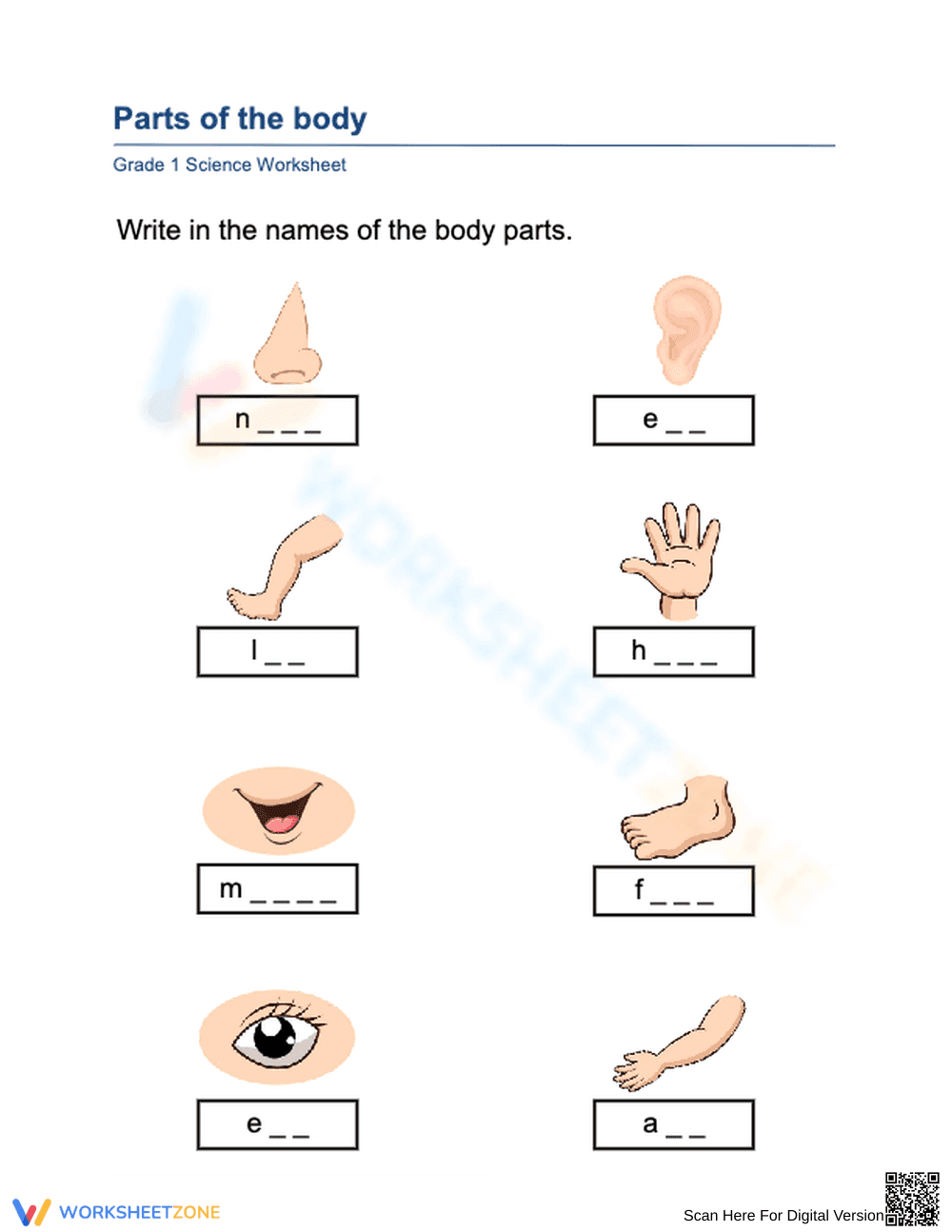

Essential Parts of the Body Worksheet | Grade K Science

Paste this activity's link or code into your existing LMS (Google Classroom, Canvas, Teams, Schoology, Moodle, etc.).
Students can open and work on the activity right away, with no student login required.
You'll still be able to track student progress and results from your teacher account.
Identifying human anatomy is a foundational skill for early learners. This "Parts of the Body" worksheet helps Kindergarten students connect visual images of common anatomy—such as the nose, ear, and leg—with their written names. Students practice spelling and vocabulary recognition through a guided fill-in-the-blank format that builds scientific observation and literacy skills simultaneously.
At a Glance
- Grade: Kindergarten · Subject: Science
- Standard:
K-LS1-1— Use observations to describe patterns of what humans need and anatomical structures- Skill Focus: Human anatomy identification and vocabulary
- Format: 2 pages · 8 problems · Answer key included · PDF
- Best For: Early science lessons and health units
- Time: 10–15 minutes
What's Inside
This two-page PDF resource features a clean, high-contrast layout perfect for young learners. The first page presents eight distinct illustrations of body parts including the eye, mouth, and arm. Each illustration is paired with a spelling box containing the first letter and blank spaces for the remaining characters. The second page provides a complete visual answer key for immediate student feedback or teacher grading.
Zero-Prep Workflow
- Print: 30 seconds to generate the single-page student copy.
- Distribute: 20 seconds to hand out during science or health blocks.
- Review: 1 minute to check for accuracy using the provided answer key.
This resource is designed for immediate classroom implementation with a total teacher prep time of under 2 minutes. It is an ideal choice for emergency sub plans or quick transitions.
Standards Alignment
Aligned to `K-LS1-1`, this worksheet supports the observation of patterns in human anatomy and biological structures. By identifying specific external parts, students begin to understand how different structures function to help humans interact with their environment. Both standard codes can be copied directly into lesson plans, IEP goals, or district curriculum mapping tools.
How to Use It
Deploy this worksheet during a "Body and Health" unit after singing "Head, Shoulders, Knees, and Toes" to reinforce the connection between movement and vocabulary. For a formative assessment observation, watch how students use the provided first-letter scaffolds to attempt spelling the words. This helps identify learners who may need additional phonics support or visual aids for common anatomical terms.
Who It's For
This resource is tailored for Kindergarten students but serves as an excellent review for Grade 1 learners or English Language Learners (ELL) requiring basic vocabulary support. It pairs naturally with a life science anchor chart or a read-aloud about the five senses, providing a structured way for students to demonstrate their understanding of basic human biology.
According to RAND AIRS 2024, the integration of visual scaffolds with phonemic awareness tasks significantly improves retention of scientific vocabulary in early childhood education. This worksheet utilizes high-quality illustrations to bridge the gap between abstract biological concepts and concrete identification. By aligning with standard K-LS1-1, it ensures students meet foundational benchmarks for human anatomy and observation. The clear structure supports the gradual release of responsibility, allowing young scientists to build confidence in spelling and anatomical knowledge. Education researchers at Fisher & Frey (2014) emphasize that such guided practice is essential for developing the complex cognitive schemas required for later scientific inquiry. This resource provides a practical, evidence-based tool for teachers to assess and develop student mastery of essential body part identification, ensuring all learners have a strong foundation in health and science literacy.


