


























Students will acquire a deeper comprehension of the notion that numbers consist of parts. At the end of the lesson, they are going to:
- accurately count and determine "how many" items there are in a set.
- count forward and backward to at least 20 both with and without objects.
- acknowledge that an object's position in a sequence or the number of objects in a set can both be represented by a number.
- combine objects and pictures to create and break down numbers up to ten.
- gain knowledge of ordinal and cardinal numbers, their relationships, and the relative positions and magnitudes of whole numbers.
- connect numerals and number words to the quantities they stand for by employing a variety of physical models and depictions.
- What happens if I combine or divide a set of numbers (objects)?
- How does mathematics aid in effective communication?
- How do patterns and relationships connect in math?
- How can numbers be represented, compared, quantified, and modeled using mathematics?
- What does it mean to evaluate or estimate a numerical quantity?
- What qualifies a tool and/or strategy for a specific task?
- When is it better to estimate rather than calculate?
- Cardinal Number: A number identifying quantity, but not order, in a set.
- Ordinal Number: A number denoting relative position in a sequence, such as first, second, third, etc.
- a paper bag containing 10 to 20 farm-animal counters (or pictures)
- T-chart labeled with Yes/No drawn on board or chart paper
- additional farm-animal counters for student use (see http://www.learningresources.com ) or any other counters, or small cards with several different types of animal pictures on both sides
- one cup for each child
- barn story board (M-K-1-4_Barn Story Board).
- student copies of Animal Spill Recording Sheet (M-K-1-4_Animal Spill Recording Sheet)
- To help determine the fluency and comprehension level of each student, make use of observations during workstations, classroom discussions, and one-on-one conferences.
- You can use the Random Reporter method at any point in the lesson to make sure that students are learning the skills of composition and decomposition and are headed in the right direction.
Explicit instruction, modeling, scaffolding, and active engagement
W: To help students become more fluent with groups, counting, numbers, and parts, use a secret number to practice joining (composting) and breaking apart (decomposing) numbers.
H: To engage students in the lesson and show that there are multiple ways to arrive at a given number, use the Guess What's in My Bag activity.
E: Using the provided storyboard, assign students to work individually or in pairs to play Animal Spill. The purpose of the exercise is to improve the student's comprehension of groups and parts.
R: Students will keep practicing Animal Spill at their workstations using their secret number, noting their progress along the way. You can change secret numbers frequently if needed. As soon as misunderstandings or confusion arise, clear them up.
E: To ensure that students are following the protocol precisely and correctly, have them perform the Animal Spill exercise.
T: You can repeat the activity multiple times, swapping out the storyboard for a different secret number each time.
O: The goal of this lesson is to help students grasp more fully that numbers are composed of parts. This lesson's primary activities include having students create questions to probe deeper into the material, keeping track of observations and parts identification with the help of a T-chart and Animal Spill Recording Sheet, and employing secret numbers. In each exercise, students are asked to think about how two other numbers can represent any given number without affecting its value.
"We will spend the majority of today working with our secret numbers at our workstations. To improve our math skills, we will practice adding and subtracting numbers. Before our start, I would like to show you this special bag."
Guess What’s in My Bag Activity
Gather counters (farm animals, if possible) or Animal Spill Recording Sheets (M-K-1-4_Animal Spill Recording Sheet), and the Barn Story Board (M-K-1-4_Barn Story Board) before starting this activity.
Make a Yes/No T-chart on the chart paper or board, and prepare a paper bag containing ten to twenty farm animal counters. Present the bag to the students and inform them that they must ask you questions about the contents. They must pose questions that can be answered with a simple "yes" or "no." Write the question on the T-chart under the Yes or No column after you have responded to each question.
Say, "I've got something in my bag. Guess what I put in the bag, please. You can determine it by posing questions to me that I can respond to with a simple "yes" or "no." As an illustration, you may ask me, "Is it red?" I can say "yes" or "no" in response to that. Similarly, a "yes" or "no" response to the question "Can I use it to draw with?" To the question, "What color is it?" I am unable to respond with a simple "yes" or "no."
Repeat the other questions with "yes" or "no" responses.
"We can try to figure out what's inside my bag by asking me ten questions as a class today. Do not forget that I will record the questions in the T-chart."
Once all ten questions have been asked, carry on with the activity. If students are unable to guess what is in your bag, you can explain it to them or provide hints so they can figure it out.
"I'll be demonstrating a new workstation to you today that makes use of some farm animals we had in the bag. It's known as Animal Spill. Just like you do with every workstation, you will utilize your secret number for Animal Spill."
Secret numbers between 4 and 12 should be assigned to each student. Students receive a number based on their proficiency with counting, composing, and decomposing tasks. If needed, you could have a chart where each secret number is covered in a sticky note so that students can find their secret number. Secret numbers should change as students improve their counting strategies and composition and decomposing abilities.
"Seven is my secret number. Consequently, I must fill my cup with seven farm animals. I believe I'm going to use pigs today. Any animal you like can be your choice. Have you noticed how I arranged every pig in my cup? You then need to shake the cup three times while placing your hand over the top in this manner."
When shaking a cup, demonstrate to the students how to cover the top of the cup to prevent animals from spilling out.
"Hold the cup approximately one foot above the Barn Story Board after you've given it three shakes. After that, carefully pour the animals onto the Barn Story Board."
Teach students to hold the cup high enough to prevent the animals from spilling out. To create two sections—on and off the barn—the intention is for some of the animals to land on and some off the barn. You can adjust the height at which you want students to spill their cups.
"Let's see where the animals ended up on my storyboard."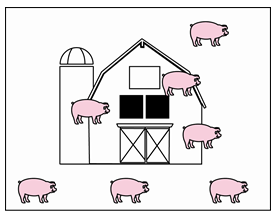
"Some pigs landed on the barn, while others landed off the barn. Let's see how many pigs there are in the barn."
When the pigs land on the board, count them with the students.
"In our cup, we had seven pigs. In the barn, we counted three pigs. Together, we will count the pigs to see how many have left the barn."
Some students can quickly count the pigs on their landing. Before counting, some people might need to collect every pig that landed off the board and arrange them in a certain order. If students are having trouble keeping track of the pigs, discuss effective counting techniques.
"Our cup contained seven pigs. Four pigs, as we counted them, fell off the barn. How can we use our numbers to describe what we see on our board?" Ask a few students to share their thoughts at random.
One possible answer from a student would be: "I believe we can say 4 and 3 make 7 because 4 pigs are off the barn and 3 pigs are on the barn. At first, there were seven pigs in our cup. We remain at 7 pigs because we did not add any more."
"Discuss with your neighbor your thoughts on our pigs and how we can utilize them to teach about the number seven."
Allow students to have a conversation with one or two neighbors. Pick a few students at random to discuss their ideas. Some examples from students could be: There are four pigs off the barn and three pigs on the barn. Thus, 3 pigs plus 4 pigs equals 7 pigs in our cup, or I know that to have 7 pigs, I will need 3 more pigs if I already have 4.
On the board or chart paper, make a T-chart and write the number of pigs in and out of the barn on the left and right sides of the chart. Provide an example of writing a number sentence on the board using the numerals: "3 pigs on + 4 pigs off is the same as 7 pigs."
"Let's put the seven pigs back in the cup and let them spill out once more."
Make sure the students understand the instructions by having them practice the Animal Spill workstation a few more times. Proceed to enter the results into the identical T-chart while demonstrating on the board how to write the numerals in each example sentence.
"We will practice number combinations on workstations for the next few days. I'm going to add Animal Spill to our desks. I'll be visiting each group to see how things are going while you're working. I'll be right over to join your group if you raise your hand in silence with a question. I might be enlisting the assistance of a small group as well. Please stay at your workstation and don't interrupt if I'm working with a small group. Recall that over the next few days, everyone will have the chance to work with the Animal Spill workstation."
While students are utilizing Animal Spill or other composing or decomposing methods on their workstations, make sure to stop by every student, correcting any errors they may have made and allowing them to clarify their ideas. Based on students' responses to your questions, you will be able to determine where they are in their learning process. You'll be able to dispel misunderstandings. You can use the following examples of questions to pose to students as they work:
"Are you going to count the animals on your storyboard?"
"What are some methods you've discovered for creating the number ___?"
"Do you believe you've figured out every way to make ___? Why do you believe that?"
"How many animals are there on your storyboard—five or fewer? "How did you find out?"
"On your board, there are ___ animals. How many animals would you have on your board if I gave you one more?"
"On your board, there are ___ animals. How many animals would you have on your board if you were to give me just one?"
Once the students have utilized the Animal Spill workstation multiple times, present the Animal Spill Recording Sheet to them.
"I'll walk you through filling out the Animal Spill Recording Sheet today. Seven is my secret number. I will have to write down what is on my storyboard once I have spilled my animals onto it."
Place the animals on the storyboard. We'll use the following example to walk through the M-K-1-4_Animal Spill Recording Sheet recording sheet in more detail..png)
"There are nine tiny barns on my recording sheet. Under the barn, there are a few words and blanks as well. They assert that ___ and ___ are equivalent to ___. To complete the recording sheet, I must draw my animals. I'll use circles to represent my pigs because I don't want to spend a lot of time drawing them. I'll sketch six pigs off the barn and one pig on the barn. In my cup, how many pigs did I have?" (seven) "That's accurate. There were seven pigs in my cup. I have to complete the statement "___ and ___ are the same as ___." after I have drawn my pigs. Who knows how I could fill it in?"
As you hear students' responses, draw attention to their clever ideas.
"____, you mentioned an idea. Could you elaborate on your thoughts?" (Possible explanation: We counted 6 pigs off the barn and 1 pig on the barn. Consequently, we received a 6 and a 1. We could write 6 and 1 is the same as 7, in my opinion. Seven pigs were in the cup. I have seven pigs if I count one more after I have six.)
Use this chance to talk about having 6 and 1 as opposed to 1 and 6. Stress the commutative property's application to this situation and other potential number combinations that students might come across.
Show students how to write number sentences with the equal plus signs included. Get a student to assist you in filling out the recording sheet so you can reinforce the proper sentence structure. Say out loud the number of sentences.
Remind students to depict the animals with squares or circles. Drawing the animals by hand would take too long. Assign students to complete their Animal Spill Recording Sheet by allowing them to "spill" their own animals and documenting the outcomes for a predetermined number of times (three to nine should suffice, depending on scheduling constraints).
You may want to assess students' understanding of composing and decomposing numbers using another animal spill or related activity after they have had multiple chances to practice and receive feedback on the Animal Spill activity. Another option would be to set up a station rotation where students are forced to count the "spill" accurately several times. This would remove the chance that a student would get good marks by guessing.
Extension:
Routine: Have students count the objects and sets they see or use during activities and book reading. Point out instances where a number can be seen in segments to your students. Students should be encouraged to bring examples of numbers that can be composed or decomposed from what they see at home to share in class. Stress the importance of using precise vocabulary words that are required to convey ideas related to numbers. As students' ideas become clearer, give them the chance to edit their work and keep an eye on their responses and progress.
Expand: Changing each student's secret number is one way to customize the farm animal exercise. A child has to be familiar with more combinations, the higher the number.
Students who are struggling or feeling discouraged about their efforts should have their secret number reduced; as they regain confidence, the number should be gradually increased once more. If students can understand the concepts easily, increase the number to 20 or higher.
Students will find the exercise engaging if the manipulatives and storyboard are changed periodically.
Fine Motor Skills: During class activities or stations, students who struggle with fine motor skills should work with a partner. Give your partner instructions to do things like spill the animals and note the outcomes. Throughout the activity, both students will participate in the vocal suggestions and counting.
Small Group: Children who are struggling can benefit from instruction in small groups. Based on information about the students from observation and other formative assessments, create one or more small groups. Go over the rules for the Animal Spill game with the groups. Put three or four creatures in each cup. While students record, reveal the animals, and demonstrate their way of thinking. Students should respond to a few questions regarding your work. After two or three rotations, have the focus switch to the students explaining what they are thinking as they write.
Expansion: Take Animal Spill and give it a new twist. Just a portion of the farm animals (counters) should be emptied from the cup; do not empty it. After that, flip the cup over (keeping the remaining tools inside). As a challenge, ask students to estimate or compute how many counters are still inside the cup by counting how many have fallen out.

Numbers Are Made of Parts (M-K-1-4)
Students will acquire a deeper comprehension of the notion that numbers consist of parts. At the end of the lesson, they are going to:
- accurately count and determine "how many" items there are in a set.
- count forward and backward to at least 20 both with and without objects.
- acknowledge that an object's position in a sequence or the number of objects in a set can both be represented by a number.
- combine objects and pictures to create and break down numbers up to ten.
- gain knowledge of ordinal and cardinal numbers, their relationships, and the relative positions and magnitudes of whole numbers.
- connect numerals and number words to the quantities they stand for by employing a variety of physical models and depictions.


