


























0
Views
0
Downloads

0.0
0
Save
0 Likes
Share
Moderate Part of Circles: Geometry Practice
0 Views
0 Downloads
Paste this activity's link or code into your existing LMS (Google Classroom, Canvas, Teams, Schoology, Moodle, etc.).
Students can open and work on the activity right away, with no student login required.
You'll still be able to track student progress and results from your teacher account.
Information
Description
What It Is:
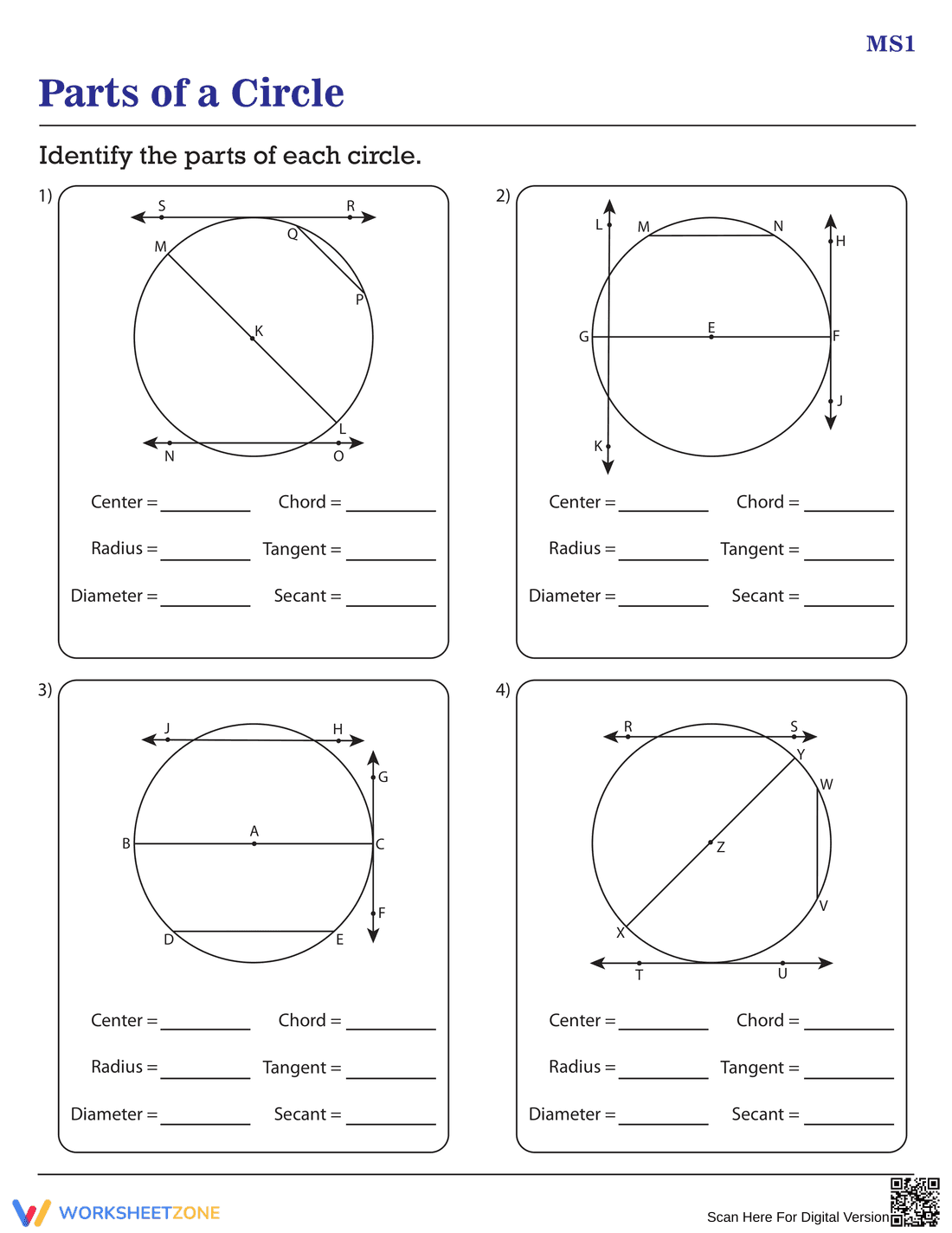
This is a geometry worksheet titled 'Parts of a Circle.' It contains four different circles, each with various lines and points labeled with letters. Students are asked to identify specific parts of each circle, such as the center, chord, radius, tangent, diameter, and secant, based on the given diagrams. Each circle has blank lines for students to write their answers.
Grade Level Suitability:
This worksheet is suitable for grades 6-8. It reinforces geometry concepts related to circles, which are typically introduced in middle school mathematics. The task of identifying circle parts requires understanding of definitions and spatial reasoning, making it appropriate for this age range.
Why Use It:
This worksheet helps students solidify their understanding of the different parts of a circle and their definitions. It provides practice in visually identifying these parts in various diagrams. It enhances geometry vocabulary and spatial reasoning skills.
How to Use It:
Students should carefully examine each circle diagram and use their knowledge of geometry terms to identify the requested parts (center, chord, radius, tangent, diameter, secant). They should write the corresponding letters or line segments on the provided blank lines for each circle.
Target Users:
The target users are middle school students (grades 6-8) who are learning about circles in geometry. It can also be used for review or remediation for students who need extra practice with these concepts.
This is a geometry worksheet titled 'Parts of a Circle.' It contains four different circles, each with various lines and points labeled with letters. Students are asked to identify specific parts of each circle, such as the center, chord, radius, tangent, diameter, and secant, based on the given diagrams. Each circle has blank lines for students to write their answers.
Grade Level Suitability:
This worksheet is suitable for grades 6-8. It reinforces geometry concepts related to circles, which are typically introduced in middle school mathematics. The task of identifying circle parts requires understanding of definitions and spatial reasoning, making it appropriate for this age range.
Why Use It:
This worksheet helps students solidify their understanding of the different parts of a circle and their definitions. It provides practice in visually identifying these parts in various diagrams. It enhances geometry vocabulary and spatial reasoning skills.
How to Use It:
Students should carefully examine each circle diagram and use their knowledge of geometry terms to identify the requested parts (center, chord, radius, tangent, diameter, secant). They should write the corresponding letters or line segments on the provided blank lines for each circle.
Target Users:
The target users are middle school students (grades 6-8) who are learning about circles in geometry. It can also be used for review or remediation for students who need extra practice with these concepts.


