




























0
Views
0
Downloads

0.0
0
Save
0 Likes
Share
Molar Enthalpies Problems Worksheet
0 Views
0 Downloads

Paste this activity's link or code into your existing LMS (Google Classroom, Canvas, Teams, Schoology, Moodle, etc.).
Students can open and work on the activity right away, with no student login required.
You'll still be able to track student progress and results from your teacher account.
Information
Description
What It Is:
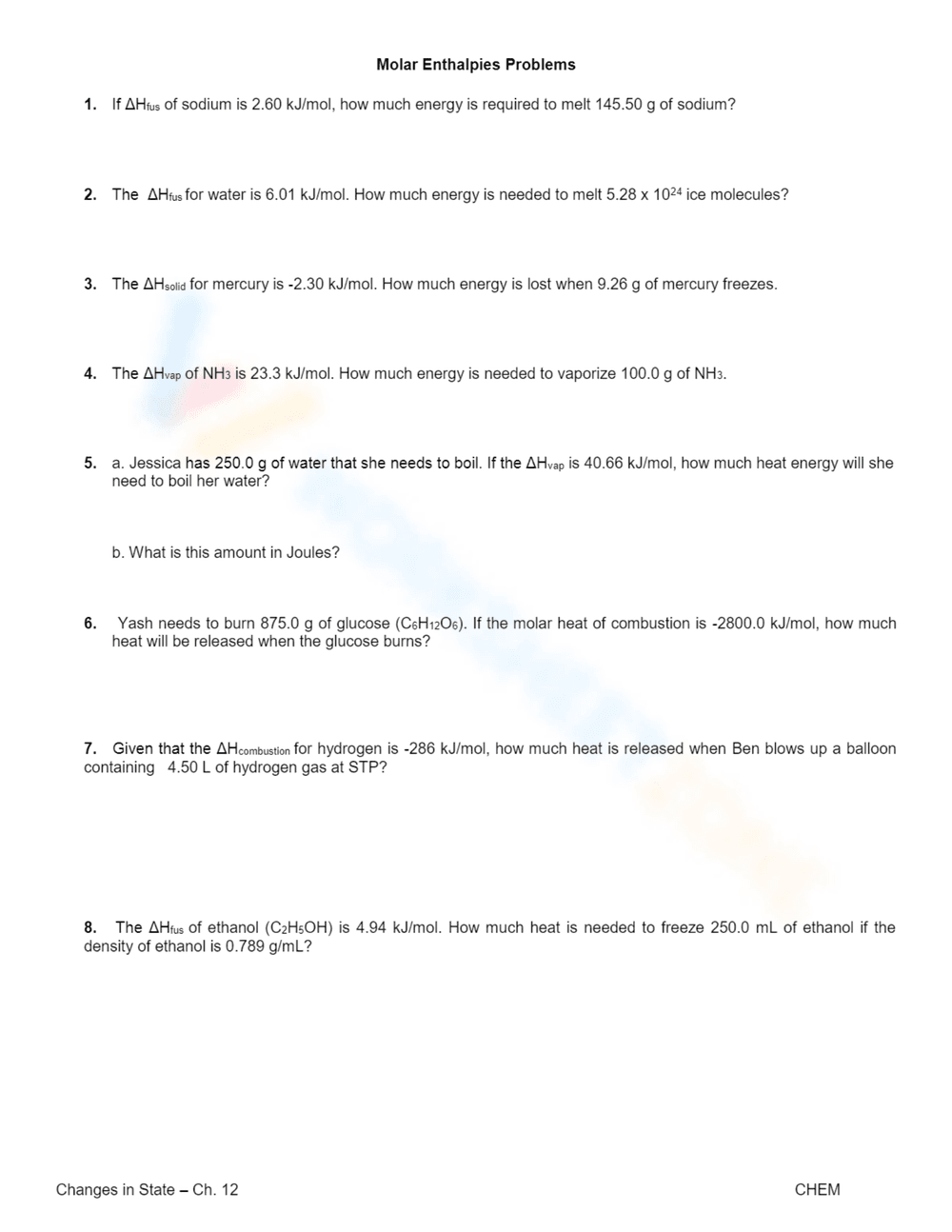
This is a chemistry worksheet titled 'Molar Enthalpies Problems.' It contains eight quantitative problems involving calculations related to enthalpy changes during phase transitions (melting, freezing, vaporization) and combustion. The problems involve substances like sodium, water, mercury, ammonia, glucose, hydrogen, and ethanol. Students are asked to calculate the energy required or released during these processes, given molar enthalpy values and masses or volumes of substances.
Grade Level Suitability:
This worksheet is suitable for high school chemistry students, specifically grades 11-12, or introductory college-level chemistry. The problems require understanding of thermochemistry, molar mass calculations, and phase changes, which are typically covered in these grades.
Why Use It:
This worksheet provides practice in applying the concept of molar enthalpy to calculate heat transfer during phase changes and combustion reactions. It reinforces the relationship between enthalpy, mass, and energy. Students will develop problem-solving skills in thermochemistry and gain experience with unit conversions and stoichiometry.
How to Use It:
Students should use the provided molar enthalpy values and the given masses or volumes of the substances to calculate the heat required or released during the specified process. They will need to use appropriate formulas (e.g., q = nΔH) and pay attention to units. For problem 5a and 5b, students need to solve the problem in kJ and then convert it to Joules. For problem 7, students must consider STP conditions. For problem 8, students must use density to find the mass of ethanol.
Target Users:
The target users are high school chemistry students or introductory college chemistry students who are learning about thermochemistry, enthalpy, and phase changes. It can also be used as a review or practice resource for students preparing for chemistry exams.
This is a chemistry worksheet titled 'Molar Enthalpies Problems.' It contains eight quantitative problems involving calculations related to enthalpy changes during phase transitions (melting, freezing, vaporization) and combustion. The problems involve substances like sodium, water, mercury, ammonia, glucose, hydrogen, and ethanol. Students are asked to calculate the energy required or released during these processes, given molar enthalpy values and masses or volumes of substances.
Grade Level Suitability:
This worksheet is suitable for high school chemistry students, specifically grades 11-12, or introductory college-level chemistry. The problems require understanding of thermochemistry, molar mass calculations, and phase changes, which are typically covered in these grades.
Why Use It:
This worksheet provides practice in applying the concept of molar enthalpy to calculate heat transfer during phase changes and combustion reactions. It reinforces the relationship between enthalpy, mass, and energy. Students will develop problem-solving skills in thermochemistry and gain experience with unit conversions and stoichiometry.
How to Use It:
Students should use the provided molar enthalpy values and the given masses or volumes of the substances to calculate the heat required or released during the specified process. They will need to use appropriate formulas (e.g., q = nΔH) and pay attention to units. For problem 5a and 5b, students need to solve the problem in kJ and then convert it to Joules. For problem 7, students must consider STP conditions. For problem 8, students must use density to find the mass of ethanol.
Target Users:
The target users are high school chemistry students or introductory college chemistry students who are learning about thermochemistry, enthalpy, and phase changes. It can also be used as a review or practice resource for students preparing for chemistry exams.


