


























1 / 2
0
Views
0
Downloads


0.0
0
Save
0 Likes
Share
Limiting Factors: Balancing Populations
0 Views
0 Downloads
Paste this activity's link or code into your existing LMS (Google Classroom, Canvas, Teams, Schoology, Moodle, etc.).
Students can open and work on the activity right away, with no student login required.
You'll still be able to track student progress and results from your teacher account.
Information
Description
What It Is:
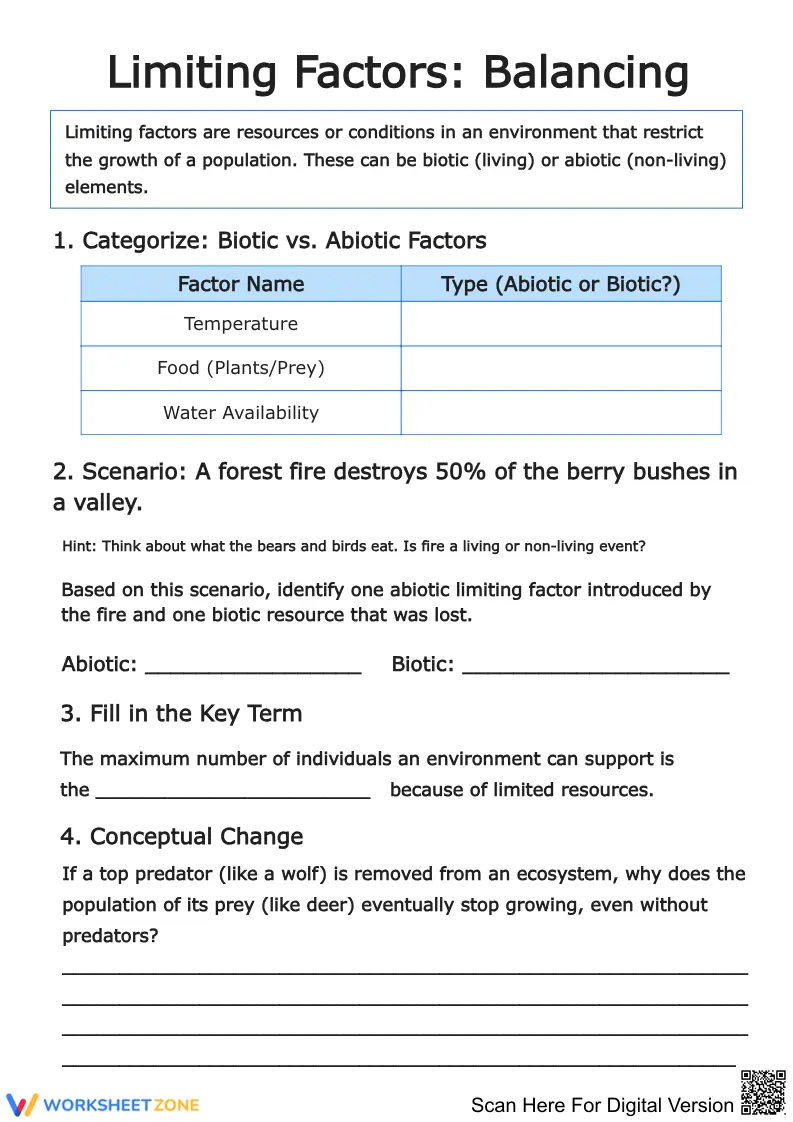
This worksheet helps students explore limiting factors in ecosystems by distinguishing between biotic and abiotic factors, analyzing real-world scenarios, and applying key ecological concepts such as carrying capacity.
Why Use It:
It strengthens students’ understanding of how resources and environmental conditions control population growth and maintain balance within ecosystems.
How to Use It:
• Categorize common limiting factors as biotic or abiotic.
• Analyze a forest fire scenario to identify lost resources and introduced limitations.
• Complete key vocabulary related to population limits.
• Explain why populations stop growing even when predators are removed.
Grade Suitability:
Best suited for Grades 6–8.
• Middle school students studying ecology and population balance.
• Upper elementary learners transitioning into systems-based science concepts.
Target Users:
Science teachers, middle school students, and homeschool educators.
This worksheet helps students explore limiting factors in ecosystems by distinguishing between biotic and abiotic factors, analyzing real-world scenarios, and applying key ecological concepts such as carrying capacity.
Why Use It:
It strengthens students’ understanding of how resources and environmental conditions control population growth and maintain balance within ecosystems.
How to Use It:
• Categorize common limiting factors as biotic or abiotic.
• Analyze a forest fire scenario to identify lost resources and introduced limitations.
• Complete key vocabulary related to population limits.
• Explain why populations stop growing even when predators are removed.
Grade Suitability:
Best suited for Grades 6–8.
• Middle school students studying ecology and population balance.
• Upper elementary learners transitioning into systems-based science concepts.
Target Users:
Science teachers, middle school students, and homeschool educators.


