


























Views
Downloads
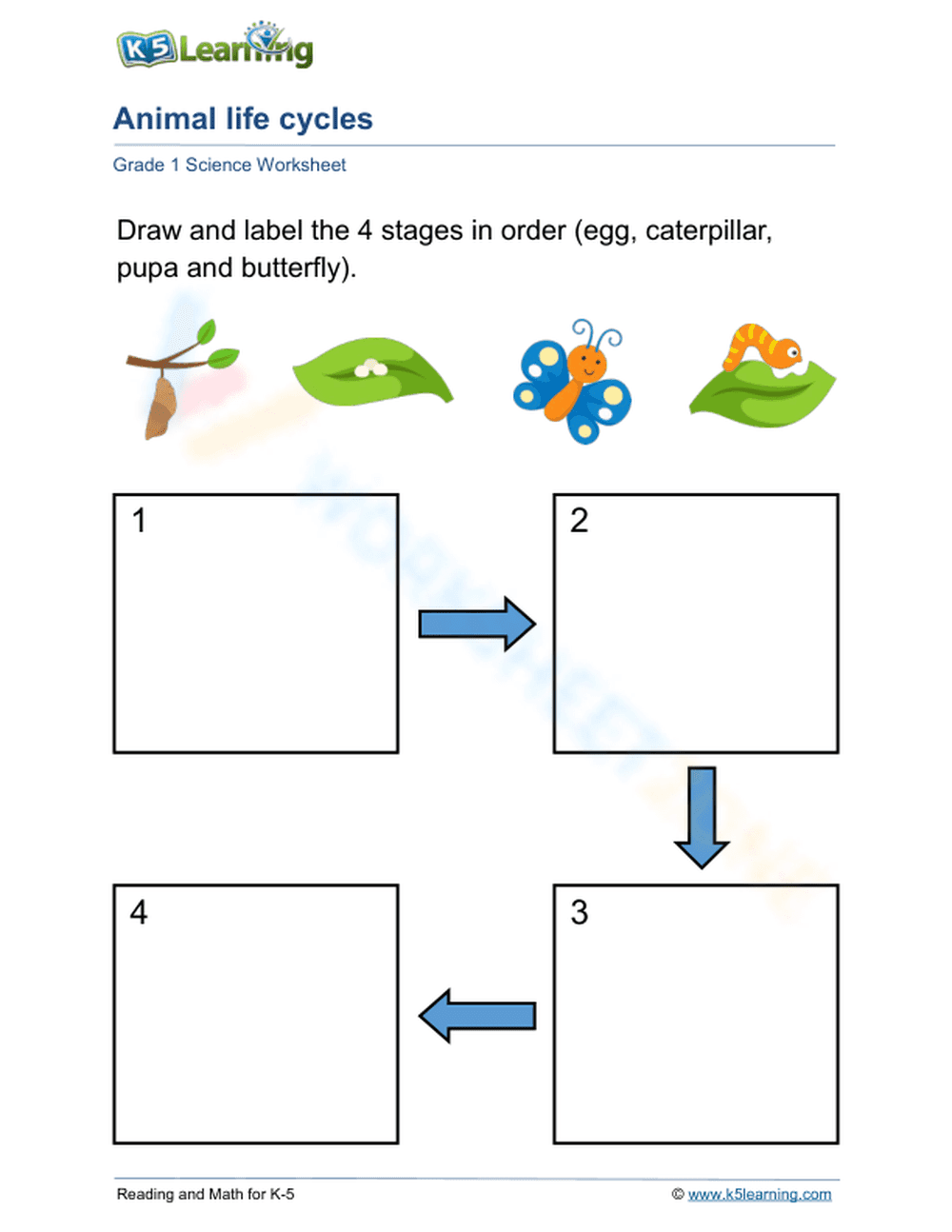

Grade 1 Butterfly Life Cycle — Printable No-Prep Worksheet
Paste this activity's link or code into your existing LMS (Google Classroom, Canvas, Teams, Schoology, Moodle, etc.).
Students can open and work on the activity right away, with no student login required.
You'll still be able to track student progress and results from your teacher account.
This Grade 1 science worksheet empowers students to visualize and order the biological development of a butterfly. By drawing and labeling the four critical stages—egg, caterpillar, pupa, and adult butterfly—learners internalize the concept of growth and metamorphosis in living things. It provides a structured environment for young scientists to demonstrate their understanding of life science.
At a Glance
- Grade: 1 · Subject: Living Things
- Standard:
1-LS1-2— Observe and describe patterns in how organisms grow and change over time- Skill Focus: Butterfly Life Cycle Sequencing
- Format: 1 page · 4 problems · Answer key included · PDF
- Best For: Independent science centers or quick formative assessment
- Time: 15–20 minutes
Inside this resource, you will find a clean, one-page worksheet designed specifically for first-grade learners. The page features four distinct drawing boxes connected by directional arrows to emphasize the cyclical nature of development. At the top, a clear word bank supports spelling and vocabulary acquisition, while vibrant reference illustrations help students visualize each stage before they begin their own drawings.
Zero-Prep Workflow
- Print (30 seconds): Simply print the single-page PDF for your entire class.
- Distribute (1 minute): Hand out the sheets along with crayons or colored pencils to facilitate the drawing tasks.
- Review (1 minute): Use the included answer key for rapid checking or project the worksheet onto a screen for a whole-class summary.
Total teacher preparation time is under three minutes, making it an ideal choice for substitute plans or last-minute lesson extensions.
Standards Alignment
This worksheet is aligned to 1-LS1-2, which requires students to obtain information that adult plants and animals have young and to observe patterns in behavior. By identifying and sequencing the stages of a butterfly, students engage with foundational life science concepts regarding growth. This standard code can be copied directly into lesson plans, IEP goals, or district curriculum mapping tools.
How to Use It
Incorporate this worksheet during the Explain or Elaborate phase of a lesson on life cycles. It works effectively as an independent activity after students have watched a video about metamorphosis. Teachers should observe whether students correctly follow the directional arrows, as this indicates an understanding of chronological sequence. The expected completion time for first graders is approximately 15 to 20 minutes.
Who It's For
This resource is tailored for Grade 1 students but is also suitable for Kindergarteners needing a challenge or second graders requiring a review. It provides excellent support for English Language Learners through visual aids and the word bank. This worksheet pairs naturally with a classroom butterfly kit or a mentor text to ground the activity in direct observation.
This resource addresses the core requirements of 1-LS1-2 by providing a structured platform for students to sequence the life cycle of a butterfly. Educational research, such as the RAND AIRS 2024 report, emphasizes that visual representation and labeling are essential for young learners to move from concrete observations to abstract biological concepts. By requiring students to both draw and label the four stages—egg, caterpillar, pupa, and butterfly—this worksheet facilitates the encoding of scientific vocabulary while reinforcing the logic of chronological development. The use of a word bank and directional arrows supports cognitive load management, allowing Grade 1 students to focus on the biological content rather than just the mechanics of the task. This dual-coding approach is a proven strategy for increasing long-term retention of life science facts in early childhood education settings.


