


























The idea of contrasting books on related subjects is introduced in this lesson. At the end of the lesson, students are able to:
- Examine two educational materials on the same subject.
- Compare and contrast information in the words, images, or features.
- How can literary and factual texts become meaningful to strategic readers?
- What is the true purpose of this text?
- How does interaction with text provoke thinking and response?
- Compare: To find what is alike.
- Contrast: To find what is different.
- Similarities: Things that are alike.
- Differences: Things that are different.
- Illustrations: Pictures or drawings.
- Caption: Words or sentences that give information about a photograph.
- Table of Contents: List of chapter titles and page numbers at the beginning of a book.
- Glossary: List of words in a book and their meanings.
- Paired pictures of two animals with easily identifiable similarities and differences (e.g., a spider and a praying mantis, a hippo and an elephant, a house cat and a tiger)
- Venn diagram (L-1-4-3_Venn diagram)
- Mari Arnaud and Linda Whiteside. (2000). In The Desert. Pacific Learning.
- Kerri O’Donnell. (2001). Life in the Desert. The Rosen Publishing Group.
Alternative books:
- Katie Daynes. (2007). Firefighters. Usborne Books.
- Heather Adamson. (2000). A Day in the Life of a Firefighter. Capstone Press.
- Anita Holmes. (2000). Can You Find Us?. Cavendish Square Publishing.
- Dahlov Ipcar. (2013). Animal Hide and Seek. Islandport Press.
- Cynthia Fitterer Klinger. (2000). Dogs. Children’s World.
- Bruce Johnson and Sindy McKay. (2009). About Dogs. Treasure Bay.
Teachers may substitute other books to provide a range of reading and level of text complexity.
- Additional pairs of informational texts about the same topic at students’ independent reading levels, to be used for small-group activities
This lesson's objective is to familiarize and expose pupils to the process of recognizing textual similarities and differences. Evaluate each student's capacity to draw comparisons between two texts on the same subject through observation and anecdotal notes.
To identify which pupils have achieved the aim and which ones can benefit from more teaching, use the following checklist:
- Students are able to point out parallels in two works that are about the same subject.
- Students are able to distinguish between two texts on the same subject.
Explicit instruction, modeling, scaffolding, and active engagement
W: Assist students in utilizing a Venn diagram to record their work and in recognizing the similarities and contrasts between two informative texts on the same subject.
H: Get students interested by asking them to discuss the similarities and differences between two images of animals.
E: Use two writings on the same topic to model the skill of finding similarities and differences between two animals. This builds on the experience of doing so. Give people the chance to practice the idea on their own. Assist pupils in recording similarities and differences using a Venn diagram.
R: Assign students to work in small groups, confer with you, and discuss their ideas in pairs and revisions.
E: Use conference and small-group instruction to let students assess how well they understood the lesson's main idea.
T: Give pupils a range of books appropriate for their level of independent reading. Keep an eye on the children while they work in small groups, and reiterate concepts as necessary.
O: The session proceeds with whole-group instruction and modeling, small-group practice, and concept understanding sharing.
Focus Question: In what ways does a comparison of two texts covering a comparable subject improve our comprehension of it?
Note: Make sure students grasp the idea of comparison and contrast before introducing this lesson. Making an anchor chart with terms that denote "compare" and "contrast" could be beneficial.
Present images of two similar animals. Say, "Take a good look at each image. What do these two creatures have in common? What has changed?" Give the pupils a minute or so to look at the images. Then ask a few volunteers to come forward and share their insights with the class. Inscribe answers on the board.
Project a Venn diagram (L-1-4-3_Venn diagram) onto an overhead projector. Take note that the lesson and modeling both make use of the classic Venn diagram with overlapping circles. But there's also a different version with colored rectangles that overlap. Say, "We can use a Venn diagram to sort the information when we want to show how things are the same and different."
Explain or go over the overlapped circles' intended use. Declare, "We'll compare and contrast the two creatures in the photographs using a Venn diagram. Every animal has a circle of its own." Over the left circle, write the name of one animal. Over the circle on the right, write the name of the other animal. Say, "We will write information about a single animal in the outside portion of each circle (point to these areas on the diagram). We will note the similarities between the two creatures in the area where the circles overlap (point to it on the diagram)."
Together with the class, proceed to fill in the Venn diagram, demonstrating where the data from the students' answers that you had written on the board should go. Ask pupils to list the animals' similarities and differences.
Ask students to turn to a partner and explain why it's critical to note the similarities and differences between two objects. As you move around the classroom, gauge how well the kids comprehend the subject.
Part 1
State, "Today we will read two novels that are about the same subject. Both of these books deal with deserts." Ask, "Why might we read different books about the same thing?" after putting the books on display. Different information may be provided by the books. (We can get additional knowledge on the subject.)
Declare, "We're going to contrast and compare the books. We'll compare and contrast the books to find commonalities and contrasts. What parallels exist?" (similar items) "What are the distinctions?" (differences between items) "We will compare and contrast the textual features after we have finished reading the books." Examine textual elements, including the glossary, index, headings, pictures, captions, and table of contents. Make a list and post it on the board or chart paper. Assist students with defining each feature and/or locating instances of each one.
Use an overhead projector or document camera to display the pages of In the Desert to your pupils while you read it. Encourage children to consider the text critically by posing queries like, "What did the text tell us about the desert?" (What is seen, audible, tactile, scented, and tasted in the desert?) "What caught your attention among the illustrations?" (The drawings were actual photos of a boy experiencing the desert through his senses.) Pupils may also draw attention to the fact that the images lacked captions. The author did not go into great detail to describe the scent of the flowers or the appearance of the mountains.
Introduce Kerri O'Donnell's book, Life in the Desert. Begin by saying, "Together, we are going to investigate this book. We'll read and compare this book to In the Desert, noting any parallels and differences." Point the pupils' attention to the contents table first. Remind them that a book's table of contents contains a list of the sections' titles together with the page number where each section starts.
Make note of the definition of the word "desert" on page 5 so the reader is aware of its meaning. Not to mention that the word "soil" appears in bold print in the final phrase. Refer to the glossary and remind the students that it provides definitions for terms used in the text. Check out the definition of "soil."
Make a question, "What features did the author use to support the text?" after reading page 6. (a photo with a description)
Point out the word "Kalahari" on page 10 after reading it. Ask the question, "Why is this word in bold print?" We may not be familiar with this word. (The glossary has it.) Add that the author demonstrates the word's pronunciation as well. Point to the parenthetical pronunciation.
Lastly, refer to the index at the end of the book and remind students that it contains a list of every topic covered in the book along with the specific pages that they are located on.
Ask students to turn and discuss any other observations they may have had about the text with a partner. Next, request that partners discuss their responses. The images are actual photos. Every page has a title and provides a distinct story.
Talk about the similarities and differences between the deserts in the two books as a class. "What new insights did reading two books about the desert provide you?" Each book included knowledge that the other did not. Every book presented a distinct aspect of the desert.
Part 2
Engage in a pop-up exercise to review the comparison of the two books about deserts. Set a five-minute timer for when all of the students are sitting and silent. As soon as you shout, "Go!" every pupil stands up and shares one memory from the desert-themed book. For instance, the illustrations were actual images. What one could see in the desert was described in a book. (Words in one book were printed in bold.) Every kid needs to be seated and quiet once more when the timer goes off.
Inquire, "What kind of graphic organizer will aid in our text comparison and contrast?" (a Venn chart)
Project the alternate or standard Venn diagram (L-1-4-3_Venn diagram) onto an overhead projector. Inform the pupils that you will collaborate to find a few comparisons and contrasts in the texts. Say, "I will put the similarities and differences in the appropriate places on the Venn diagram as we identify them."
Alert students that the overlapping portion of the circles is where similarities are noted, and the outside circles are where differences are recorded. An example of a completed diagram can be shown below, although you might be able to add more similarities and distinctions.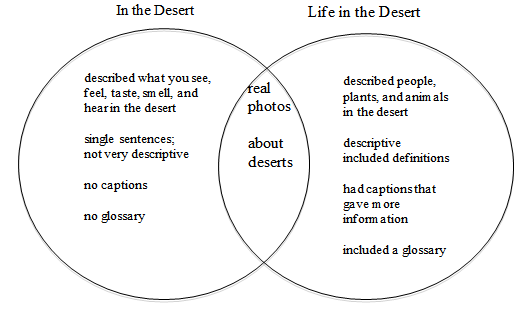
Part 3
Go over how to compare texts and how to construct a Venn diagram to note the differences and similarities. Inform the students that they will read and compare two books in small groups, recording their findings in a Venn diagram. Following assignment completion, groups will exchange books and information.
"What are some elements or characteristics of reference books that we may contrast?" you can ask. Make a list that the students can refer to, like this one:
For instance,
Explanations
Specifics
Features: captions, table of contents, glossary, index
Students should be divided into groups and given two texts at each group's independent reading level that cover the same subject, along with a copy of a Venn diagram. Allow students to review the books and make notes on their comparisons for approximately thirty minutes. Walk around the classroom while the pupils are working and offer assistance where it is required.
As they compare and contrast the similarities and differences in the novels they read, have the students in each group share their work. Venn diagrams can be gathered and evaluated.
Extension
Students who require extra learning opportunities could find the following small-group exercise beneficial:
Ask students to assess the two texts they read in class or other books that are appropriate for their level of independent reading, with guidance and assistance. Let's say a feature like captions. If there is a difference between the texts, have the pupils rise; if there is a commonality, have them stay seated. Proceed with the remaining textual components in the same manner. Ask students to use the books to support their responses.
Pupils who are prepared to go beyond the requirements might collaborate in pairs to develop a checklist using Venn diagrams. A list of elements included in instructional books, such as a table of contents, index, glossary, images or drawings, captions, and headings, should be included in the checklist. Give a blank Venn diagram and two books on the same subject to each couple. Using the checklist, each couple should try to find as many characteristics as they can about one of the books. Following that, the couples ought to contrast their lists and finish the Venn diagram.

Introduction to Comparing Two Informational Texts on a Similar Topic (L-1-4-3)
The idea of contrasting books on related subjects is introduced in this lesson. At the end of the lesson, students are able to:
- Examine two educational materials on the same subject.
- Compare and contrast information in the words, images, or features.


