




























Views
Downloads

Integumentary System Review | Essential Grade 9 Biology

Paste this activity's link or code into your existing LMS (Google Classroom, Canvas, Teams, Schoology, Moodle, etc.).
Students can open and work on the activity right away, with no student login required.
You'll still be able to track student progress and results from your teacher account.
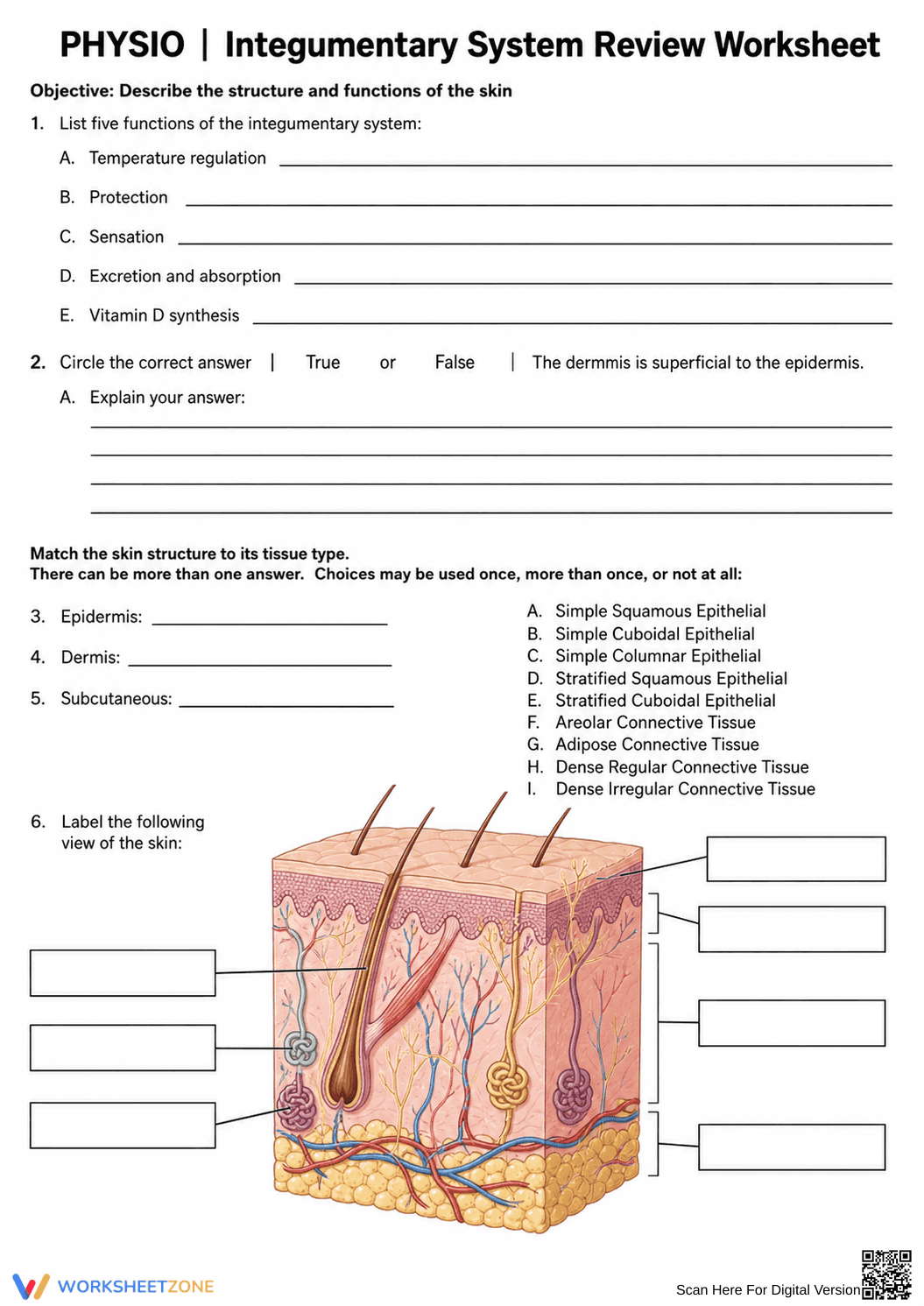
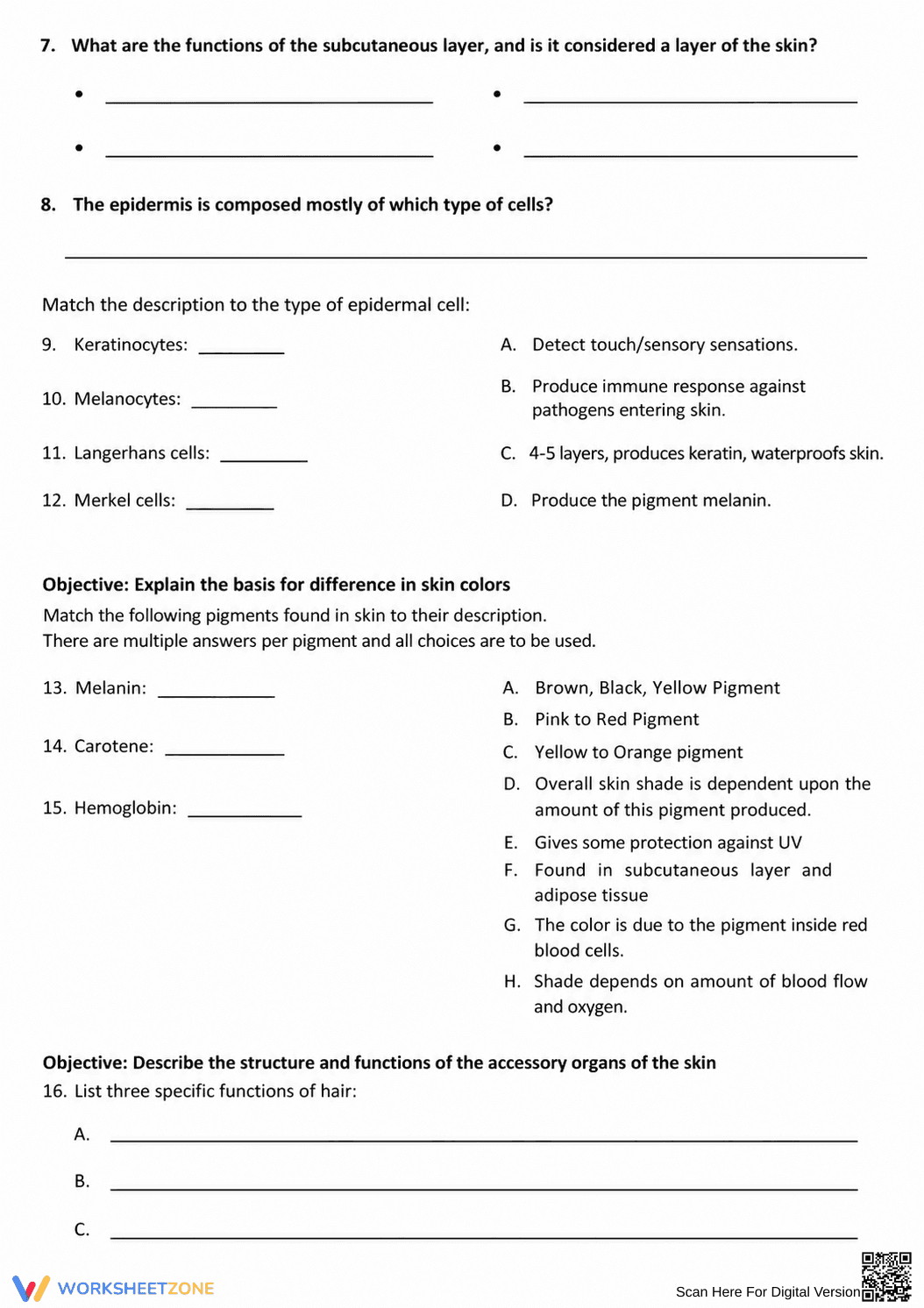
This comprehensive Integumentary System Review Worksheet provides a rigorous assessment of skin anatomy and physiology. Students demonstrate mastery by identifying the five primary functions of the skin, matching specific histological tissue types to epidermal layers, and labeling complex anatomical diagrams. It is designed to move students from basic recall to high-level structural analysis.
At a Glance
- Grade: 9 · Subject: Biology
- Standard:
HS-LS1-2— Develop and use a model to illustrate the hierarchical organization of interacting systems- Skill Focus: Anatomical identification and physiological function
- Format: 4 pages · 33 problems · Answer key included · PDF
- Best For: End-of-unit review or formative assessment
- Time: 45–60 minutes
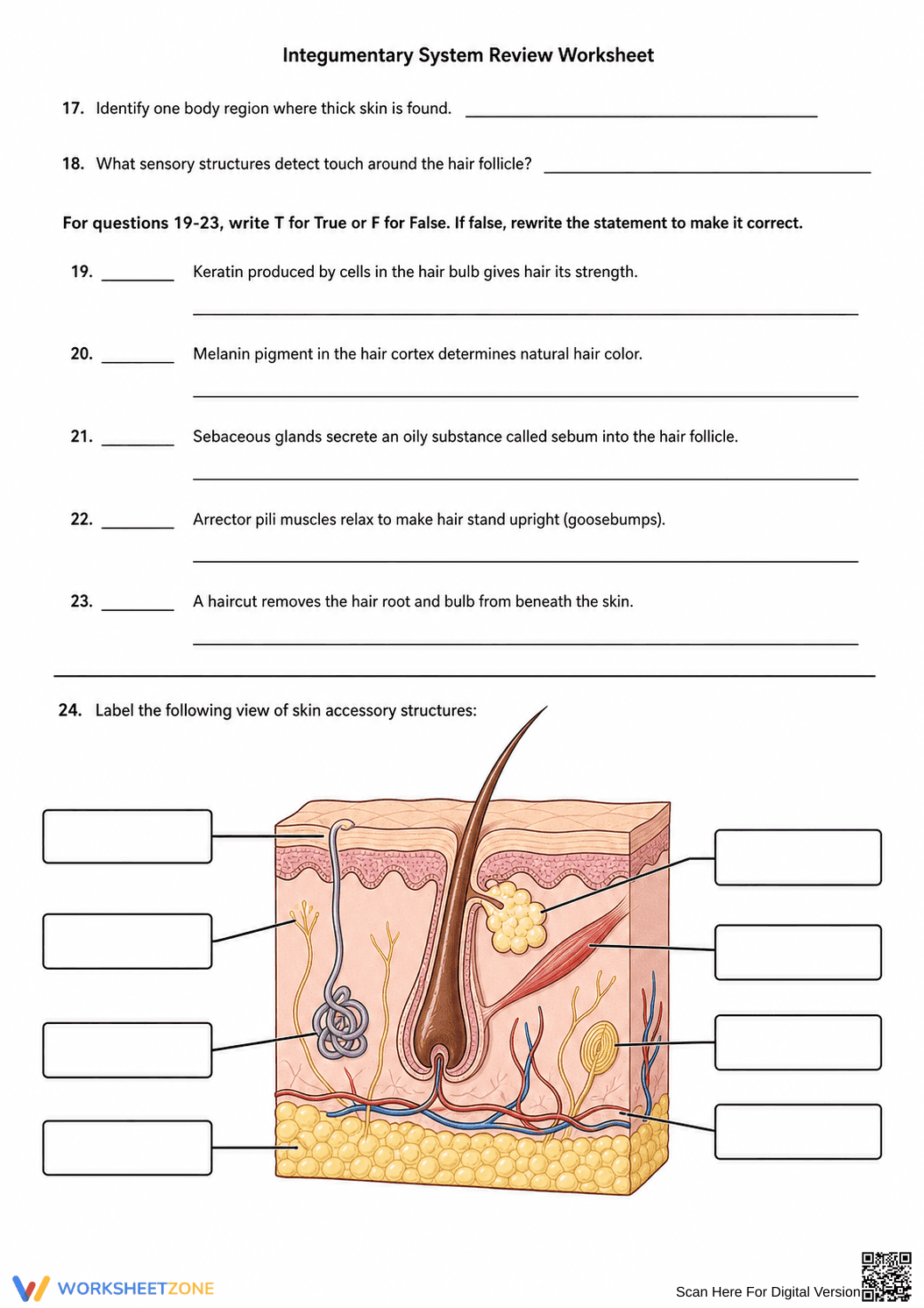
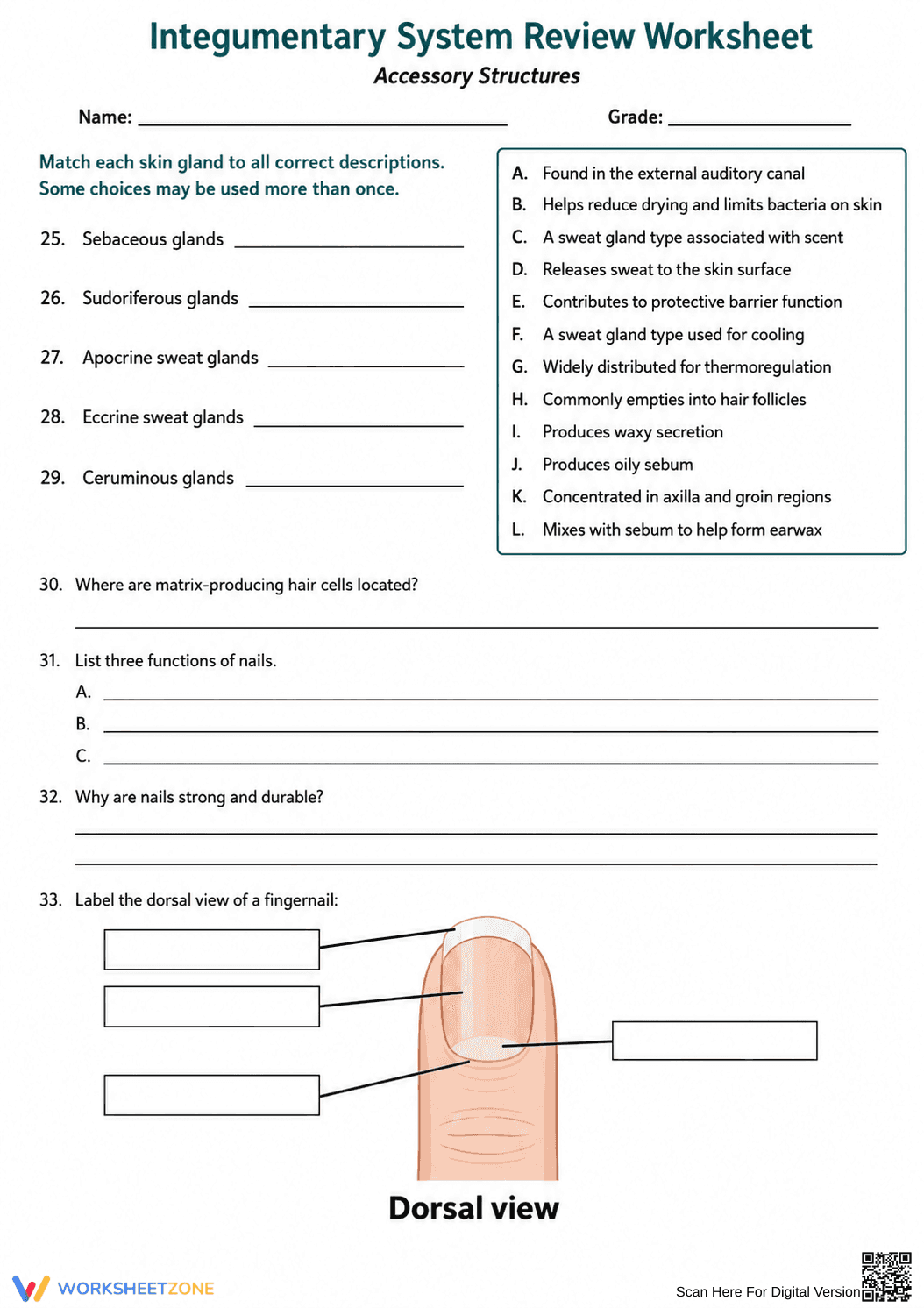
What’s Inside: This 4-page instructional packet contains 33 structured tasks, including multiple-choice questions, true/false statements with justification requirements, and detailed matching sections for epidermal cells and skin pigments. The resource features three high-quality anatomical diagrams for labeling: a cross-section of the skin, a detailed view of accessory structures, and a dorsal view of the fingernail. A complete answer key is provided to facilitate rapid grading.
Zero-Prep Workflow
- Print (1 minute): Select the specific pages needed for your lesson or print the entire 4-page packet for a full-period review session.
- Distribute (1 minute): Hand out the worksheets as a standalone assignment or as a guided note-taking tool during a lecture on the human body systems.
- Review (10 minutes): Use the included answer key to conduct a whole-class review or allow students to self-correct their work to identify personal knowledge gaps.
This resource is ideal for emergency sub plans because it is entirely self-contained and requires no additional laboratory equipment or textbooks to complete.
Standards Alignment
This worksheet aligns with `HS-LS1-2`: "Develop and use a model to illustrate the hierarchical organization of interacting systems that provide specific functions within multicellular organisms." It specifically addresses how different tissue types (epithelial, connective, muscular, and nervous) integrate to form the integumentary organ system. This standard code can be copied directly into lesson plans, IEP goals, or district curriculum mapping tools.
How to Use It
Assign this worksheet as a summative review after completing direct instruction on the human body. It serves as an excellent bridge between cellular biology and systemic physiology. For a formative assessment, have students complete the labeling sections (Tasks 6, 24, and 33) individually to observe their ability to visualize spatial relationships within the dermis. Expected completion time ranges from 45 to 60 minutes depending on prior knowledge.
Who It's For
This resource is tailored for high school biology students, particularly those in Grade 9 or introductory Anatomy and Physiology courses. It provides necessary scaffolding for general education students while maintaining the technical depth required for honors-level learners. It pairs naturally with a skin model or a histology slide set showing stratified squamous epithelium.
The use of structured review and visual labeling in science education is supported by Fisher & Frey (2014), who emphasize that gradual release of responsibility through scaffolded practice leads to higher retention of complex biological terminology. This worksheet applies those principles by transitioning students from simple listing of functions to the complex task of matching specific epidermal cells, such as Langerhans and Merkel cells, to their physiological roles. By requiring students to justify true/false answers, the resource forces active engagement with the material rather than passive recognition. According to research in the 2024 ScienceDirect analysis of secondary science materials, worksheets that integrate anatomical diagrams with functional descriptions significantly improve student performance on standardized life science assessments. This 4-page packet ensures that the standard HS-LS1-2 is met through rigorous, evidence-based practice that clarifies the hierarchical organization of the integumentary system.


