


























0
Views
0
Downloads

0.0
0
Save
0 Likes
Identifying Fourths
0 Views
0 Downloads
Paste this activity's link or code into your existing LMS (Google Classroom, Canvas, Teams, Schoology, Moodle, etc.).
Students can open and work on the activity right away, with no student login required.
You'll still be able to track student progress and results from your teacher account.
Information
Description
What It Is:
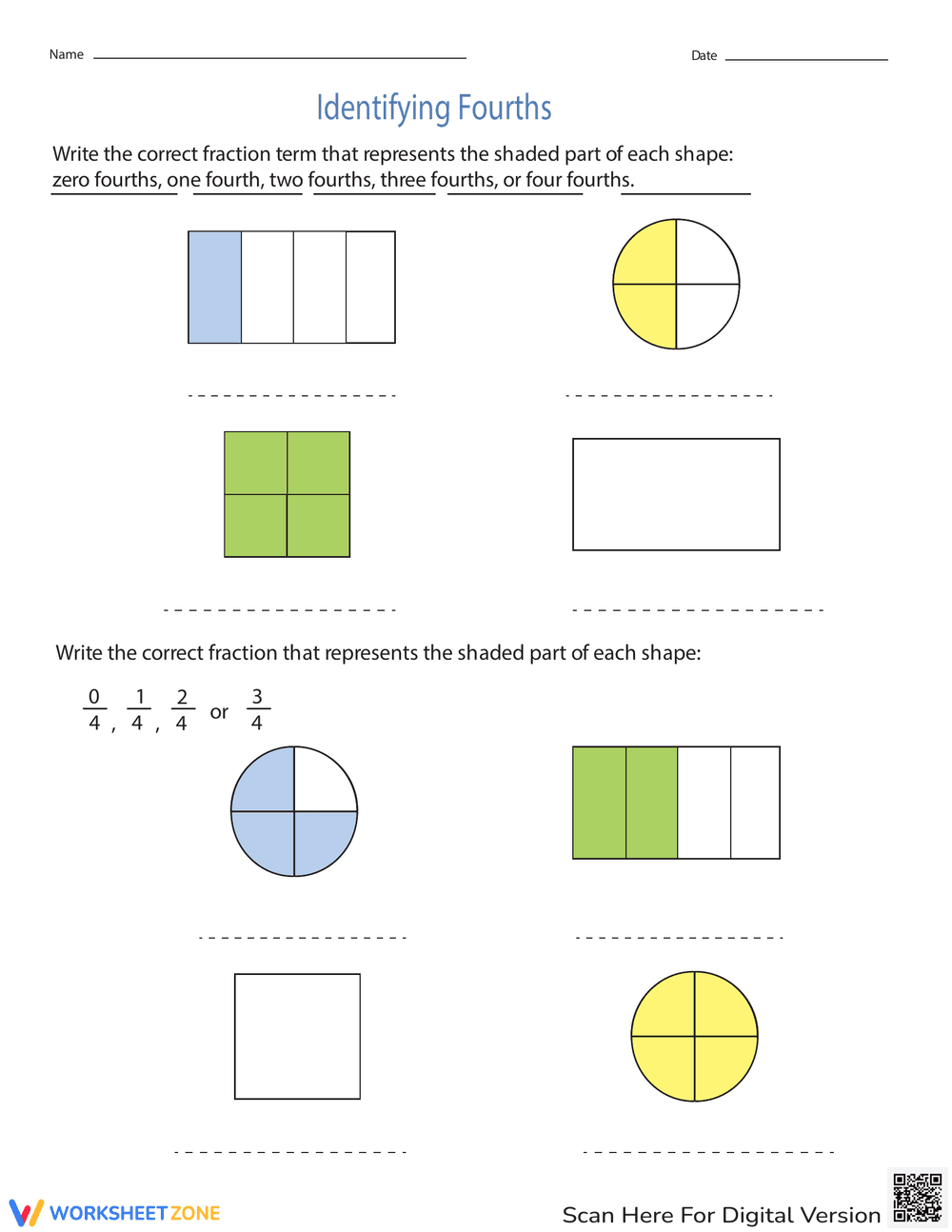
This worksheet helps students identify fourths by examining shaded parts of shapes divided into four equal parts. Students determine whether each shape shows zero fourths, one fourth, two fourths, three fourths, or four fourths, and write the correct fraction (0/4, 1/4, 2/4, 3/4, or 4/4). Clear visuals support understanding through hands-on fraction modeling.
Why Use It:
Recognizing fourths is an important step in building fraction fluency. This worksheet strengthens visual fraction skills, reinforces equal partitioning, and helps students connect shaded models to fraction notation. It is ideal for moving beyond halves into more complex fractional understanding.
How to Use It:
• Review how shapes can be divided into four equal parts before starting.
• Have students observe each shape and count how many fourths are shaded.
• Students write the matching fraction under each shape.
• Discuss answers together to reinforce correct fraction reasoning and address misconceptions.
Grade Suitability:
Best suited for Grade 2 to Grade 3.
• Supports early fraction development with fourths.
• Reinforces visual models and fraction notation.
Target Users:
Grade 2 and 3 students, elementary math teachers, special education teachers, and homeschool families teaching foundational fraction concepts.
This worksheet helps students identify fourths by examining shaded parts of shapes divided into four equal parts. Students determine whether each shape shows zero fourths, one fourth, two fourths, three fourths, or four fourths, and write the correct fraction (0/4, 1/4, 2/4, 3/4, or 4/4). Clear visuals support understanding through hands-on fraction modeling.
Why Use It:
Recognizing fourths is an important step in building fraction fluency. This worksheet strengthens visual fraction skills, reinforces equal partitioning, and helps students connect shaded models to fraction notation. It is ideal for moving beyond halves into more complex fractional understanding.
How to Use It:
• Review how shapes can be divided into four equal parts before starting.
• Have students observe each shape and count how many fourths are shaded.
• Students write the matching fraction under each shape.
• Discuss answers together to reinforce correct fraction reasoning and address misconceptions.
Grade Suitability:
Best suited for Grade 2 to Grade 3.
• Supports early fraction development with fourths.
• Reinforces visual models and fraction notation.
Target Users:
Grade 2 and 3 students, elementary math teachers, special education teachers, and homeschool families teaching foundational fraction concepts.


