


























Views
Downloads
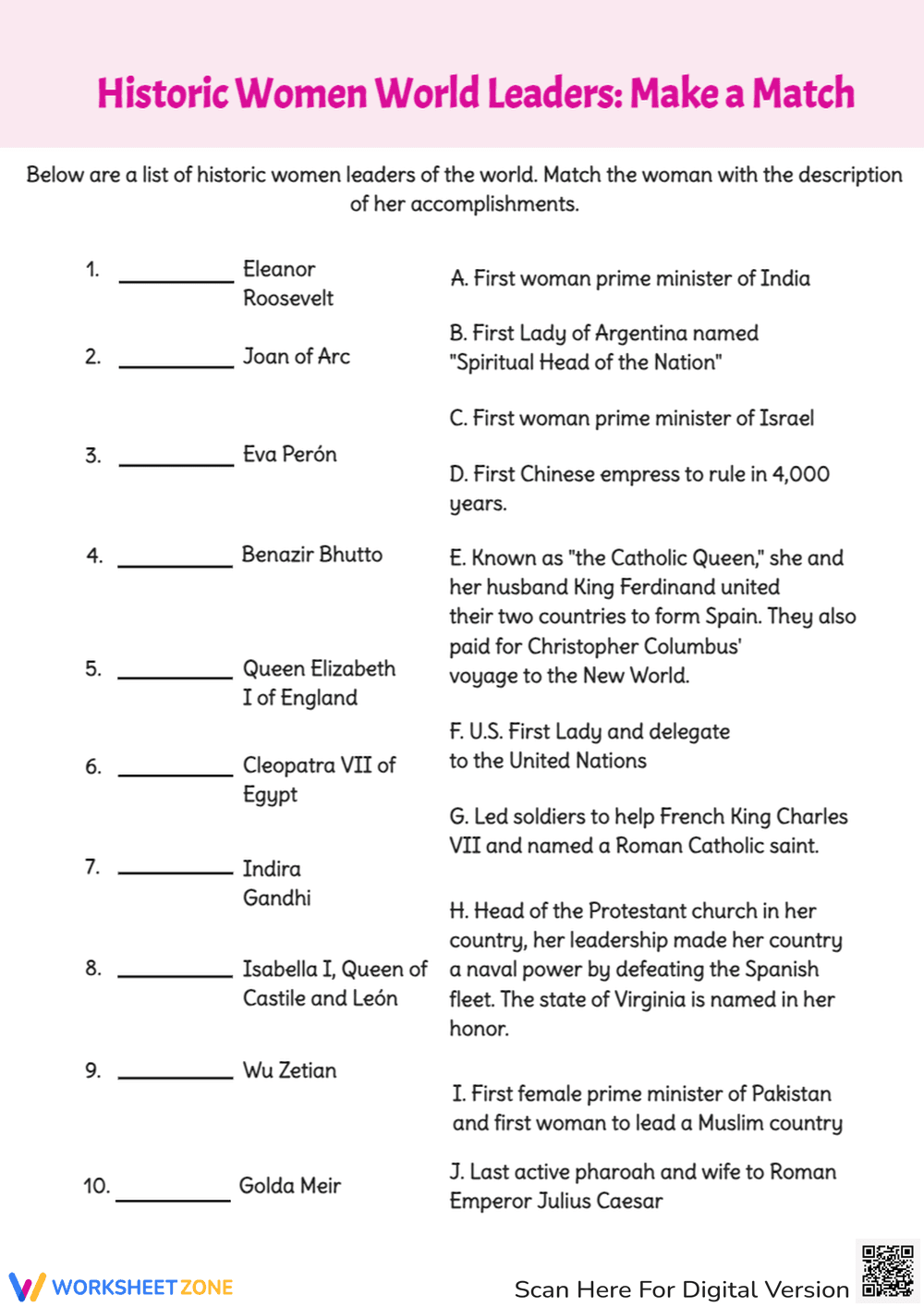

Historic Women World Leaders Worksheet | Grade 4 Ready
Paste this activity's link or code into your existing LMS (Google Classroom, Canvas, Teams, Schoology, Moodle, etc.).
Students can open and work on the activity right away, with no student login required.
You'll still be able to track student progress and results from your teacher account.
This Grade 4 Social Studies worksheet helps students identify influential female leaders throughout history by matching names to their significant global accomplishments. Students develop historical literacy while exploring the diverse roles women have played in shaping nations, from ancient Egypt to modern India. It serves as an effective introduction to Women's History Month.
At a Glance
At a Glance
- Grade: 4 · Subject: Social Studies
- Standard:
CCSS.ELA-LITERACY.RI.4.3— Explain events, ideas, or concepts in a historical text- Skill Focus: Historical Figure Identification
- Format: 1 page · 10 problems · Answer key included · PDF
- Best For: Women's History Month introductory activity
- Time: 15–20 minutes
What's Inside
The resource features a single-page layout containing 10 matching tasks. On the left, students find a list of prominent world leaders, including Eleanor Roosevelt and Cleopatra VII. On the right, detailed descriptions of their achievements are provided. The clear, legible font and structured design ensure students can focus on the content without visual clutter.
Zero-Prep Workflow
This worksheet is designed for immediate classroom implementation with a three-step workflow. First, print the single-page PDF (30 seconds). Second, distribute the sheets to students for independent or partner work (1 minute). Finally, use the included answer key for a quick whole-class review or self-correction (5 minutes). Total teacher preparation time is under 2 minutes.
Standards Alignment
This activity aligns with CCSS.ELA-LITERACY.RI.4.3, requiring students to explain events, ideas, or concepts in a historical text, including what happened and why, based on specific information in the text. By connecting names to specific historical contexts, students practice informational text synthesis. This standard code can be copied directly into lesson plans, IEP goals, or district curriculum mapping tools.
How to Use It
Use this worksheet during the initial phase of a unit on global history to gauge prior knowledge. It also functions as a formative assessment after a lesson on world governments. Teachers should observe if students use process of elimination for unfamiliar figures. Completion typically takes 15 to 20 minutes depending on the student's reading level.
Who It's For
This resource is ideal for general education students in grades 3 through 5, as well as English Language Learners who benefit from the concise, descriptive text. It pairs naturally with a biographical anchor chart or a short introductory video about the featured leaders to provide additional context for the matching exercise.
According to the RAND AIRS 2024 report, structured matching activities in Social Studies help elementary students build the foundational schema necessary for complex historical analysis. This worksheet targets the CCSS.ELA-LITERACY.RI.4.3 standard by requiring students to link specific historical figures to their unique contributions and leadership roles. By engaging with 10 distinct leaders across different eras and geographies, students develop a broader perspective on global history and gender roles in governance. Research from Fisher & Frey (2014) suggests that such focused practice supports vocabulary acquisition and retention of informational content. This printable resource provides a reliable, evidence-based method for introducing significant historical concepts in a time-efficient manner. The clear alignment with national standards ensures that classroom time is spent on high-leverage instructional tasks that contribute to long-term academic mastery in the humanities.


