


























0
Views
0
Downloads

0.0
0
Save
0 Likes
Share
Finding Unknown Angles in Straight Lines and Triangles
0 Views
0 Downloads
Paste this activity's link or code into your existing LMS (Google Classroom, Canvas, Teams, Schoology, Moodle, etc.).
Students can open and work on the activity right away, with no student login required.
You'll still be able to track student progress and results from your teacher account.
Information
Description
What It Is:
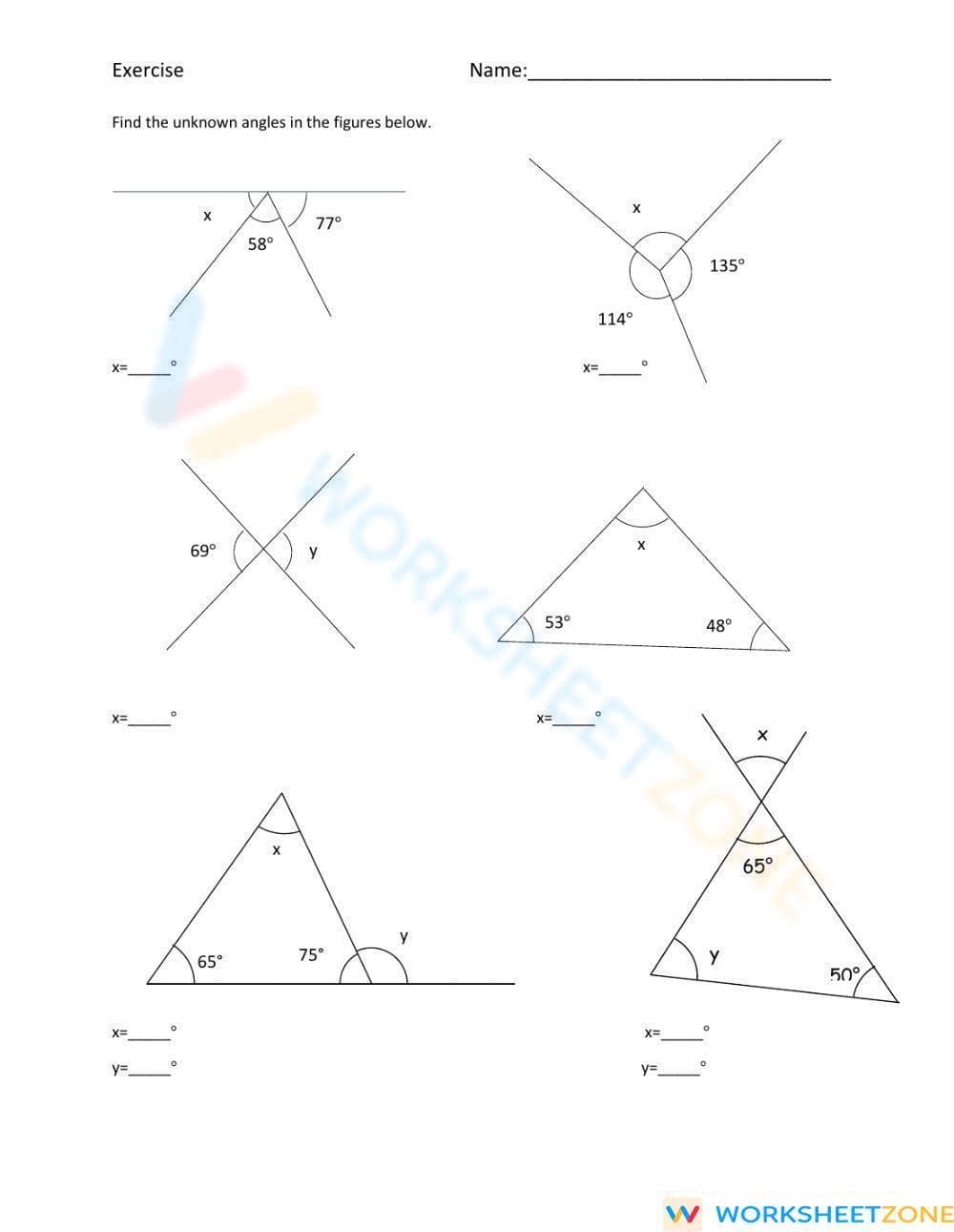
This is a geometry worksheet focused on finding unknown angles. It features several diagrams including intersecting lines and triangles. Students must calculate the missing angle measures, labeled as 'x' or 'y', using their knowledge of angle relationships such as supplementary angles, vertical angles, and the angle sum of a triangle. Each diagram provides some angle measurements to help solve for the unknowns.
Grade Level Suitability:
This worksheet is suitable for grades 6-8. It requires understanding of basic geometric shapes (triangles, lines), angle types, and angle relationships, which are typically covered in middle school geometry curricula.
Why Use It:
This worksheet reinforces the concepts of angle relationships, including supplementary angles, vertical angles, and angles in a triangle. It helps students develop problem-solving skills by applying these concepts to find unknown angle measures. It also provides practice in geometric reasoning and spatial visualization.
How to Use It:
Students should use their knowledge of angle relationships to determine the value of the unknown angles (x and y) in each diagram. For example, they might use the fact that angles on a straight line add up to 180 degrees or that the angles in a triangle add up to 180 degrees. Students should write their answers on the lines provided below each diagram.
Target Users:
This worksheet is beneficial for students learning about angle relationships in geometry, particularly those in middle school (grades 6-8). It's also helpful for students who need extra practice in applying these concepts to solve problems. It can be used for classroom practice, homework assignments, or review activities.
This is a geometry worksheet focused on finding unknown angles. It features several diagrams including intersecting lines and triangles. Students must calculate the missing angle measures, labeled as 'x' or 'y', using their knowledge of angle relationships such as supplementary angles, vertical angles, and the angle sum of a triangle. Each diagram provides some angle measurements to help solve for the unknowns.
Grade Level Suitability:
This worksheet is suitable for grades 6-8. It requires understanding of basic geometric shapes (triangles, lines), angle types, and angle relationships, which are typically covered in middle school geometry curricula.
Why Use It:
This worksheet reinforces the concepts of angle relationships, including supplementary angles, vertical angles, and angles in a triangle. It helps students develop problem-solving skills by applying these concepts to find unknown angle measures. It also provides practice in geometric reasoning and spatial visualization.
How to Use It:
Students should use their knowledge of angle relationships to determine the value of the unknown angles (x and y) in each diagram. For example, they might use the fact that angles on a straight line add up to 180 degrees or that the angles in a triangle add up to 180 degrees. Students should write their answers on the lines provided below each diagram.
Target Users:
This worksheet is beneficial for students learning about angle relationships in geometry, particularly those in middle school (grades 6-8). It's also helpful for students who need extra practice in applying these concepts to solve problems. It can be used for classroom practice, homework assignments, or review activities.


