


























Views
Downloads
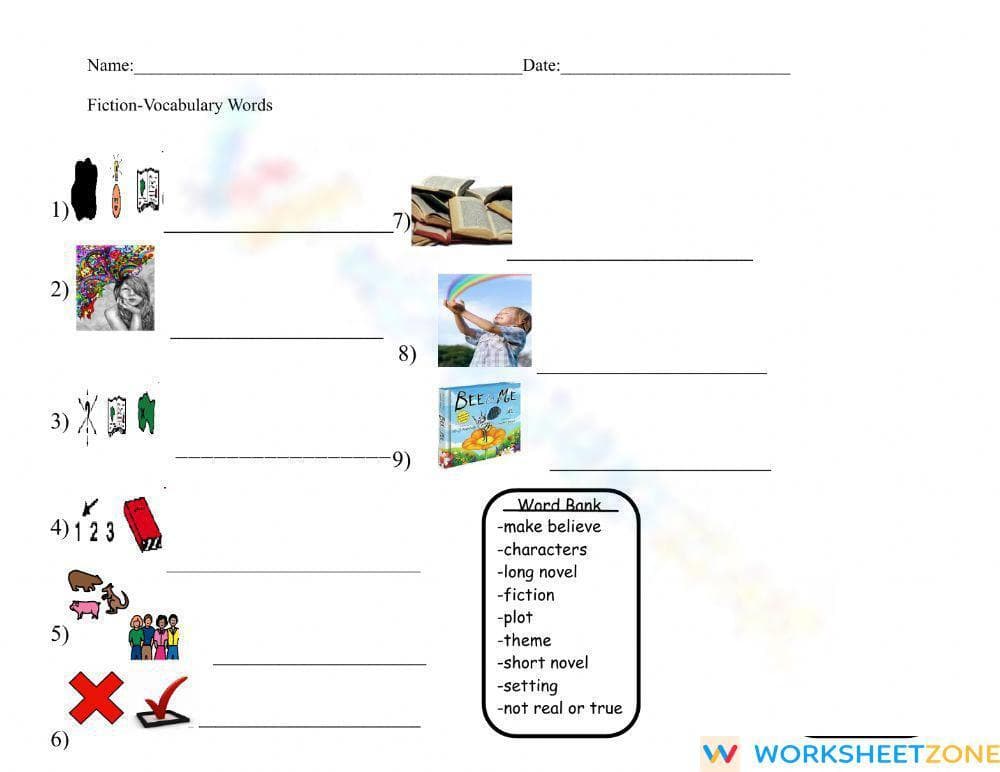

Essential Fiction Vocabulary Worksheet | Grades 2-5 Ready
Paste this activity's link or code into your existing LMS (Google Classroom, Canvas, Teams, Schoology, Moodle, etc.).
Students can open and work on the activity right away, with no student login required.
You'll still be able to track student progress and results from your teacher account.
This essential fiction vocabulary worksheet helps students master the foundational language of storytelling through visual association. By connecting key terms like plot, theme, and setting to clear illustrations, learners develop a concrete understanding of literary elements. This resource ensures students accurately identify and apply academic vocabulary during reading and writing units.
At a Glance
- Grade: 2–5 · Subject: English Language Arts
- Standard:
CCSS.ELA-LITERACY.L.3.6— Acquire and use accurately grade-appropriate general academic and domain-specific words and phrases- Skill Focus: Fiction Vocabulary & Story Elements
- Format: 1 page · 9 problems · Answer key included · PDF
- Best For: Independent practice or morning work
- Time: 10–15 minutes
The worksheet features a single-page layout with nine matching tasks. Each pairs a descriptive image with a blank line for terms from a provided word bank. The bank includes essential fiction terms such as characters, plot, theme, and setting. An answer key is included for rapid grading and immediate student feedback.
Zero-Prep Workflow
This resource is designed for a simple, zero-prep experience. Print the one-page PDF in seconds and distribute it as a bell-ringer or independent practice activity. Review the answers as a group or use the included key for individual assessment. Total teacher preparation time is under two minutes, making it ideal for substitute folders.
Standards Alignment
This resource is aligned with CCSS.ELA-LITERACY.L.3.6, which requires students to acquire and use accurately grade-appropriate general academic and domain-specific words and phrases. It specifically targets the vocabulary needed to discuss fiction and literary analysis. Both standard codes can be copied directly into lesson plans, IEP goals, or district curriculum mapping tools.
How to Use It
Use this worksheet as a formative assessment after introducing a fiction unit to gauge student knowledge. It also works effectively as a post-reading activity to reinforce terminology. For a quick check, observe students as they match the "plot" and "theme" illustrations, which often require the most conceptual clarity.
Who It's For
This activity is designed for elementary students in Grades 2-5, especially English Language Learners and special education students who benefit from visual scaffolds. The pictorial cues provide support for decoding concepts. Pair this with a story elements anchor chart to provide additional support during independent work.
Mastery of domain-specific vocabulary is a critical predictor of reading comprehension success across all grade levels. This worksheet targets CCSS.ELA-LITERACY.L.3.6 by providing visual associations for fiction terms, facilitating deeper semantic encoding of concepts like plot, setting, and theme. According to research from Fisher & Frey (2014) on the gradual release of responsibility, structured vocabulary practice with visual supports helps bridge the gap between word recognition and conceptual application. By providing 9 targeted tasks in a no-prep format, this resource allows teachers to maximize instructional time while ensuring students engage with essential literary language. The inclusion of a word bank and pictorial cues aligns with evidence-based practices for supporting diverse learners in general education and special education environments. This assessment-ready tool provides immediate data on student vocabulary acquisition, supporting district-level goals for literacy proficiency and standards-based instruction.


