


























Views
Downloads

Feelings Scrambled Words Worksheet | Grade 1 Essential
Paste this activity's link or code into your existing LMS (Google Classroom, Canvas, Teams, Schoology, Moodle, etc.).
Students can open and work on the activity right away, with no student login required.
You'll still be able to track student progress and results from your teacher account.
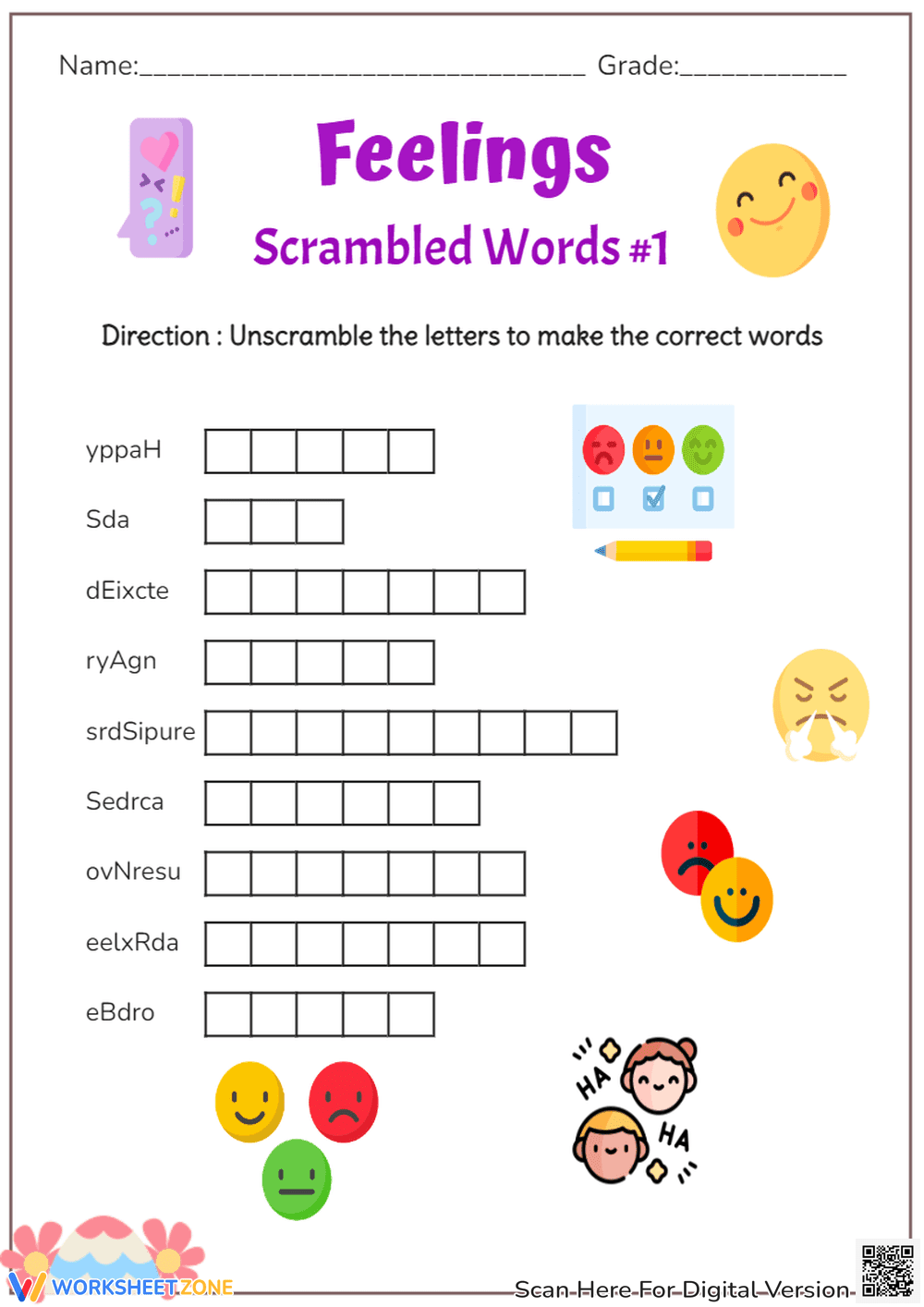
This Grade 1 feelings scrambled words worksheet helps students master emotional vocabulary through engaging letter-sequencing tasks. By unscrambling 9 common emotion words, learners strengthen their phonics awareness and spelling accuracy. This resource provides a clear, visual way for young students to connect letters to meaningful concepts they experience daily in the classroom.
At a Glance
- Grade: 1 · Subject: ELA / Social-Emotional Learning
- Standard:
CCSS.ELA-LITERACY.L.1.2— Use conventional spelling for words with common spelling patterns and for frequently occurring irregular words.- Skill Focus: Spelling and Emotional Vocabulary
- Format: 1 page · 9 problems · Answer key included · PDF
- Best For: Morning work or SEL warm-up
- Time: 10–15 minutes
Inside this printable PDF, you will find a single-page activity featuring 9 scrambled words representing various feelings like "Happy," "Excited," and "Nervous." Each task includes a letter-box grid to guide student handwriting and letter placement. The worksheet is supported by colorful emoji graphics that provide visual context clues for students who may need extra support identifying the target emotion.
The zero-prep workflow for this resource is designed for maximum efficiency. First, print the single-page PDF (30 seconds). Next, distribute the sheets to your students as they enter the room or transition between subjects (1 minute). Finally, review the correct spellings as a whole group using the included answer key to provide immediate feedback (2 minutes). This makes it an ideal choice for emergency sub plans or quick transitions.
This resource is aligned with CCSS.ELA-LITERACY.L.1.2, which focuses on using conventional spelling for frequently occurring words. It also supports CCSS.ELA-LITERACY.L.K.1.F, helping students produce and expand complete sentences by first mastering the core vocabulary. Both standard codes can be copied directly into lesson plans, IEP goals, or district curriculum mapping tools.
Use this worksheet as a formative assessment during a Social-Emotional Learning (SEL) unit to gauge student familiarity with feeling words. It also works well as a quiet morning work activity. Observe if students are using the letter boxes to self-correct their spelling; this indicates developing orthographic mapping skills. Completion typically takes 10 to 15 minutes depending on the student's phonics level.
This activity is ideal for Kindergarten through Grade 2 students, particularly those developing foundational literacy skills or English Language Learners (ELLs) building basic vocabulary. It pairs naturally with a "Feelings Chart" anchor chart or a read-aloud book about emotions to provide a comprehensive instructional experience for the whole class.
According to the RAND AIRS 2024 report, integrating vocabulary instruction with social-emotional contexts significantly improves word retention and emotional literacy in early childhood education. This worksheet addresses the CCSS.ELA-LITERACY.L.1.2 standard by requiring students to manipulate letters to form conventional spellings of high-frequency emotion words. Research from Fisher & Frey (2014) emphasizes that word-work activities, such as scrambles, provide the necessary cognitive friction to move vocabulary from short-term recognition to long-term orthographic memory. By providing 9 distinct tasks with visual scaffolding, this resource ensures that students are not just memorizing strings of letters but are connecting those letters to specific, relatable concepts. This dual-focus approach supports both literacy development and self-awareness, making it a versatile tool for diverse primary classrooms. The inclusion of an answer key allows for immediate corrective feedback, a critical component of effective independent practice.


