


























0
Views
0
Downloads

0.0
0
Save
0 Likes
Autumn Idioms Matching Game Worksheet
0 Views
0 Downloads
Paste this activity's link or code into your existing LMS (Google Classroom, Canvas, Teams, Schoology, Moodle, etc.).
Students can open and work on the activity right away, with no student login required.
You'll still be able to track student progress and results from your teacher account.
Information
Description
What It Is:
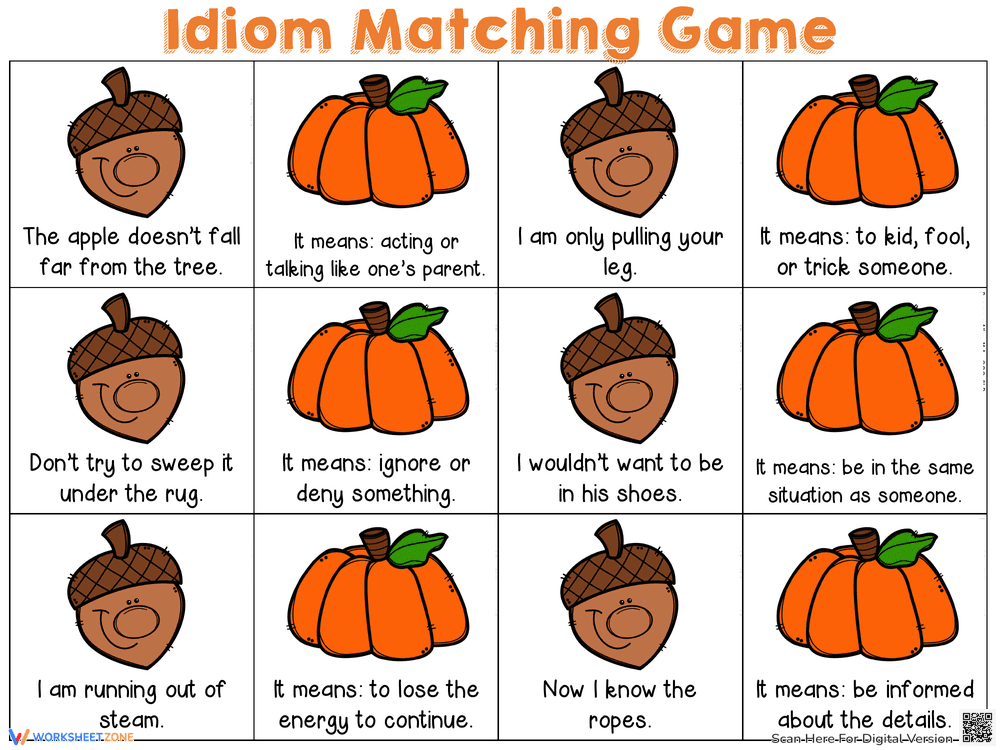
An idiom matching game worksheet. It features 12 cards with illustrations of acorns and pumpkins. Each card either presents an idiom (like 'The apple doesn't fall far from the tree' or 'I am only pulling your leg') or its definition ('It means: acting or talking like one's parent' or 'It means: to kid, fool, or trick someone'). Students are expected to match the idiom with its correct meaning.
Grade Level Suitability:
Suitable for grades 3-5. It's appropriate for this range because it involves understanding figurative language, which is a skill typically developed in these grades. The idioms are relatively common, making them accessible to this age group.
Why Use It:
This worksheet helps students learn and understand common idioms. It improves vocabulary, enhances reading comprehension skills, and develops the ability to interpret figurative language. It also promotes critical thinking as students match idioms with their meanings.
How to Use It:
Cut out the individual cards. Students can then play a matching game, pairing each idiom with its corresponding definition. Alternatively, the worksheet can be used as a review activity where students write the correct definition next to each idiom, or vice-versa. It can be played individually or in small groups.
Target Users:
Elementary school students in grades 3-5, particularly those learning about figurative language and idioms. ESL students could also benefit from this worksheet to expand their understanding of American English idioms.
An idiom matching game worksheet. It features 12 cards with illustrations of acorns and pumpkins. Each card either presents an idiom (like 'The apple doesn't fall far from the tree' or 'I am only pulling your leg') or its definition ('It means: acting or talking like one's parent' or 'It means: to kid, fool, or trick someone'). Students are expected to match the idiom with its correct meaning.
Grade Level Suitability:
Suitable for grades 3-5. It's appropriate for this range because it involves understanding figurative language, which is a skill typically developed in these grades. The idioms are relatively common, making them accessible to this age group.
Why Use It:
This worksheet helps students learn and understand common idioms. It improves vocabulary, enhances reading comprehension skills, and develops the ability to interpret figurative language. It also promotes critical thinking as students match idioms with their meanings.
How to Use It:
Cut out the individual cards. Students can then play a matching game, pairing each idiom with its corresponding definition. Alternatively, the worksheet can be used as a review activity where students write the correct definition next to each idiom, or vice-versa. It can be played individually or in small groups.
Target Users:
Elementary school students in grades 3-5, particularly those learning about figurative language and idioms. ESL students could also benefit from this worksheet to expand their understanding of American English idioms.


