


























1 / 2
0
Views
0
Downloads

0.0
0
Save
0 Likes
Share
Rewrite Repeated Multiplication In Exponent Form
0 Views
0 Downloads
Paste this activity's link or code into your existing LMS (Google Classroom, Canvas, Teams, Schoology, Moodle, etc.).
Students can open and work on the activity right away, with no student login required.
You'll still be able to track student progress and results from your teacher account.
Information
Description
What It Is:
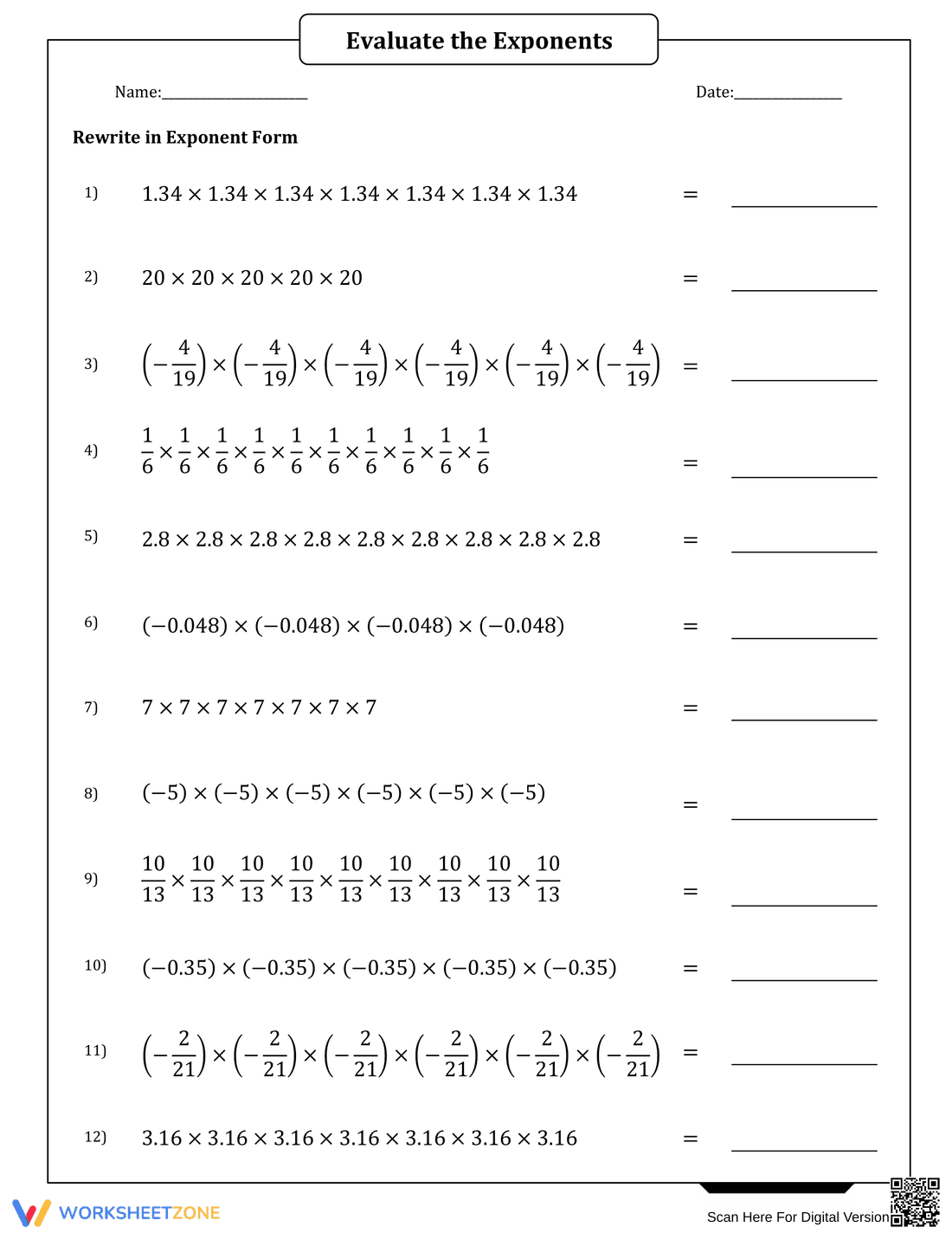
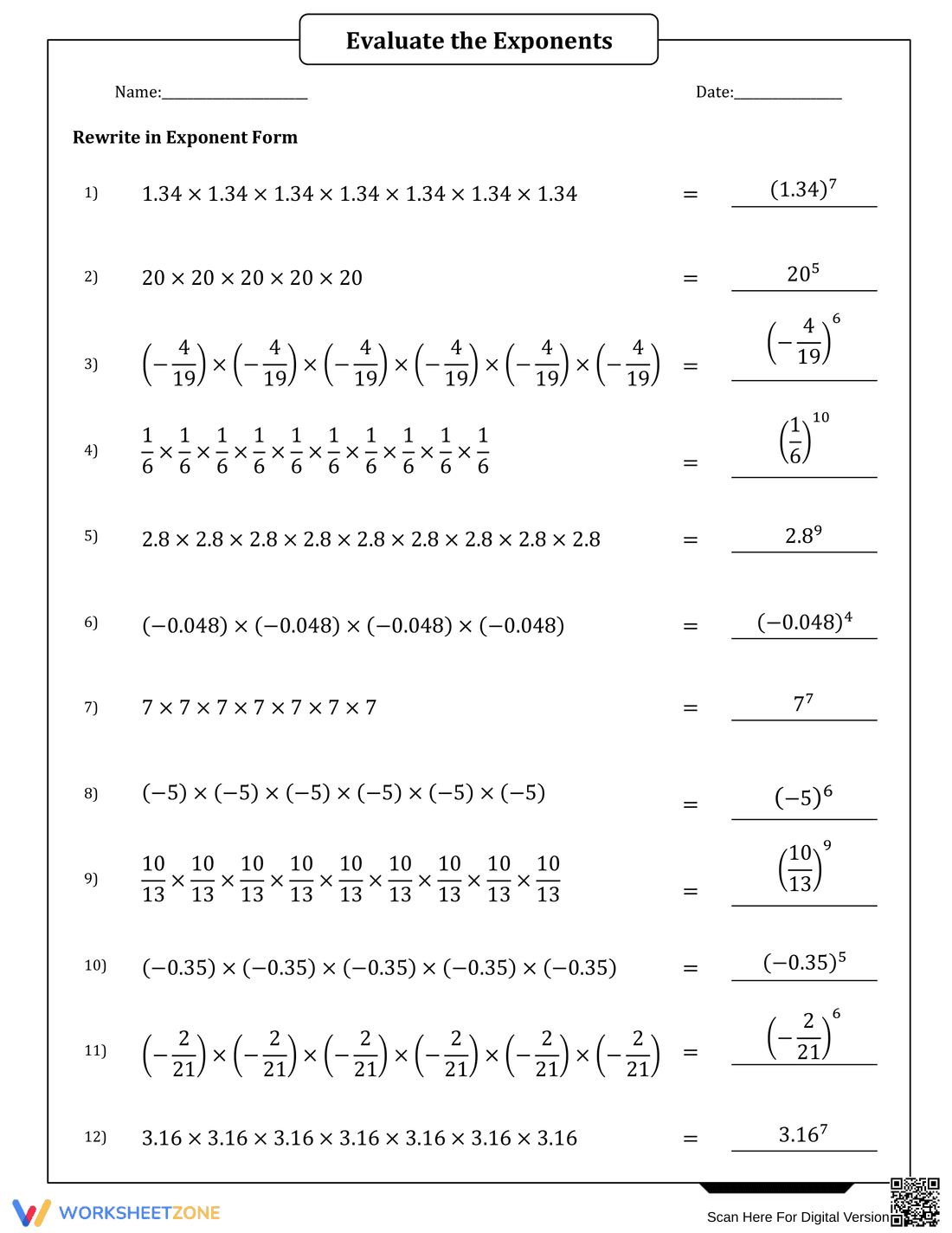
This math worksheet is designed to help students transition from repeated multiplication to exponential notation. It features 12 diverse problems involving whole numbers, negative integers, decimals, and fractions, challenging students to condense these expressions into their shorthand exponent form.
Why Use It:
Understanding exponents is a crucial building block for algebra and higher-level math. This worksheet reinforces the relationship between a base and its power while providing varied practice with different types of numerical values, ensuring students are comfortable handling more than just basic integers.
How to Use It:
• Begin by identifying the base, which is the number being multiplied by itself.
• Count how many times that specific number appears in the multiplication sequence to determine the exponent.
• Write the final answer on the provided line, ensuring parentheses are used correctly for negative numbers and fractions.
Grade Suitability:
Best for Grade 6 and Grade 7.
• Younger students focus on recognizing whole number patterns and simple bases.
• Older students focus on the nuances of exponents with negative numbers, decimals, and complex fractions.
Target Users:
This resource is perfect for middle school math teachers, homeschooling parents looking for extra practice, and students needing to reinforce their pre-algebra skills.
This math worksheet is designed to help students transition from repeated multiplication to exponential notation. It features 12 diverse problems involving whole numbers, negative integers, decimals, and fractions, challenging students to condense these expressions into their shorthand exponent form.
Why Use It:
Understanding exponents is a crucial building block for algebra and higher-level math. This worksheet reinforces the relationship between a base and its power while providing varied practice with different types of numerical values, ensuring students are comfortable handling more than just basic integers.
How to Use It:
• Begin by identifying the base, which is the number being multiplied by itself.
• Count how many times that specific number appears in the multiplication sequence to determine the exponent.
• Write the final answer on the provided line, ensuring parentheses are used correctly for negative numbers and fractions.
Grade Suitability:
Best for Grade 6 and Grade 7.
• Younger students focus on recognizing whole number patterns and simple bases.
• Older students focus on the nuances of exponents with negative numbers, decimals, and complex fractions.
Target Users:
This resource is perfect for middle school math teachers, homeschooling parents looking for extra practice, and students needing to reinforce their pre-algebra skills.


