


























Views
Plays

Grade 6-7 Present Perfect Worksheet | Essential Practice
Paste this activity's link or code into your existing LMS (Google Classroom, Canvas, Teams, Schoology, Moodle, etc.).
Students can open and work on the activity right away, with no student login required.
You'll still be able to track student progress and results from your teacher account.
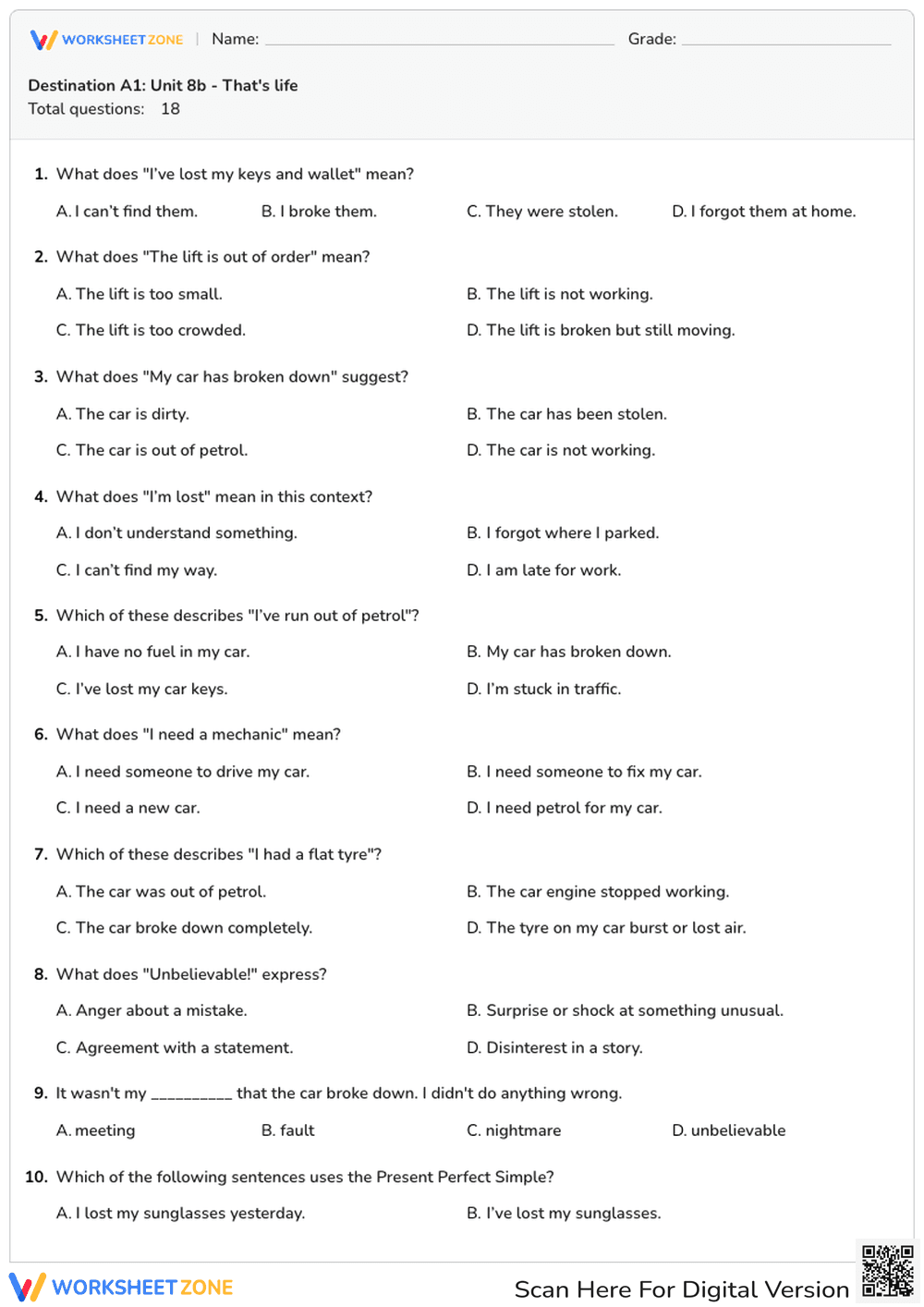
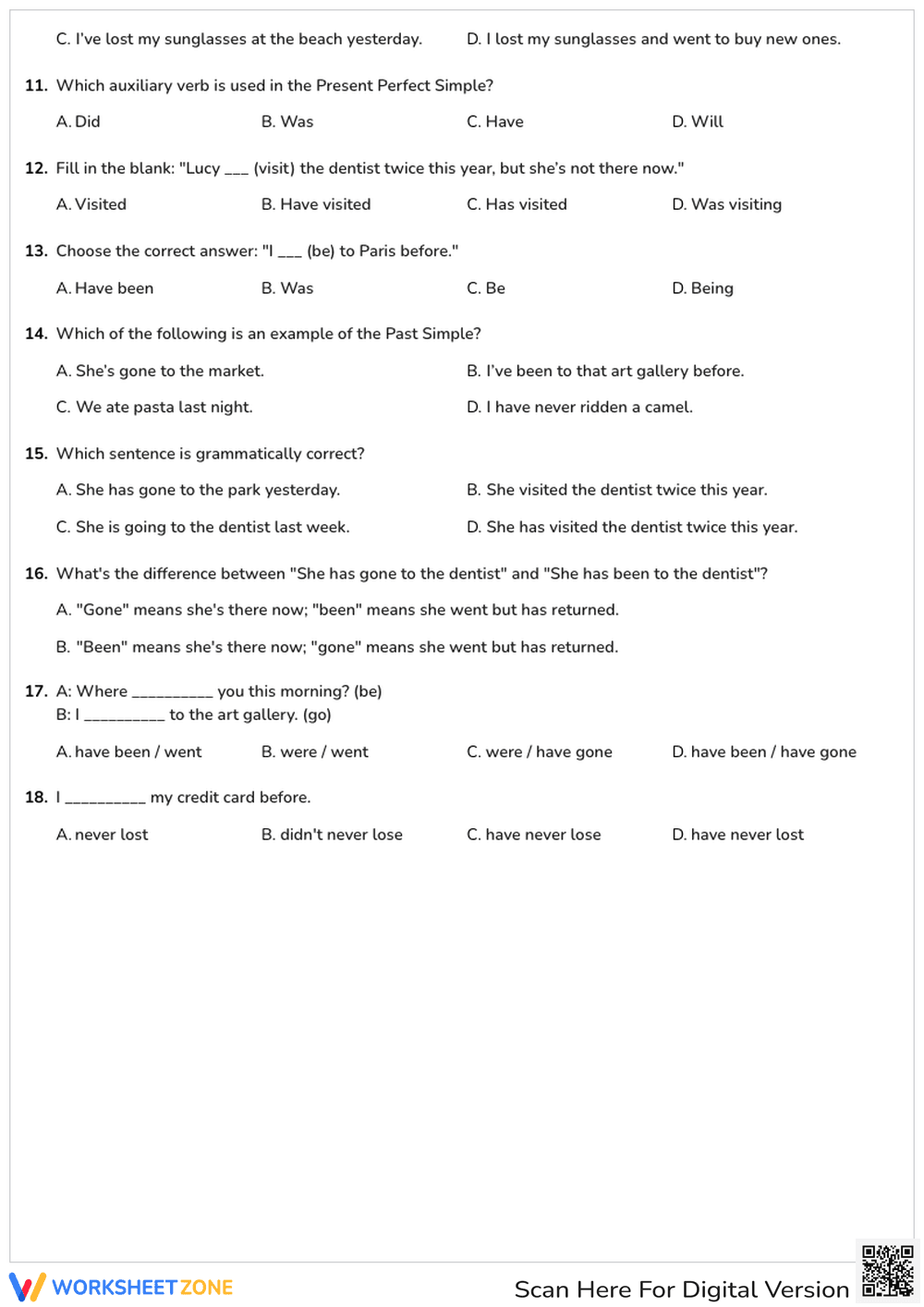
This Grade 7 grammar worksheet provides students with 18 targeted multiple-choice questions to master the distinction between the Present Perfect and Simple Past tenses. By contextualizing grammar within real-life scenarios—such as car trouble or losing items—students develop both linguistic precision and practical vocabulary. This resource ensures learners can accurately communicate past actions with present relevance.
At a Glance
- Grade: 7 · Subject: ELA Grammar
- Standard:
CCSS.ELA-LITERACY.L.7.1— Demonstrate command of the conventions of standard English grammar and usage when writing.- Skill Focus: Present Perfect vs. Simple Past
- Format: 2 pages · 18 problems · Answer key included · PDF
- Best For: Grammar reinforcement and formative assessment
- Time: 20–30 minutes
What's Inside
The worksheet consists of two comprehensive pages featuring 18 multiple-choice questions. The first half focuses on situational vocabulary, asking students to interpret phrases like "out of order" or "broken down." The second half transitions into technical grammar application, requiring students to identify auxiliary verbs, choose the correct tense for specific time markers, and differentiate between "been" and "gone." A full answer key is provided for rapid grading.
Zero-Prep Workflow
- Print: Download and print the two-page PDF in seconds.
- Distribute: Hand out as a bell-ringer, independent practice, or a quick quiz.
- Review: Use the included answer key for immediate feedback or peer-grading.
Total teacher preparation time is under 2 minutes, making this an ideal resource for busy classrooms or emergency sub plans.
Standards Alignment
This resource is primary aligned to `CCSS.ELA-LITERACY.L.7.1`, which requires students to demonstrate command of standard English grammar and usage. Specifically, it addresses the nuances of verb tenses and their relationship to time and context. It also supports vocabulary acquisition by building familiarity with common idioms and phrases. Both standard codes can be copied directly into lesson plans, IEP goals, or district curriculum mapping tools.
How to Use It
Use this worksheet during the independent practice phase of a lesson after direct instruction on the Present Perfect tense. It serves as an excellent formative assessment to identify students who struggle with irregular past participles or time-marker recognition. Alternatively, assign it as a homework reinforcement task. Most students will complete the 18 items within a 25-minute window, allowing for a quick wrap-up discussion.
Who It's For
This worksheet is tailored for Grade 6 and 7 students, but is equally effective for high school ELL/ESL learners working at the A1-A2 proficiency level. The real-world scenarios provide necessary scaffolding for students who need concrete examples of abstract grammar rules. It pairs naturally with a grammar anchor chart or a short reading passage focusing on personal experiences and travel.
Effective grammar instruction requires moving beyond rote memorization toward contextual application. According to Fisher & Frey (2014), the gradual release of responsibility is most effective when students are provided with structured opportunities to apply new linguistic structures in varied contexts. This worksheet facilitates that transition by providing 18 specific tasks that bridge the gap between vocabulary recognition and grammatical accuracy. By aligning with CCSS.ELA-LITERACY.L.7.1, the resource ensures that middle school students develop the necessary command of verb tenses required for complex academic writing. Research from the NAEP suggests that students who master the nuances of perfect tenses early are better equipped to handle the temporal shifts required in narrative and informational texts. This printable PDF provides the high-repetition practice needed to solidify these skills, ensuring that students can distinguish between completed past actions and ongoing states of being with accuracy.


