


























Students will learn the definitions of assertion and evidence in this session. At the end of the lesson, students are able to:
- Clarify the definition of assertion.
- Determine the claims made in a nonfiction text and provide references to the relevant passages for proof.
- How can literary and factual texts become meaningful to strategic readers?
- How does interaction with text provoke thinking and response?
- What is the true purpose of this text?
- Assertion: A statement or claim.
- Evidence: Support for a response.
- copies of the following articles to use for identifying and supporting assertions:
+ Want to Hold On to a Memory?
http://www.timeforkids.com/news/want-hold-memory/91511
+Elephant Alert!
http://www.timeforkids.com/news/elephant-alert/86631
+ Is Bottled Water Really Better?
http://www.scholastic.com/browse/article.jsp?id=3758072&print=1
- copies of magazines at students’ instructional level, such as the following:
+ National Geographic Kids (at level)
http://kids.nationalgeographic.com/kids
+ Ranger Rick (at level)
http://www.nwf.org/Kids/Ranger-Rick.aspx
+ Jack and Jill (easy)
http://www.uskidsmags.com/jack-and-jill-home/
+ Spider (easy to midlevel)
http://www.cricketmag.com/kids_home.asp
+ Cobblestone (higher level)
http://www.cobblestonepub.com/magazine/COB
- Teachers may substitute other nonfiction books or electronic sources to provide a range of reading and level of text complexity.
self-stick notes
- When conducting student observations or conferences, use the following checklist to gauge how well the students comprehend the following ideas:
+ Students provide a precise definition of what constitutes an assertion.
+ Students show that they can recognize an assertion or claim made by an author.
+ Students correctly identify textual evidence to back up their claims.
+ Students are able to articulate the significance of providing textual evidence to back their claims.
+ Utilize the three-column chart to gauge pupils' comprehension. Provide each student with detailed feedback.
Explicit instruction, modeling, and active engagement
W: Explain the idea of recognizing the claims made by the author and go over how to cite textual data to back these claims.
H: Have students create claims based on objects to get them involved in the lesson.
E: Give pupils the chance to experience recognizing and defending claims.
R: Assist students in finishing a chart that enumerates statements and supporting evidence to assist them in expanding their comprehension of identifying assertions.
E: Use dialogue and teacher-student conferences to assess whether reteaching or additional practice is required.
T: Through a range of readings and peer interaction, assist students at all levels in accessing the notion of recognizing assertions and applying it at their conceptual level.
O: This lesson's learning exercises include large-group instruction and discussion, small-group inquiry, pair work, and individual application of the material.
Focus question: What are claims, and how are they backed up by textual evidence?
Bring in multiple artifacts before the class that give hints about your hobbies, talents, and trip destinations. Display the items and ask students to write a sentence about what they like to do. Ask students to back up their answers with evidence from the artifacts. (For instance, you brought in sheet music and a CD of violin performances; thus, you like to play the violin.) Draw attention to the fact that students are putting up an argument and providing proof for it.
Part 1
On the board or interactive whiteboard, show a copy of one of the articles from the Materials list or another similar article. Give the pupils the passage to read. Say, "As you read, take note of the claims and statements made by the author. How does the writer substantiate the claims?"
Before sharing their responses with the class, have students discuss them with a partner. Draw attention to the fact that a writer may make multiple claims in one work. Some instances are as follows:
Statement: Clenching your fists could aid with memory recall.
Proof: Those who tried to learn words and grasped a ball were able to remember the words.
Statement: Tap water is healthier than bottled water.
Proof: Tap water is subjected to more testing than bottled water, and some bottled water is tap water.
Statement: Elephants are in danger due to the demand for ivory.
Proof: A large number of elephants have been killed for their tusks.
Part 2
Show more nonfiction resources (magazines, books with short chapters or sections), and the final two articles from the resources list. Provide a range of resources to suit the instructional reading levels of your pupils. You might want to add texts for social studies and science.
Display a three-column chart similar to the one below on the board or interactive whiteboard.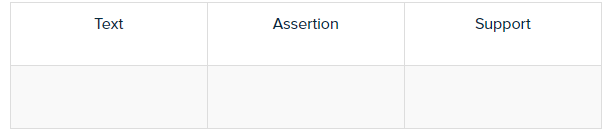
Give three self-stick notes to every student. Ask pupils to write a heading from the chart on each note.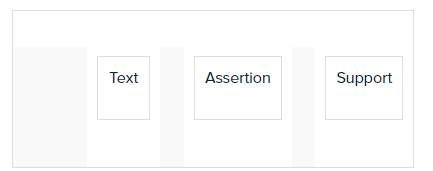
Give pupils a short period to select a text.
Say, "You are going to read a part or an article from your textbook. On the text note, write the text's title. Take note of the author's claims as you read them. A text will probably contain multiple assertions. Select one to write on the note of assertion. Lastly, annotate the support note with the textual evidence that bolsters the assertion. Put the finished notes in the appropriate chart columns."
Go around the classroom after the pupils have finished the task to see if they have a grasp of the ideas.
After the students are done, discuss the data on the chart. Ask, "Why is it vital for writers to provide evidence for their claims in the text?" (An author's claim might be true, but readers might not accept it if the text doesn't include evidence to back it up.)
Extension:
For extra practice, students can read another nonfiction piece or article with a partner, pinpoint the author's claim, and then provide evidence from the text to back up their claim.
When they are prepared to go above and beyond the requirements, students can compose a nonfiction work in which they present a claim and back it up with verifiable data from references.

Citing Evidence to Support Assertions in Nonfiction Text (L-4-4-3)
Students will learn the definitions of assertion and evidence in this session. At the end of the lesson, students are able to:
- Clarify the definition of assertion.
- Determine the claims made in a nonfiction text and provide references to the relevant passages for proof.


