


























Views
Downloads
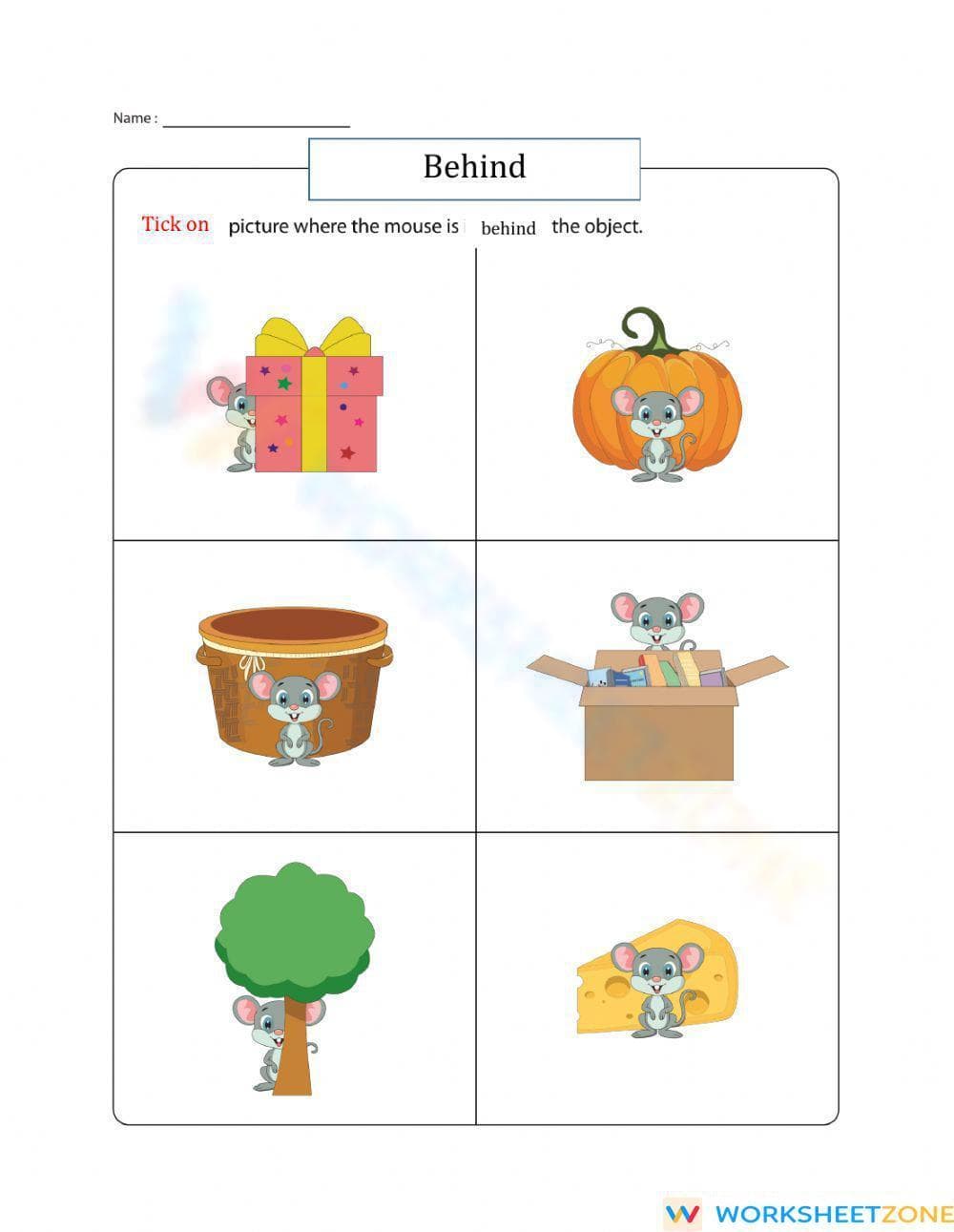

Essential Behind Preposition Worksheet | Preschool & Kinder
Paste this activity's link or code into your existing LMS (Google Classroom, Canvas, Teams, Schoology, Moodle, etc.).
Students can open and work on the activity right away, with no student login required.
You'll still be able to track student progress and results from your teacher account.
This Kindergarten "Behind" preposition worksheet provides a focused, visual approach to mastering spatial relationships. By identifying the mouse's position relative to common objects, young learners develop essential vocabulary. This resource ensures students can accurately use and understand the concept of being "behind" in daily language and academic contexts.
At a Glance
- Grade: Kindergarten · Subject: English Language Arts
- Standard:
L.K.1.E— Use frequently occurring prepositions to describe the relative positions of objects in pictures- Skill Focus: Spatial Preposition "Behind"
- Format: 1 high-quality page · 6 visual problems · Answer key included · PDF
- Best For: Independent practice, literacy centers, and morning work
- Time: 5–10 minutes
What's Inside
This high-quality PDF features six visual scenarios where a mouse is placed relative to objects like a gift, pumpkin, and tree. Students tick the boxes where the mouse is specifically "behind" the object. The clear illustrations are designed for preschoolers and kindergartners to make accurate observations independently with minimal distractions.
Zero-Prep Workflow
This resource is designed for immediate classroom implementation with zero teacher setup. First, print the single-page PDF (10 seconds). Second, distribute the worksheet to your students (30 seconds). Third, review the completed work using the included answer key (60 seconds). Total teacher preparation time is well under two minutes, making it an ideal choice for morning work, centers, or emergency substitute plans that require no prior explanation.
Standards Alignment
This worksheet is directly aligned with CCSS.ELA-LITERACY.L.K.1.E, which requires students to use frequently occurring prepositions. By focusing on "behind," this resource provides the repetitive, visual practice necessary for students to internalize positional vocabulary. This standard code can be copied directly into lesson plans, IEP goals, or district curriculum mapping tools to demonstrate rigorous adherence to foundational kindergarten language standards and literacy development.
How to Use It
Use this worksheet as a quick formative assessment after a lesson on prepositions. Ask students to "show me behind" using objects before starting the paper task. During independent work, observe if students confuse "inside" or "in front of" with "behind," providing opportunity for corrective feedback. It typically takes 5 to 10 minutes to complete, fitting perfectly into a literacy center rotation or transition activity.
Who It's For
This resource is intended for Preschool and Kindergarten students beginning to build foundational ELA skills. It is also excellent for English Language Learners needing visual support for spatial concepts. For differentiation, pair this worksheet with a physical "mouse and box" activity or an anchor chart to provide a multi-sensory experience for students who require extra scaffolding or language support during independent practice.
According to Fisher & Frey (2014), the use of visual scaffolds is critical in the gradual release of responsibility for foundational language skills. This Grade K "Behind" preposition worksheet utilizes high-interest illustrations to bridge the gap between concrete physical experience and abstract linguistic labels. By isolating the preposition "behind" across six tasks, the resource prevents cognitive overload and allows students to focus entirely on mastering L.K.1.E requirements. Research indicates that early mastery of spatial prepositions is a strong predictor of later reading comprehension and mathematical reasoning, as it forms the basis for understanding complex syntax. This standards-aligned tool provides the structured practice necessary for students to transition from simple identification to active usage in their own speech. It is an essential component of a comprehensive vocabulary development strategy that prioritizes clarity and measurable student outcomes.


