


























Views
Plays
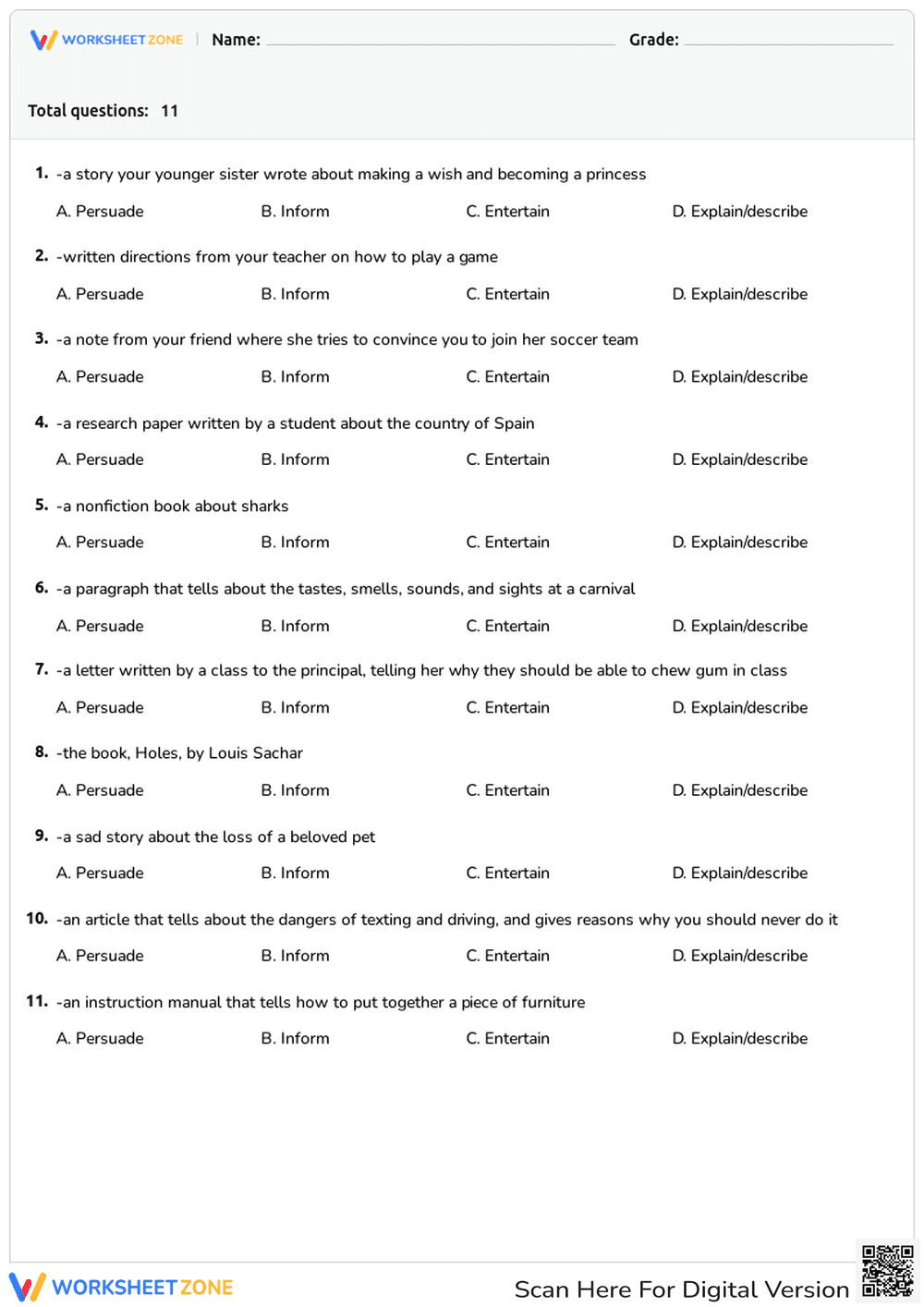

Author's Purpose Worksheet | Grade 2-3 Essential
Paste this activity's link or code into your existing LMS (Google Classroom, Canvas, Teams, Schoology, Moodle, etc.).
Students can open and work on the activity right away, with no student login required.
You'll still be able to track student progress and results from your teacher account.
Help your students master intent with this focused Author's Purpose worksheet. By analyzing eleven writing scenarios, learners determine if a writer is trying to persuade, inform, entertain, explain, or describe. This activity ensures students can distinguish between various text types and understand the underlying goals of different authors across multiple genres.
At a Glance
- Grade: 2-3 · Subject: ELA
- Standard:
CCSS.ELA-LITERACY.RI.2.6— Identify the main purpose of a text and author intent- Skill Focus: Author's Purpose (PIEED)
- Format: 1 page · 11 problems · Answer key included · PDF
- Best For: Quick formative assessment or independent practice
- Time: 15–20 minutes
This single-page PDF contains 11 multiple-choice questions. Each question presents a text description—ranging from research papers to letters—and asks students to select the correct purpose: Persuade, Inform, Entertain, or Explain/describe. The worksheet uses the PIEED acronym to help students categorize information. A comprehensive answer key is provided for rapid grading and immediate feedback.
This resource is designed for immediate implementation with teacher preparation under 2 minutes. First, print the single-page PDF (30 seconds). Second, distribute the worksheet during your ELA block as a quick check for understanding (30 seconds). Finally, review the 11 responses using the answer key to identify students needing support (1 minute). It is an ideal candidate for sub plans.
This resource aligns with CCSS.ELA-LITERACY.RI.2.6, requiring students to identify the main purpose of a text. It also supports CCSS.ELA-LITERACY.RI.3.6 by helping students distinguish their point of view from the author's. Both standard codes can be copied directly into lesson plans, IEP goals, or district curriculum mapping tools.
Use this as a formative assessment after teaching the PIEED acronym. As students work, observe if they can distinguish between "Inform" and "Explain/describe," which are often challenging for third graders. This activity takes 15 to 20 minutes and serves as a bridge between modeling and independent reading of longer passages.
This resource is tailored for Grade 2 and Grade 3 students developing analytical skills. It is effective for English Language Learners who benefit from the concise format. Pair this worksheet with an anchor chart or a short informational passage to provide a complete instructional cycle for your classroom.
According to the RAND AIRS 2024 report on literacy instruction, the ability to discern an author's intent is a foundational component of critical reading comprehension in the primary grades. This worksheet targets CCSS.ELA-LITERACY.RI.2.6 by requiring students to categorize eleven distinct text scenarios into the PIEED framework: Persuade, Inform, Entertain, or Explain/Describe. Research by Fisher & Frey (2014) suggests that providing students with concrete examples of text types—such as research papers, letters to principals, and instruction manuals—helps bridge the gap between abstract concepts and practical application. By identifying whether a writer aims to convince, teach, or amuse, students develop the metacognitive skills necessary for navigating complex informational and literary texts. This resource provides a structured environment for students to practice these skills independently, ensuring they can accurately identify the main purpose of a text and explain what the author wants to answer or describe.


