


























Views
Downloads

Grade 4-6 Area of Rectilinear Shapes — Printable Worksheet
Paste this activity's link or code into your existing LMS (Google Classroom, Canvas, Teams, Schoology, Moodle, etc.).
Students can open and work on the activity right away, with no student login required.
You'll still be able to track student progress and results from your teacher account.
This Grade 4-6 math worksheet provides students with comprehensive practice in calculating the area of rectilinear shapes through decomposition and real-world word problems. Students master the ability to partition complex figures into manageable rectangles, ensuring a deep conceptual understanding of additive area principles. This resource delivers measurable outcomes for standard measurement and data proficiency.
At a Glance
- Grade: 4-6 · Subject: Math
- Standard:
CCSS.MATH.CONTENT.4.MD.A.3— Apply area and perimeter formulas for rectangles in real-world and mathematical problems- Skill Focus: Area of Rectilinear Shapes
- Format: 3 pages · 20 problems · Answer key included · PDF
- Best For: Independent practice or small group review
- Time: 25–35 minutes
What's Inside
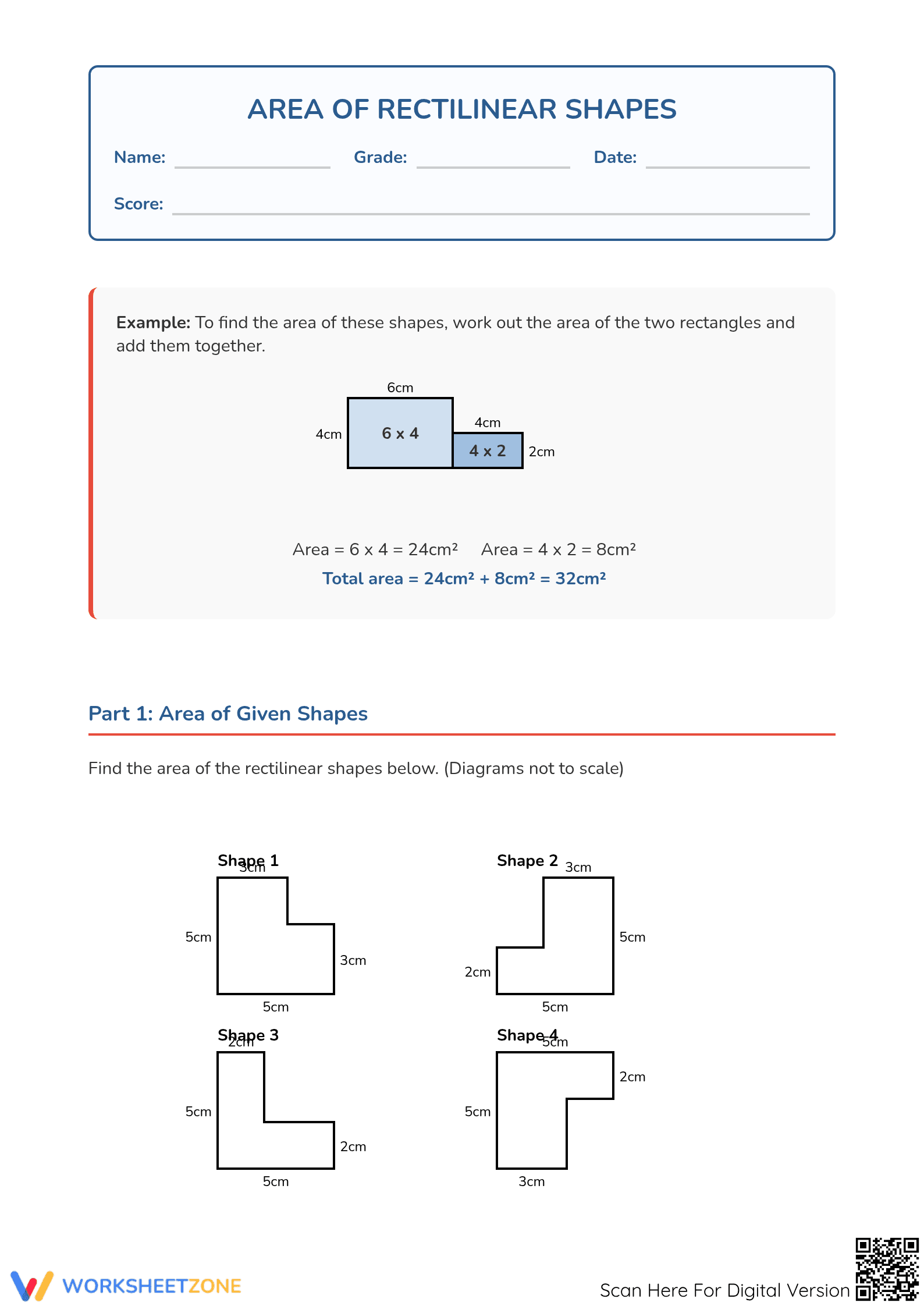
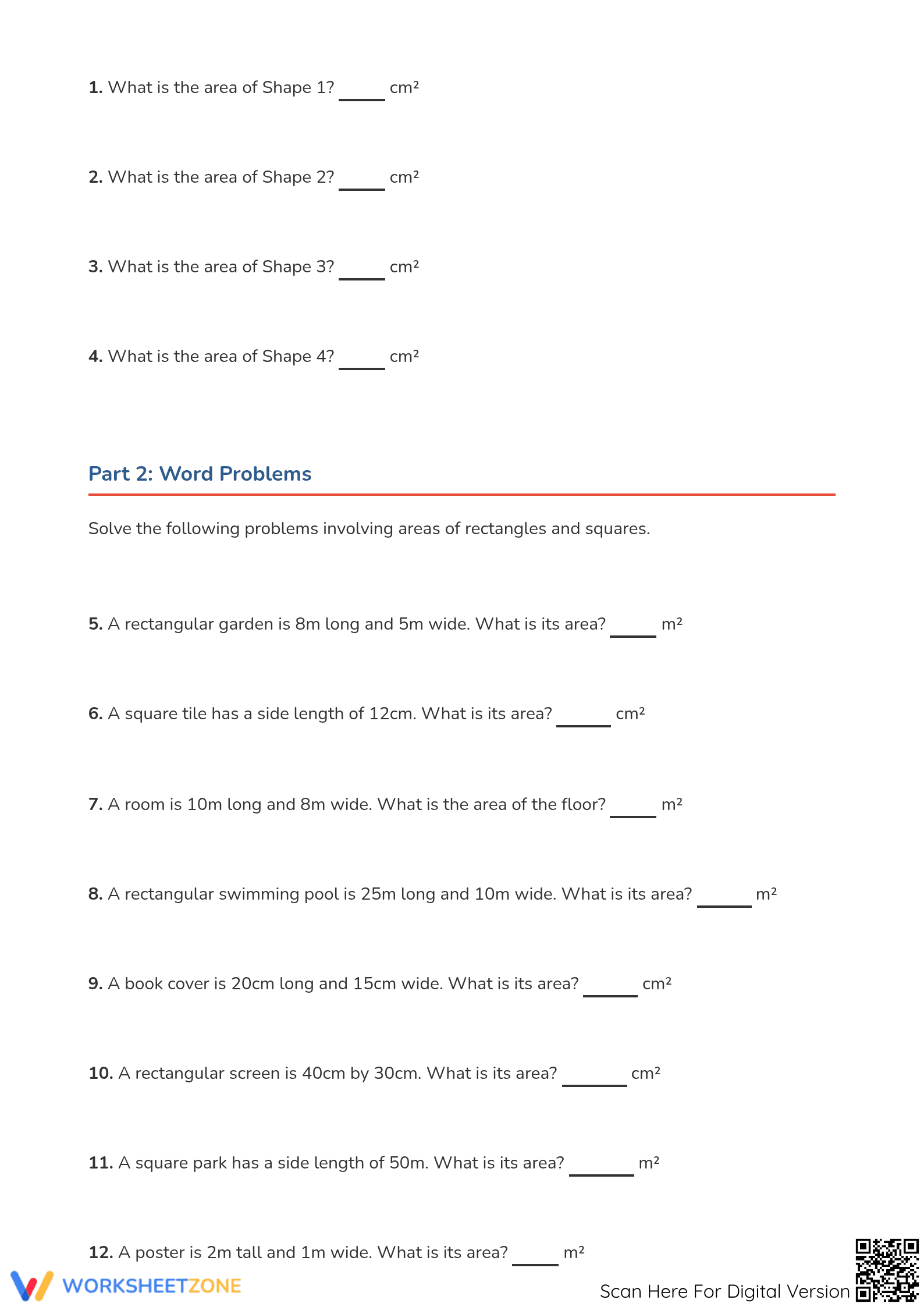
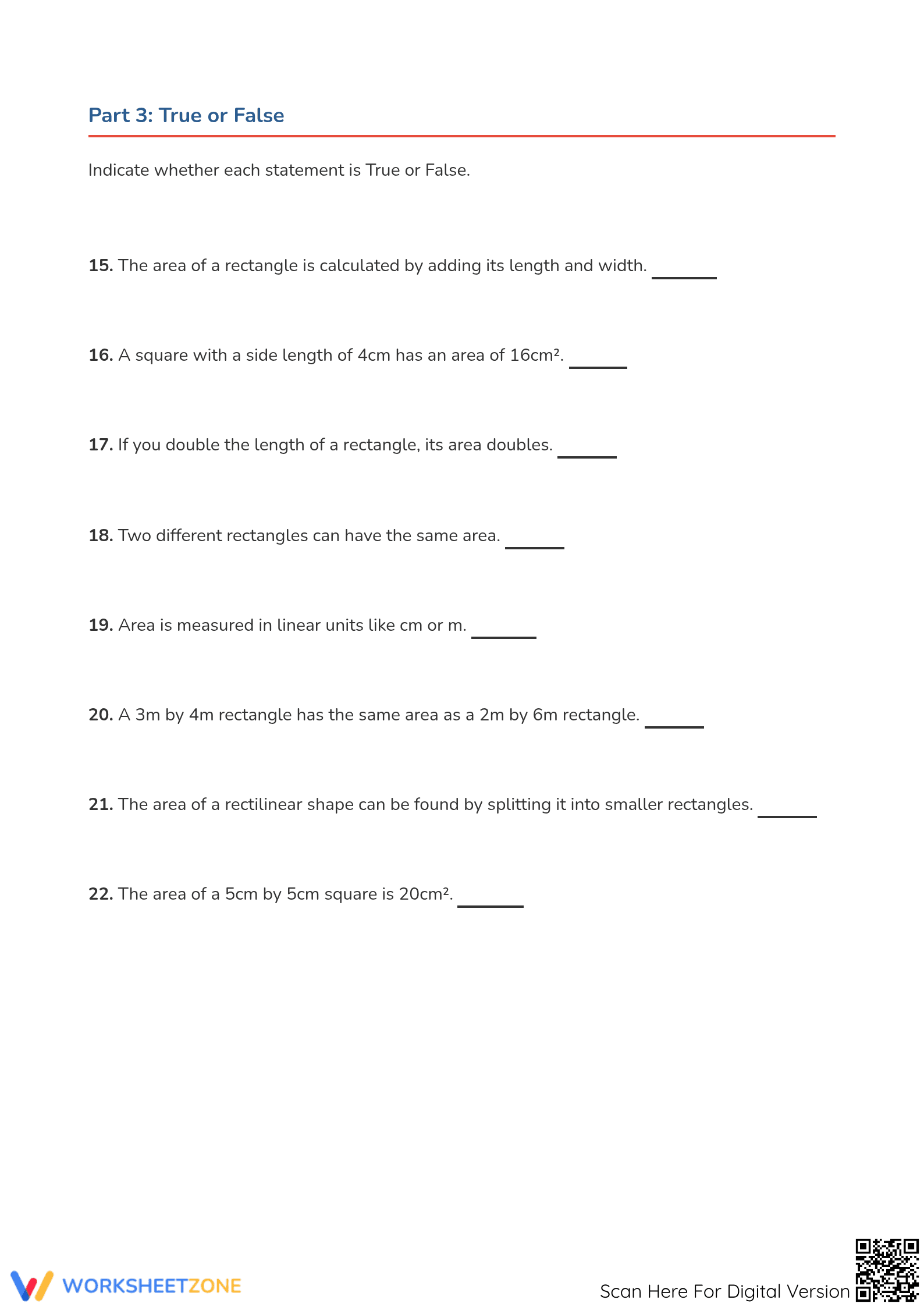
The worksheet spans three pages with 20 tasks in three sections. It begins with a worked example showing how to split rectilinear shapes. Part 1 has 4 figures for decomposition. Part 2 features 8 word problems involving rectangles and squares. Part 3 offers 8 conceptual true-or-false statements to solidify student reasoning.
Zero-Prep Workflow
Step 1: Print the PDF (30 seconds). Step 2: Distribute and review the worked example (2 minutes). Step 3: Use the key for grading (5 minutes). This process saves planning time while providing assessment data.
Standards Alignment
This resource is primarily aligned to `CCSS.MATH.CONTENT.4.MD.A.3`, which requires students to apply area formulas to rectangles in mathematical and real-world problems. It also supports `CCSS.MATH.CONTENT.3.MD.C.7.D` by emphasizing that the area of a rectilinear figure can be found by decomposing it into non-overlapping rectangles and adding the areas of the parts. Both standard codes can be copied directly into lesson plans, IEP goals, or district curriculum mapping tools.
How to Use It
Use this for practice after direct instruction. Circulate to observe if students partition shapes correctly; this serves as a formative-assessment observation tip. It is also ideal for sub plans or homework.
Who It's For
Tailored for Grades 4-6, this resource scaffolds visual learners and challenges them with word problems. It pairs well with an area anchor chart to support students developing geometric reasoning.
Research from RAND AIRS 2024 emphasizes that structured practice in geometric decomposition is essential for transitioning students from basic counting methods to multiplicative area reasoning. By providing 20 diverse tasks that move from visual manipulation to linguistic word problems and finally to conceptual true-or-false validation, this worksheet aligns with the gradual release of responsibility model. This approach ensures that Grade 4-6 students build the cognitive flexibility required to solve complex spatial problems. Systematic exposure to rectilinear area tasks helps bridge the gap between elementary measurement and the more abstract geometric proofs encountered in secondary education. Educators can utilize the standard code CCSS.MATH.CONTENT.4.MD.A.3 to track progress toward mastery in rectilinear area calculation, a foundational skill that serves as a prerequisite for understanding surface area and volume in advanced STEM curricula. The inclusion of a clear visual example facilitates self-directed learning and reduces instructional friction.


