


























Students will investigate how facts and opinions are used in nonfiction literature in this session. At the end of the lesson, students are able to:
- Differentiate between an opinion and a fact.
- Provide evidence based on text to establish the distinction between opinion and fact.
- Determine the purpose of the usage of opinions and facts in nonfiction writing.
- How can literary and factual texts become meaningful to strategic readers?
- How does interaction with text provoke thinking and response?
- What is the true purpose of this text?
- Nonfiction: Writing that is not fictional; designed to explain, argue, instruct, or describe rather than entertain.
- Fact: Information that can be proved.
- Opinion: A belief or conclusion that cannot be proved.
Nonfiction books at students’ reading levels, which have easily identifiable facts and opinions, one per student. Some examples include the following:
- Science Vocabulary Readers. Scholastic Inc.
- Emergent Science Readers. Scholastic Inc.
- World Discovery History Readers. Scholastic Inc.
- Kristeen Rogers. (2003).The Usborne Internet-Linked Introduction to Weather & Climate Change. Usborne Publishing Ltd.
- Paul Whalley. (2000). Butterfly and Moth (Eyewitness Books). Dorling Kindersley Ltd.
- David A. Adler. (1993). A Picture Book of Anne Frank. Holiday House Inc.
- Wil Mara. (2007). Rosa Parks (Rookie Biographies). Children’s Press.
Teachers may substitute other books to provide a range of reading and level of text complexity. Alternative books should be nonfiction texts with easily identifiable facts and opinions.
- Fact and Opinion Cards (L-3-4-3_Fact and Opinion Cards)
- Stingray Passage (L-3-4-3_Stingray Passage), one copy to read aloud to students
- copies of Fact or Opinion worksheet (L-3-4-3_Fact or Opinion Worksheet)
- sticky notes
- index cards (one per student) with fact written on one side and opinion written on the other side
This lesson's objective is to help students gain a deeper knowledge of facts and views and explain their usage in nonfiction texts.
Give students the Fact or Opinion Worksheet (L-3-4-3_Fact or Opinion Worksheet) to complete in order to gauge their comprehension of the material. Gather the completed forms from the students and assign grades based on their ability to comprehend the purpose of facts, opinions, and their usage in nonfiction texts. Whenever necessary, give more instructions.
Keep an eye on the students while they converse with one another. Assess pupils' proficiency in the following areas:
- Recognize and distinguish between views and facts.
- Comprehend the application of opinions and facts in nonfiction writings.
Explicit instruction, modeling, scaffolding, and active engagement
W: Use a class game to review the definitions of fact and opinion.
H: Assign students to collaborate in order to locate instances of opinions and facts in nonfiction texts.
E: Assist pupils in determining if they have accurately recognized instances of views and facts.
R: Give students the chance to share their findings with a partner and the entire class when they have had a chance to discuss them. Students should be encouraged to justify or modify their decisions.
E: Provide students with an opportunity to exhibit what they have learned and watch them to gauge how well they understand opinion and fact when reading nonfiction texts.
T: Provide students the chance to read a nonfiction text independently, participate in small and large groups, and show that they grasp the difference between fact and opinion.
O: This lesson's learning exercises include large-group instruction and discussion, small-group inquiry, pair work, and individual application of the material.
Focus Question: When reading nonfiction literature, how can a reader distinguish between opinion and fact?
Put up a two-column chart on the interactive whiteboard, chart paper, or board. The Fact and Opinion Cards (L-3-4-3_Fact and Opinion Cards) should be spread out. Give the pupils some time to peruse the cards.
Choose a fact card and tape it in the left column on the chart. Then choose an opinion card and tape it in the right column on the chart.
Ask students to arrange the remaining cards into the proper columns on the chart. Ask, "What method did you use to sort the cards, students? " Assist students in realizing that views make up the other column and facts make up the first. Provide labels for the columns before starting the activity if students have trouble sorting the cards.
Put "Opinions" at the top of the right column and "Facts" at the top of the left. Throughout the lecture, remind students to consult the chart.
Ask pupils to define the difference between a fact and an opinion. At the bottom of the chart, write a definition for each word. (Opinion: a belief or conclusion that cannot be proven; fact: knowledge that can be proven)
To assist pupils in identifying opinions, highlight words in opinion statements. Make note of the fact that not all opinions will utilize these or words that sound similar. Describe how the statement "The story is boring" reflects an opinion but omits a phrase that might be considered an opinion, like the ones below.
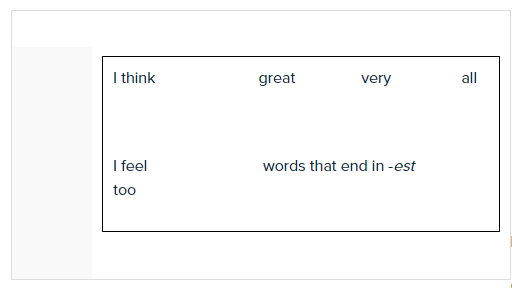
Part 1
Assign each student an index card with an "opinion" written on one side and a "fact" on the other. Tell the pupils that you will be reading a passage and that they should hold up the card's corresponding sentence after each sentence. Read the Stingray Passage (L-3-4-3 Stingray Passage) aloud. You might want to pick a different text with a different level of difficulty. Talk about the pupils' responses and settle any disputes. Ask pupils to explain their selection when they mark a sentence as true. "How would you prove the sentence is a fact?" you ask. "What keyword shows the sentence is an opinion?" if they recognize a sentence as an opinion. Students who can tell the difference between facts and opinions should be noted.
Talk about the use of facts and views in nonfiction works. (They give the work more attention, give the writing a voice, and aid in the author's attempt to persuade the reader.) Read the article aloud one more time without the opinions. Have students discuss if the piece would still be fascinating if the viewpoints weren't there.
Part 2
Assign each kid a nonfiction book that is appropriate for their reading level, along with a few sticky notes. Instruct pupils to study their books and select intriguing ideas and information. Ask children to write down any opinions or facts they may have on a sticky note. Draw attention to the fact that not all books will have opinions and that they might be harder to come by. Tell pupils to write their own opinions about the book on a sticky note in case it doesn't have one. In a similar vein, a fact and an opinion can coexist in the same sentence.
Once students have written their opinions and facts, ask them to exchange their responses with a partner to see if they can agree on which statements are opinions and which are facts. Next, instruct pupils to place their sticky notes in the relevant chart columns.
Ask the students to look over the chart and determine if each answer is in the right column.
Extension:
Put a list of science-related subjects on the board or interactive whiteboard, such as mountains, storms, and the solar system. Give pupils access to sources so they may learn the facts about the subjects. Ask students to produce a nonfiction essay on one of the themes that combines facts and views.
Assign students the task of locating nonfiction works that offer both opinions and facts. Ask students to find an interesting fact and an interesting viewpoint in the book and share their discoveries with the class.

Analyzing Key Ideas and Details Through the Use of Facts and Opinions (L-3-4-3)
Students will investigate how facts and opinions are used in nonfiction literature in this session. At the end of the lesson, students are able to:
- Differentiate between an opinion and a fact.
- Provide evidence based on text to establish the distinction between opinion and fact.
- Determine the purpose of the usage of opinions and facts in nonfiction writing.


