




























1 / 4
0
Views
0
Downloads

10.0
0
Save
0 Likes
Share
Abiotic vs Biotic Factors Practice Worksheet
0 Views
0 Downloads

Paste this activity's link or code into your existing LMS (Google Classroom, Canvas, Teams, Schoology, Moodle, etc.).
Students can open and work on the activity right away, with no student login required.
You'll still be able to track student progress and results from your teacher account.
Information
Description
What It Is:
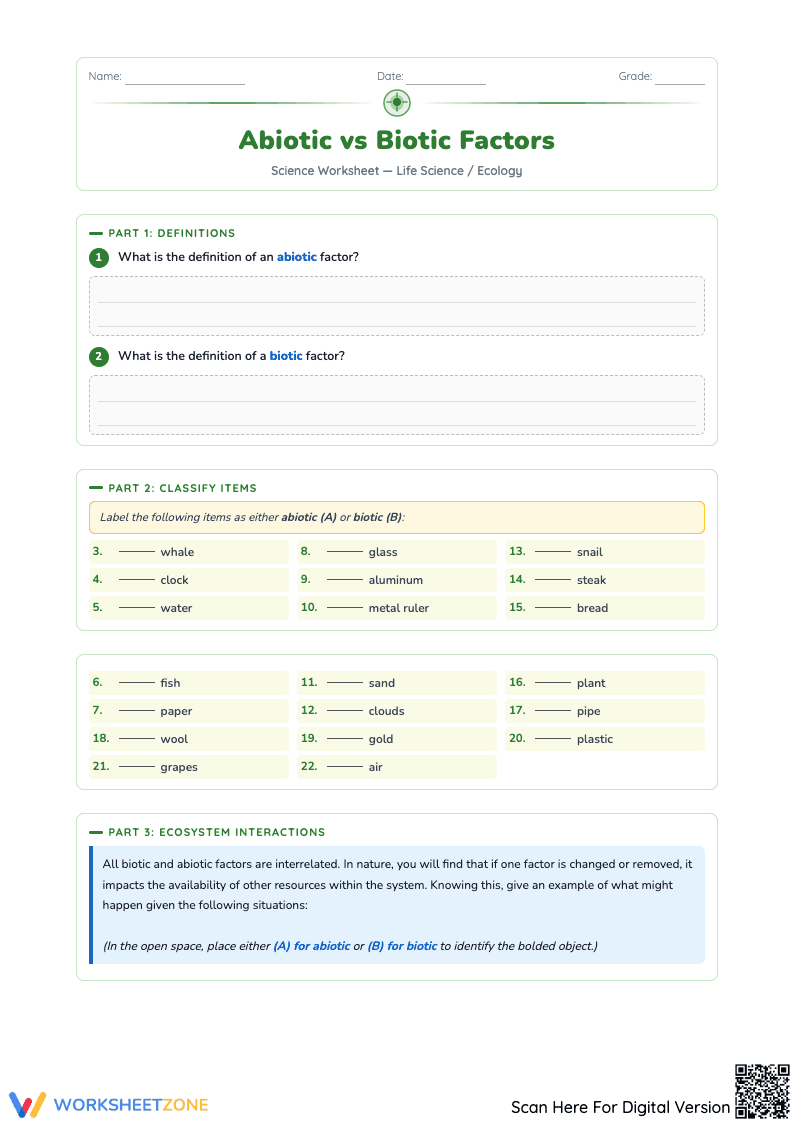
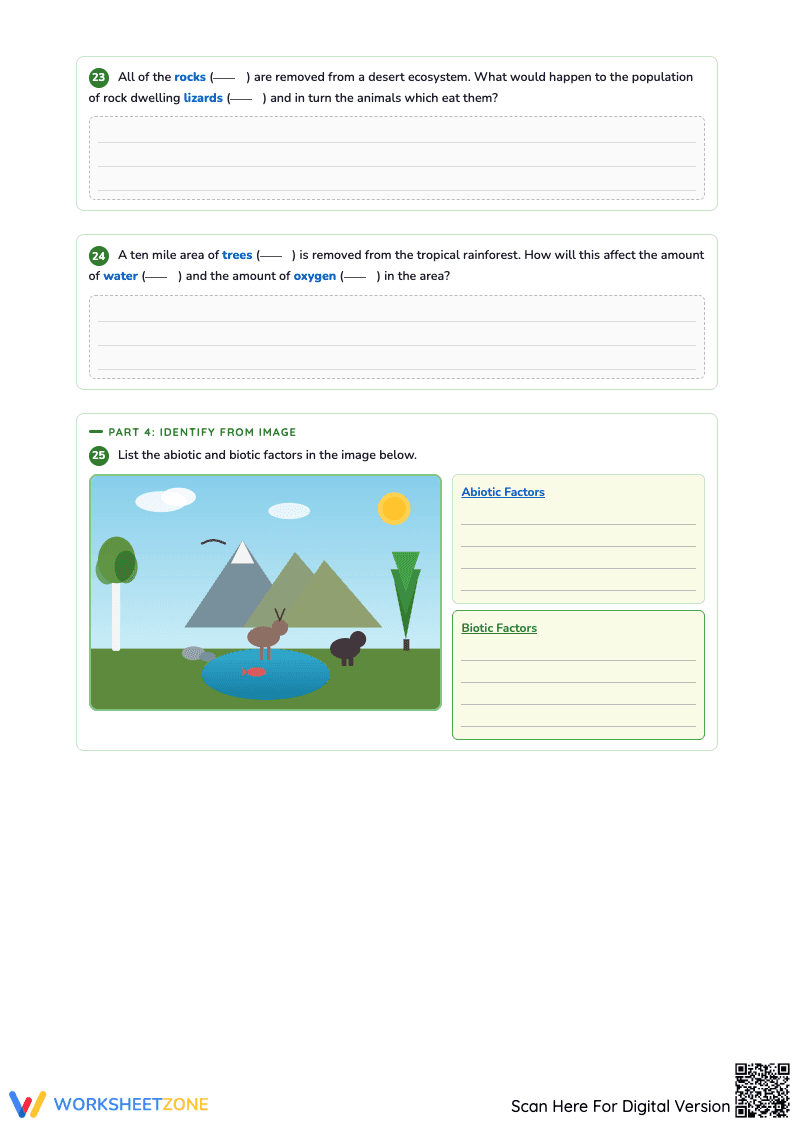
This is an educational worksheet focusing on abiotic and biotic factors in an ecosystem. It includes questions asking for definitions of abiotic and biotic factors, a labeling activity where students classify items as abiotic or biotic (whale, glass, clock, aluminum, water, metal ruler, fish, sand, paper, clouds, snail, steak, bread, plant, pipe, air, wool, gold, plastic, grapes), fill-in-the-blank questions regarding the impact of removing rocks from a desert ecosystem and trees from a rainforest, and finally asks the student to identify the abiotic and biotic factors from an accompanying image of a forest ecosystem.
Grade Level Suitability:
This worksheet is suitable for grades 6-8. The concepts of abiotic and biotic factors are typically introduced in middle school science. The questions require critical thinking and understanding of ecological relationships, making it appropriate for this age group.
Why Use It:
This worksheet helps students understand the difference between abiotic and biotic factors and their importance in an ecosystem. It promotes critical thinking by asking students to predict the consequences of environmental changes. The image provides a visual aid for identifying these factors in a real-world setting.
How to Use It:
Students should first define abiotic and biotic factors. Then, they should classify the listed items as either abiotic or biotic. Next, they should read the scenarios and fill in the blanks with their predictions. Finally, they should analyze the image and list the abiotic and biotic factors they observe.
Target Users:
The target users are middle school students learning about ecosystems and environmental science. It's also suitable for teachers looking for a worksheet to reinforce these concepts.
This is an educational worksheet focusing on abiotic and biotic factors in an ecosystem. It includes questions asking for definitions of abiotic and biotic factors, a labeling activity where students classify items as abiotic or biotic (whale, glass, clock, aluminum, water, metal ruler, fish, sand, paper, clouds, snail, steak, bread, plant, pipe, air, wool, gold, plastic, grapes), fill-in-the-blank questions regarding the impact of removing rocks from a desert ecosystem and trees from a rainforest, and finally asks the student to identify the abiotic and biotic factors from an accompanying image of a forest ecosystem.
Grade Level Suitability:
This worksheet is suitable for grades 6-8. The concepts of abiotic and biotic factors are typically introduced in middle school science. The questions require critical thinking and understanding of ecological relationships, making it appropriate for this age group.
Why Use It:
This worksheet helps students understand the difference between abiotic and biotic factors and their importance in an ecosystem. It promotes critical thinking by asking students to predict the consequences of environmental changes. The image provides a visual aid for identifying these factors in a real-world setting.
How to Use It:
Students should first define abiotic and biotic factors. Then, they should classify the listed items as either abiotic or biotic. Next, they should read the scenarios and fill in the blanks with their predictions. Finally, they should analyze the image and list the abiotic and biotic factors they observe.
Target Users:
The target users are middle school students learning about ecosystems and environmental science. It's also suitable for teachers looking for a worksheet to reinforce these concepts.


