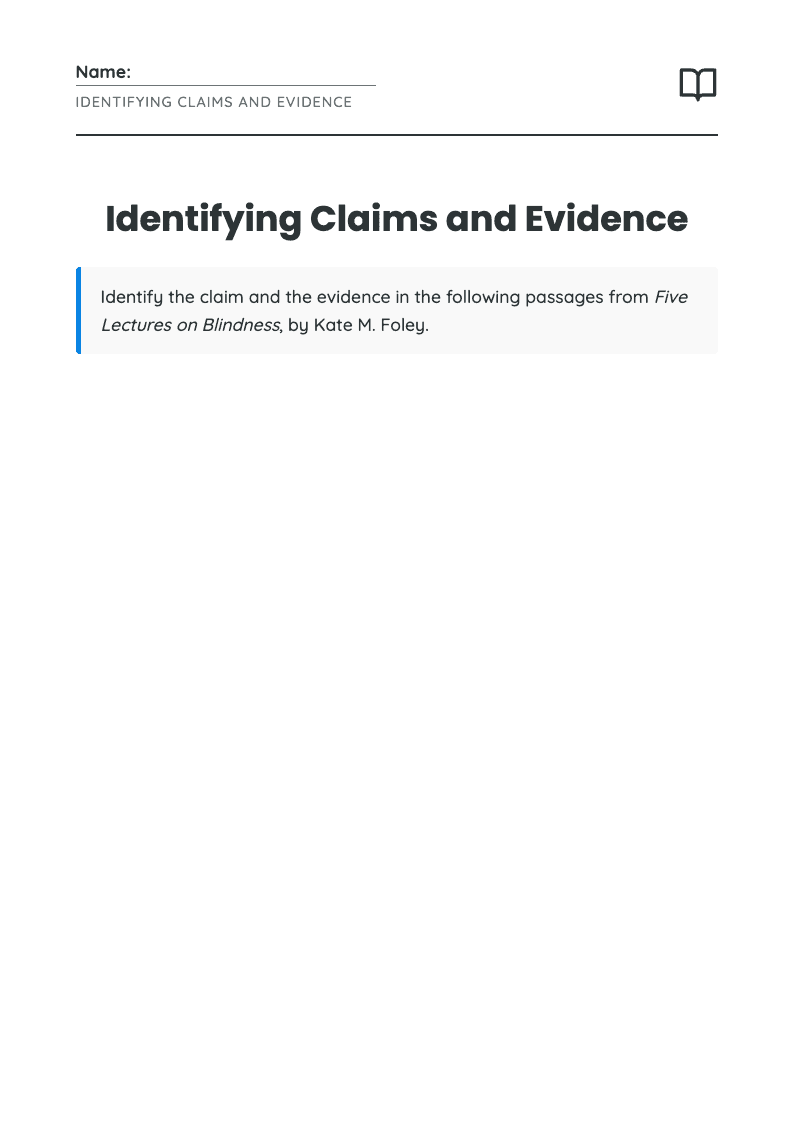
What It Is:The
Identifying Claims and Evidence Worksheet helps students practice distinguishing between a writer’s
main claim and the
supporting evidence provided in a text. Using a passage from Five Lectures on Blindness by Kate M. Foley, learners analyze how the author uses reasoning and examples to support her argument about the senses and intelligence of individuals who are blind.
Why Use It:This worksheet strengthens
critical reading and analytical thinking skills by guiding students to identify key arguments and textual proof. It encourages close reading, improves comprehension, and builds foundational skills for writing evidence-based responses and essays.
How to Use It:• Begin by reading the passage carefully as a class or individually.
• Guide students to underline or highlight sentences that express the main idea or claim.
• Have them write the identified claim in the first box and the supporting evidence in the second box.
• Discuss why the chosen evidence supports the author’s claim and how it strengthens the argument.
• Continue with the next worksheet,
“Claim vs. Evidence Matching”, to reinforce understanding through a structured matching activity.
Grade Level Suitability:Best for
Grades 6–8.
•
Grade 6: Introduces identifying arguments and textual support.
•
Grade 7–8: Strengthens analytical reading and prepares students for argument writing tasks.
Target Users:Perfect for
middle school teachers,
ELA tutors, and
homeschool educators teaching evidence-based reading and writing skills.