


























0
Views
0
Downloads

Save
0 Likes
Share
Using I-Statements Communication
0 Views
0 Downloads
Paste this activity's link or code into your existing LMS (Google Classroom, Canvas, Teams, Schoology, Moodle, etc.).
Students can open and work on the activity right away, with no student login required.
You'll still be able to track student progress and results from your teacher account.
Information
Description
What It Is:
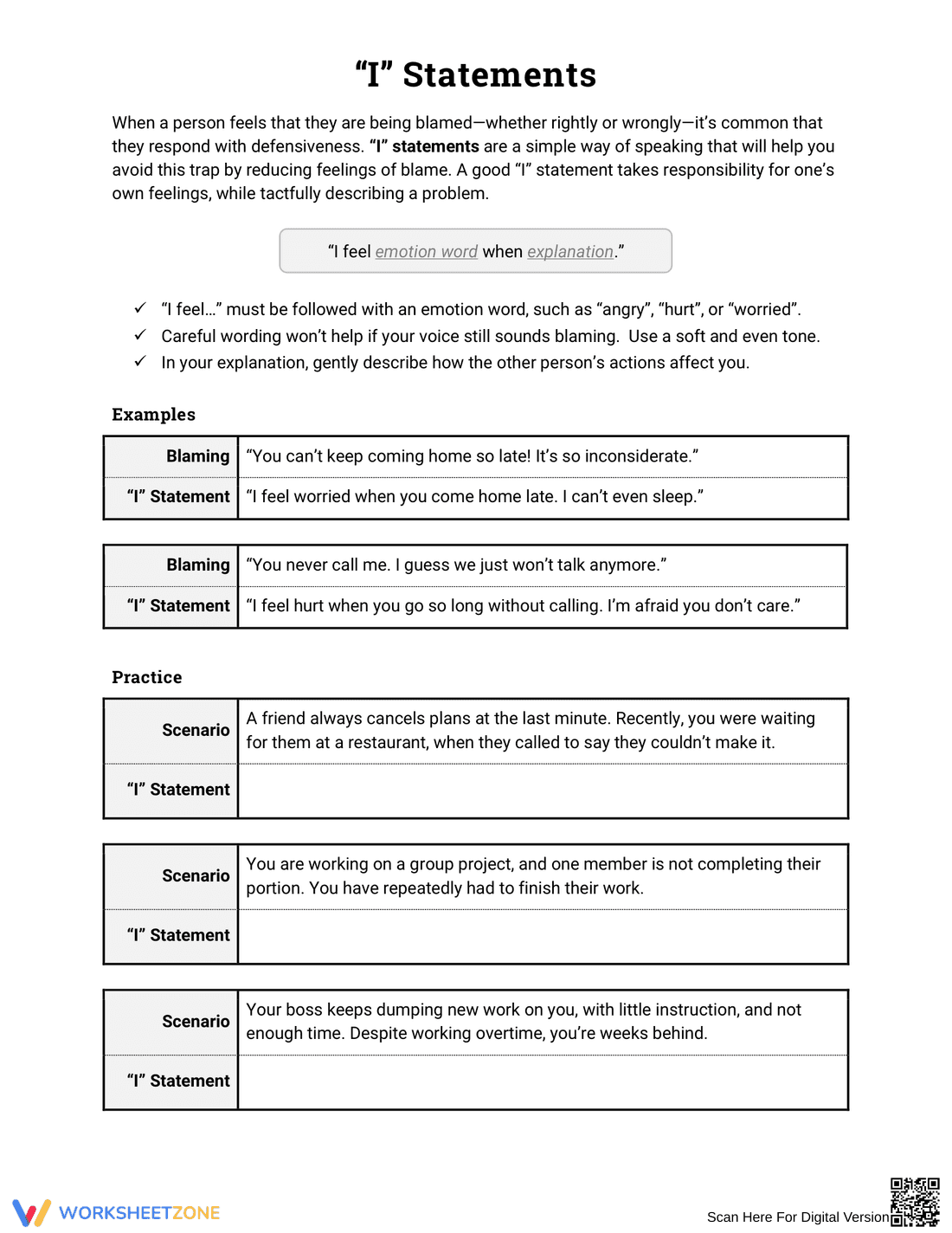
This is an educational worksheet about using 'I' statements to communicate effectively and avoid defensiveness when feeling blamed. It explains the concept of 'I' statements, emphasizing the importance of expressing one's own feelings tactfully and describing the problem. The worksheet includes examples of blaming statements versus 'I' statements and provides practice scenarios where the user can write their own 'I' statements in response to given situations.
Grade Level Suitability:
This worksheet is suitable for late middle school (grades 7-8) through high school (grades 9-12), and even for adults. The concepts require a certain level of emotional maturity and understanding of interpersonal dynamics. The writing prompts require critical thinking and the ability to articulate feelings.
Why Use It:
This worksheet helps individuals learn to communicate their feelings in a constructive way, reducing conflict and improving relationships. It teaches users how to take responsibility for their own emotions and express them without blaming others. This can lead to improved self-awareness, better communication skills, and healthier relationships.
How to Use It:
First, read the explanation of 'I' statements and the tips provided. Then, review the examples of blaming statements and their corresponding 'I' statement alternatives. Finally, for each practice scenario, identify the feelings involved and construct an 'I' statement that expresses those feelings while describing the problem without blaming the other person.
Target Users:
This worksheet is beneficial for students learning about communication skills, conflict resolution, and emotional intelligence. It is also useful for adults seeking to improve their communication in personal or professional relationships. Therapists and counselors can use it as a tool in therapy sessions to help clients develop healthier communication patterns.
This is an educational worksheet about using 'I' statements to communicate effectively and avoid defensiveness when feeling blamed. It explains the concept of 'I' statements, emphasizing the importance of expressing one's own feelings tactfully and describing the problem. The worksheet includes examples of blaming statements versus 'I' statements and provides practice scenarios where the user can write their own 'I' statements in response to given situations.
Grade Level Suitability:
This worksheet is suitable for late middle school (grades 7-8) through high school (grades 9-12), and even for adults. The concepts require a certain level of emotional maturity and understanding of interpersonal dynamics. The writing prompts require critical thinking and the ability to articulate feelings.
Why Use It:
This worksheet helps individuals learn to communicate their feelings in a constructive way, reducing conflict and improving relationships. It teaches users how to take responsibility for their own emotions and express them without blaming others. This can lead to improved self-awareness, better communication skills, and healthier relationships.
How to Use It:
First, read the explanation of 'I' statements and the tips provided. Then, review the examples of blaming statements and their corresponding 'I' statement alternatives. Finally, for each practice scenario, identify the feelings involved and construct an 'I' statement that expresses those feelings while describing the problem without blaming the other person.
Target Users:
This worksheet is beneficial for students learning about communication skills, conflict resolution, and emotional intelligence. It is also useful for adults seeking to improve their communication in personal or professional relationships. Therapists and counselors can use it as a tool in therapy sessions to help clients develop healthier communication patterns.


