


























Views
Downloads

Essential Integumentary System Worksheet | Grade 7 Science
Paste this activity's link or code into your existing LMS (Google Classroom, Canvas, Teams, Schoology, Moodle, etc.).
Students can open and work on the activity right away, with no student login required.
You'll still be able to track student progress and results from your teacher account.
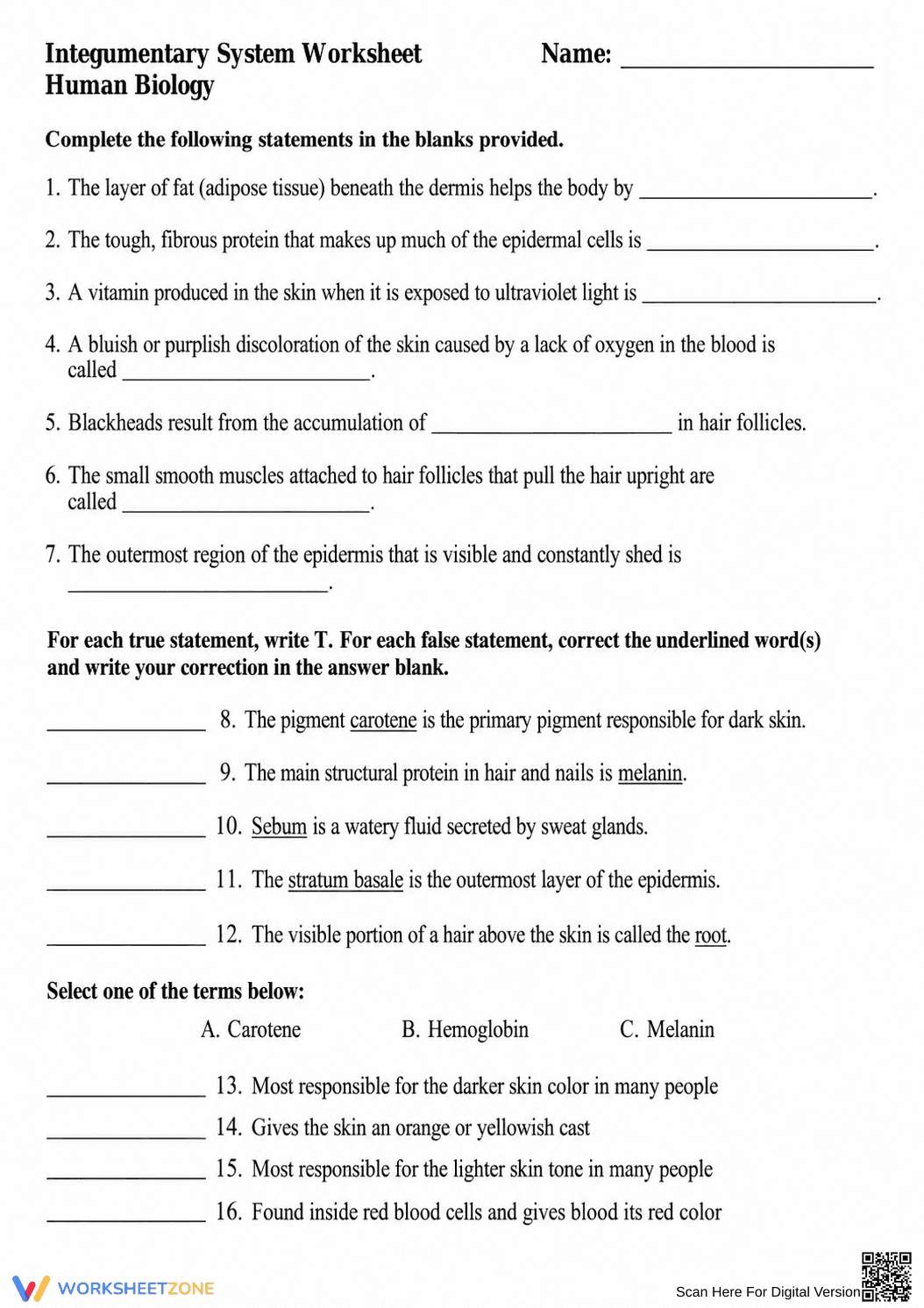
This Grade 7 Integumentary System worksheet provides a comprehensive review of human skin, hair, and nail structures. Students identify key biological components and explain physiological functions through varied question formats. By completing these exercises, learners master the complex interactions within the human body's largest organ system, ensuring readiness for advanced anatomy assessments.
At a Glance
- Grade: 7 · Subject: Biology
- Standard:
MS-LS1-3— Explain how the body is a system of interacting subsystems composed of cells- Skill Focus: Integumentary system anatomy
- Format: 1 page · 16 problems · Answer key included · PDF
- Best For: Independent practice or quick formative assessment
- Time: 20–30 minutes
This single-page PDF contains 16 targeted questions divided into three distinct sections. It features 7 fill-in-the-blank statements regarding skin layers and proteins, 5 true/false questions requiring error correction for false statements, and 4 multiple-choice items focusing on skin pigmentation. The layout is clean and professional, including a dedicated space for student names and clear instructional headers for each task type.
The zero-prep design allows for immediate classroom implementation. Teachers can print the single-page PDF in less than 1 minute, distribute it to the class in 30 seconds, and use the included answer key for a 5-minute peer-review or whole-class check. This streamlined workflow makes it an ideal resource for emergency sub plans or as a transition activity between direct instruction and lab work.
This resource is aligned with MS-LS1-3, which requires students to provide evidence for how the body is a system of interacting subsystems. By identifying specific tissues like adipose and epidermal layers, students demonstrate understanding of how specialized cells form the integumentary subsystem. This standard code can be copied directly into lesson plans, IEP goals, or district curriculum mapping tools.
Use this worksheet as a mid-unit check for understanding after introducing the layers of the epidermis and dermis. During the activity, circulate to observe if students can correctly identify the difference between keratin and melanin, which serves as a formative assessment of their vocabulary retention. Expect students to complete the full page within 20 to 30 minutes depending on prior knowledge.
This resource is designed for Grade 7 life science students but is rigorous enough for introductory high school biology. It provides excellent support for visual learners through structured text and is easily paired with a labeled anatomical diagram of the skin or a direct instruction slide deck on human body systems.
According to the RAND AIRS 2024 report on instructional materials, high-quality science worksheets that utilize varied response formats—such as the fill-in-the-blank and error-correction tasks found here—significantly improve student retention of complex anatomical terminology. This worksheet focuses on the MS-LS1-3 standard, requiring students to explain how the integumentary system functions as a vital subsystem within the human body. By engaging with 16 specific tasks related to skin pigmentation, hair structure, and epidermal layers, learners build the foundational knowledge necessary for mastery of human biology. The inclusion of error-correction for false statements specifically targets higher-order thinking skills, moving beyond simple recall to conceptual analysis. This resource provides a reliable, evidence-based tool for teachers seeking to reinforce core science standards while maintaining a low-prep classroom environment.


