


























Views
Downloads


Counting Coins Worksheet | Grade 2 Essential Money Math
Paste this activity's link or code into your existing LMS (Google Classroom, Canvas, Teams, Schoology, Moodle, etc.).
Students can open and work on the activity right away, with no student login required.
You'll still be able to track student progress and results from your teacher account.
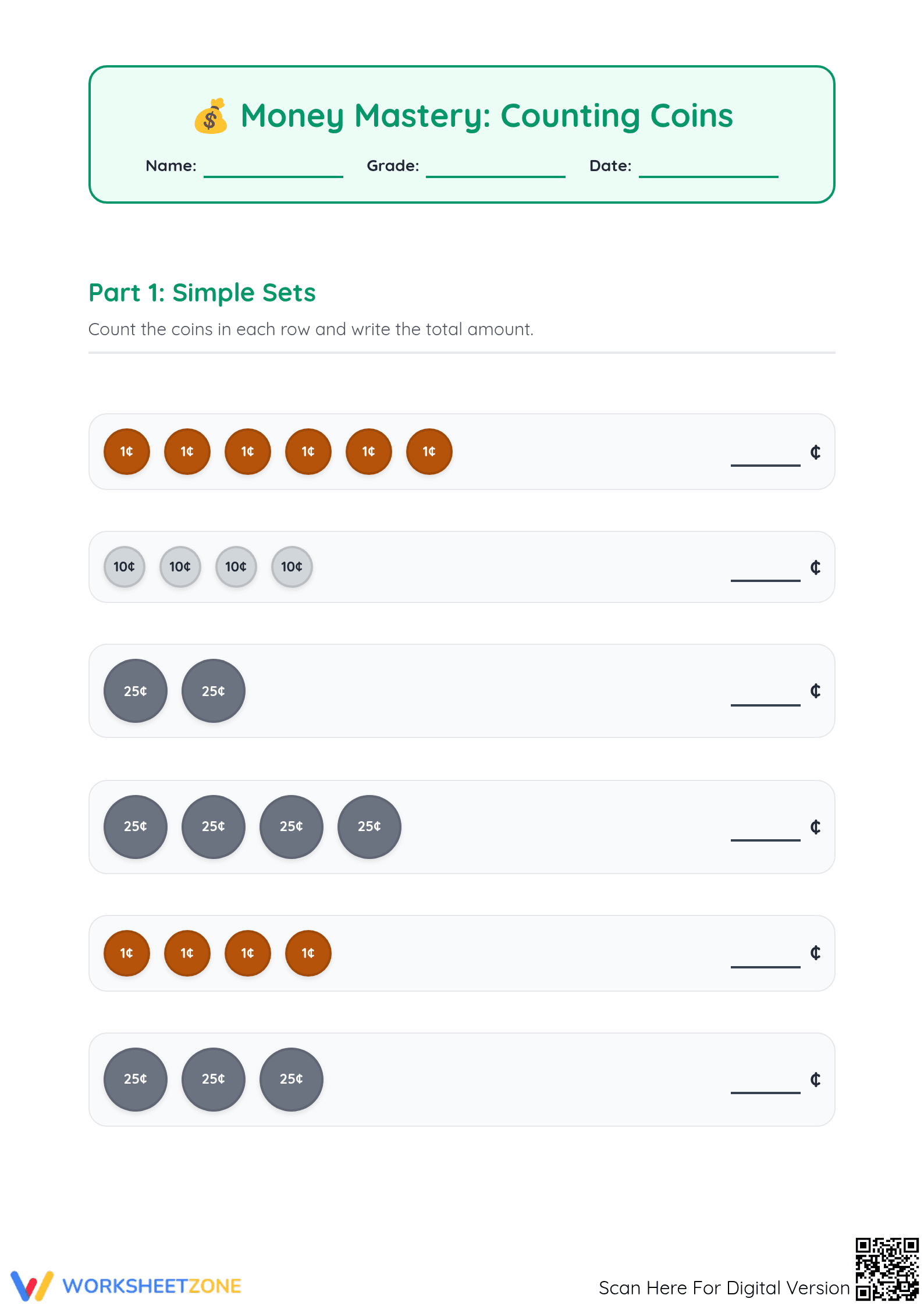
This comprehensive counting coins worksheet helps Grade 2 students build confidence in identifying and summing the values of American currency. By progressing from uniform coin sets to complex mixed combinations, students develop the mental math stamina required for real-world financial literacy. This printable resource masterfully ensures students master the foundational skill of adding pennies, nickels, dimes, and quarters.
At a Glance
- Grade: 2 · Subject: Math
- Standard:
2.MD.C.8— Solve problems involving coins and use money symbols appropriately- Skill Focus: Counting mixed coin sets up to one dollar
- Format: 2 pages · 13 problems · Answer key included · PDF
- Best For: Independent math centers or homework
- Time: 15–20 minutes
What's Inside
This two-page PDF includes 13 structured counting tasks. Page one features "Simple Sets," where students count rows of identical coins to establish value recognition. Page two introduces "Mixed Coins," challenging students to calculate totals for combinations of pennies, nickels, dimes, and quarters. Each problem provides a clear workspace and a designated line for the final cent total, accompanied by high-quality coin illustrations.
Zero-Prep Workflow
- Print (30 seconds): Select the two pages and the answer key to generate a class set in seconds.
- Distribute (1 minute): Hand out the worksheets as a warm-up or center activity without any additional cutting or laminating required.
- Review (30 seconds): Use the included answer key for rapid grading or have students self-check their work during independent practice.
This resource requires less than two minutes of total teacher preparation, making it ideal for sub plans.
Standards Alignment
The primary focus of this worksheet is `CCSS.MATH.CONTENT.2.MD.C.8`, which requires students to solve word problems involving quarters, dimes, nickels, and pennies, using money symbols appropriately. This activity provides the prerequisite computational practice needed to move from simple counting to complex situational word problems. This standard code can be copied directly into lesson plans, IEP goals, or district curriculum mapping tools.
How to Use It
Use this worksheet as a "Transition Task" between direct instruction on coin values and more advanced money word problems. As students work through the mixed sets on page two, circulate the room to observe if students are "counting on" from the largest coin value, which is a key indicator of mathematical fluency. Students typically complete both pages in approximately 18 minutes.
Who It's For
This resource is optimized for Grade 2 students but serves as an excellent enrichment tool for Grade 1 or a remediation exercise for Grade 3 students needing to shore up their base-ten understanding. It pairs naturally with physical coin manipulatives or a digital "money board" to provide a multi-sensory learning experience for diverse learners in the general education classroom.
Aligned to `CCSS.MATH.CONTENT.2.MD.C.8`, this worksheet facilitates the development of coin-counting fluency, a critical component of early algebraic thinking. Research from `RAND AIRS 2024` indicates that students who engage in frequent, scaffolded practice with money math demonstrate significantly higher proficiency in place-value concepts. By transitioning from simple sets of identical coins to heterogeneous groups, this resource supports the cognitive shift from rote counting to strategic summation. The inclusion of a dedicated answer key allows for immediate feedback loops, which is essential for correcting common misconceptions regarding the relative values of nickels and dimes. Practitioners can utilize this data-driven design to meet mandates for evidence-based numeracy instruction while ensuring students attain the practical life skills necessary for financial independence and real-world calculation.


