Kindergarten Letters and Words Tracing Pages for Concept-of-Print Practice
Why letters-and-words tracing belongs in kindergarten reading time
Letters and words tracing worksheets printable for kindergarten work best when they do more than build pencil control. In an early literacy block, these pages give teachers a simple way to teach concept of print while children are still learning how print works on a page. A child may know the alphabet song and still need direct practice noticing that one letter is not the same thing as one whole word. That distinction matters in kindergarten because students are beginning to track print, listen for language in books, and connect spoken words to what they see.
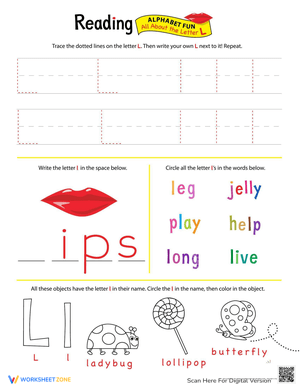
When a worksheet asks children to trace a single letter, circle a space, and then trace a short word, the page becomes a guided print-awareness routine. It gives teachers a visible task they can model, repeat, and assess quickly. It also fits common classroom realities: a short center rotation, a morning work bin, a small-group re-teach lesson, or a calm follow-up after a read-aloud. Instead of treating tracing as isolated handwriting practice, teachers can use it to teach how print is organized and how meaning is carried through words on the page.
What strong kindergarten tracing pages should include
Teachers usually need printable pages that are easy to explain and easy to repeat across the week. The strongest sets for this topic keep directions concrete. Students might first identify one uppercase or lowercase letter, then trace a short high-frequency word, then point to the space between two printed words. That sequence keeps attention on the difference between units of print instead of overwhelming children with too many tasks at once.
Useful letters and words tracing worksheets printable for kindergarten often include these features:
- Clear models of one target letter and one short target word
- Large tracing paths that fit early fine-motor development
- Short print lines with visible spacing between words
- Directions teachers can model orally in one sentence
- Repeatable prompts such as point, trace, say, and check
Teachers should also look for pages that make word boundaries obvious. If a line is crowded or uses long sentence frames, students may complete the tracing without actually noticing where one word ends and the next begins. Cleaner layouts support better observation because teachers can immediately see whether a student is tracing shapes only or understanding print units.
How tracing supports concept of print before decoding takes off
Print awareness develops before most kindergarten students become confident decoders. Reading Rockets describes print awareness as understanding that print carries meaning and is read from left to right and top to bottom. That idea connects directly to tracing. When children move their finger or pencil across letters and then across a whole word, they practice the organization of print in a concrete way.
Reading Rockets' Concepts of Print Assessment highlights three observable kindergarten checks: point to a letter, point to a word, and point to a space. That three-part routine matters because it separates symbol recognition from word awareness, giving teachers a fast assessment lens during worksheet use.
This is why tracing pages should not stop at letter formation. A page that mixes single letters, simple words, and spaces gives students repeated exposure to the building blocks of print. In practice, that means a child can learn that m is a letter, mom is a word, and the blank area between printed words has a job. Once students begin noticing those differences, shared reading and sentence work become much easier to teach.
Classroom Implementation
These worksheets fit best inside short, consistent routines. In whole group, a teacher can project one example and model the language: “This is one letter. This is one word. Show me the space.” Students then carry that language into independent practice. In a literacy center, the same page can be paired with a dry-erase sleeve so children trace, erase, and repeat without extra prep. In intervention, teachers can reduce the task to one letter and one word if a student still confuses the two.
A practical weekly routine might look like this:
- Monday: introduce the target letter and one short word during mini-lesson
- Tuesday: use the page in a small group and ask students to point before tracing
- Wednesday: place the worksheet in centers with a verbal checklist
- Thursday: revisit the same pattern with a new word from classroom reading
- Friday: do a quick assessment by asking students to identify letter, word, and space without teacher prompts
This structure keeps the activity brief enough for kindergarten attention spans while giving enough repetition for transfer. It also helps teachers avoid a common problem: moving to new pages too quickly before students can reliably name what they are tracing.
How to connect tracing pages to books and classroom print
Tracing pages become more effective when they echo the print children already see during the day. After a read-aloud, teachers can lift one familiar word from the story, print it clearly on the board, and compare it with the traced word on the worksheet. That small bridge helps students see that worksheets are not separate from real reading. They are practice spaces for noticing the same print features that appear in labels, charts, poems, and big books.
Classroom labels also help. If students trace the word door, they can walk to the classroom door label and compare the printed word. If they trace a name or a color word, they can find the same word on a pocket chart or attendance board. NAEYC's description of high-quality kindergarten learning points toward active, meaningful experiences rather than disconnected drills, and this is one way to keep worksheet practice grounded in real classroom language.
What teachers should watch for while students work
The worksheet itself is only half of the value. The other half is what teachers can observe. As students work, notice whether they can name the target letter, whether they treat a whole word as one unit, and whether they recognize that spaces separate words. Those observations line up well with early print-awareness goals and can guide next-step grouping.
A useful pattern to watch is this: some children can trace a three-letter word accurately but still point to each letter as if each one were a separate word. When that happens, add a two-step prompt before tracing: tap the whole word once, then sweep under it left to right. That tiny adjustment often reveals whether the issue is motor control or concept of word.
The Florida Center for Reading Research kindergarten alignment materials are helpful here because they keep attention on foundational reading behaviors rather than on finished handwriting alone. If a student reverses a letter but still identifies the word boundary correctly, the teaching response should differ from the response for a student who forms letters neatly but cannot point to one word on a line. The worksheet gives you a way to separate those needs.
Choosing printable pages that make assessment easier
For teachers, the best printable page is often the one that makes student thinking visible in under five minutes. Choose layouts with enough white space, a small number of targets, and predictable directions. Repeated page structure matters because it reduces the language load. When students already know the routine, teachers can spend their energy listening and watching instead of re-explaining.
It also helps to vary only one feature at a time. Keep the tracing task familiar while changing the target letter or word. That makes it easier to tell whether confusion comes from the literacy concept or from the worksheet format. If the goal is concept of print, a simpler page usually produces better instructional information than a decorated page with many distractions.
Frequently Asked Questions
1. What is the difference between a letter tracing sheet and a word tracing sheet in kindergarten?
A letter tracing sheet focuses on one symbol and how it is formed. A word tracing sheet asks students to treat several letters as one meaningful unit. In kindergarten, both matter, but they teach different ideas. Teachers should use each one on purpose so students learn that letters build words and spaces separate words.
2. How do tracing worksheets help children learn the difference between letters and words?
They make the contrast visible and repeatable. Students can point to one letter, trace one whole word, and identify the space between words on the same page. That sequence supports print awareness because children are not only hearing the explanation, they are acting on it with their eyes, fingers, and pencils.
3. When should kindergarten students practice concepts of print like spaces and word boundaries?
They should practice them throughout the kindergarten year, especially during read-alouds, shared reading, centers, and short intervention groups. Reading Rockets identifies these as assessable kindergarten behaviors, so regular brief practice is more useful than waiting for a separate unit on conventions of print.
4. How can teachers use printable tracing pages in literacy centers or small groups?
In centers, keep the routine short: point, say, trace, and check. In small groups, model one example first and ask students to explain why something is a letter, a word, or a space. That teacher language turns a simple printable into a stronger formative assessment tool.
Clear All