


























Views
Downloads

Printable Grade 1 Mammals Worksheet | Essential Science
Paste this activity's link or code into your existing LMS (Google Classroom, Canvas, Teams, Schoology, Moodle, etc.).
Students can open and work on the activity right away, with no student login required.
You'll still be able to track student progress and results from your teacher account.
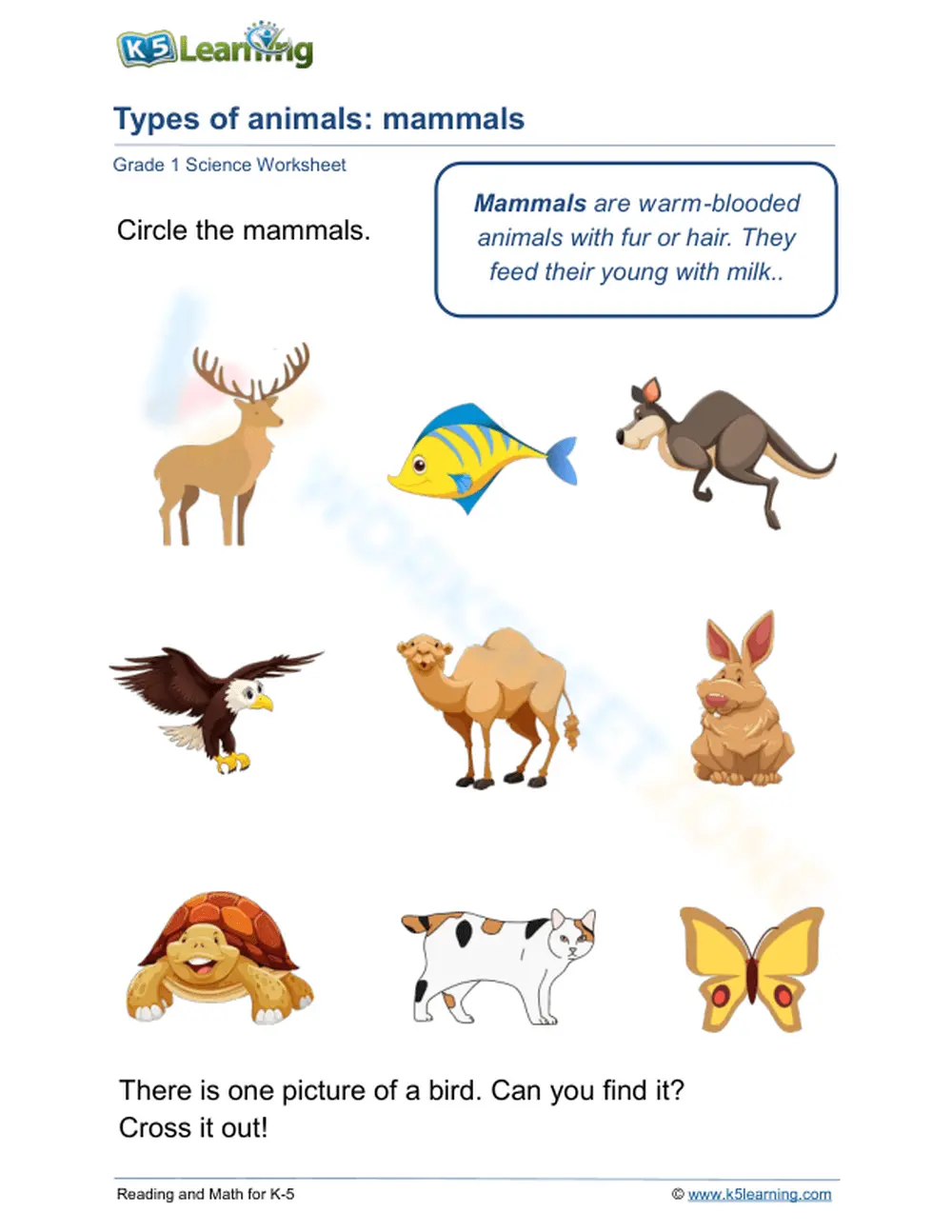
This Grade 1 mammals worksheet provides a clear and engaging way for students to identify animals based on biological characteristics. By focusing on specific traits like fur, hair, and being warm-blooded, learners develop foundational classification skills essential for life science. Students immediately apply their knowledge to a diverse set of animal illustrations.
At a Glance
- Grade: 1 · Subject: Science
- Standard:
1-LS3-1— Analyze animal traits and characteristics to identify biological patterns and classifications.- Skill Focus: Mammal trait identification
- Format: 1 page · 10 tasks · Answer key included · PDF
- Best For: Early finishers or homework supplement
- Time: 10–15 minutes
This single-page PDF features a concise informational header defining mammals as warm-blooded animals with fur or hair that feed their young with milk. Below, students find 9 varied animal graphics—including a deer, kangaroo, eagle, and butterfly—where they must circle the mammals. A final task asks students to locate and cross out a specific bird image.
The zero-prep workflow for this resource is designed for maximum classroom efficiency. First, print the single-page PDF for your class, which takes less than 30 seconds for a standard group. Next, distribute the sheets; the clear definitions at the top mean students can begin working immediately without a lengthy introduction. Finally, review the answers collectively in under 2 minutes.
Standards Alignment
This resource is primary aligned to `1-LS3-1`, focusing on observing traits to understand biological patterns. By identifying specific characteristics of mammals and distinguishing them from birds and insects, students build the evidence-based reasoning required for higher-order science. This standard code can be copied directly into lesson plans, IEP goals, or district curriculum mapping tools.
How to Use It
Use this worksheet as a quick check-for-understanding immediately after a direct instruction lesson on animal types. As students work, circulate to observe if they can distinguish between the dolphin-like fish and the mammals based on the provided definition. It also serves as an excellent formative assessment tool during a science center rotation. Expected completion time is roughly 12 minutes.
Who It's For
This worksheet is designed for first-grade students but is also suitable for second-grade review or kindergarten enrichment. It naturally pairs with animal-themed reading passages or life science anchor charts that detail various animal classes. Differentiation is supported through the visual nature of the tasks, making it accessible for English language learners and students with diverse learning needs.
Effective classification activities in early science education are vital for developing cognitive schemas. According to the RAND AIRS 2024 analysis, structured worksheets that provide immediate reference definitions—like the mammal characteristic box used here—significantly improve retention rates among Grade 1 learners compared to unstructured observation. By isolating specific traits such as "fur or hair" and "warm-blooded," this resource helps students organize the complex biological diversity of the animal kingdom. The standard code `1-LS3-1` represents a foundational shift from simple identification to evidence-based classification, a key metric in the NAEP science framework. This worksheet provides 10 distinct identification tasks that reinforce these concepts through repetitive, successful practice. Educators can confidently integrate this tool into curriculum maps to meet rigorous state and national expectations for life science proficiency and observational data collection in the elementary classroom.


